
Interior Designer in Mankapur Nagpur: Getting a Respected Nagpur Neighbourhood’s Homes Right.
Mankapur occupies a part of Nagpur that people who know the city well tend to value for reasons that aren’t always immediately obvious to outsiders. It’s not the flashiest address on the map. But it has the kind of residential functionality — genuine connectivity, established amenities, solid housing stock, a community character that’s been accumulating for decades — that families with children, families with elderly parents, families who need their neighbourhood to work reliably rather than impressively, tend to gravitate toward.
The homes here reflect that practical seriousness. They’re built to be lived in, and the families who live in them tend to use them fully — cooking properly, hosting regularly, raising children in rooms that get genuinely used rather than staged for occasional impressiveness.
When a Mankapur family engages an interior designer, the brief almost always has this quality of groundedness to it. They want their home to be better. Genuinely better — more comfortable, more functional, more beautiful in an everyday sense rather than a special-occasion sense. That’s an excellent brief to work with.
Interior Designer in Mankapur Nagpur
The Homes of Mankapur
Mankapur’s residential character is shaped by a mix of apartment complexes — predominantly mid-rise buildings with 2BHK and 3BHK configurations — alongside a meaningful number of older independent houses that were built when the neighbourhood was first developing and plot sizes reflected a more generous land-to-dwelling ratio. Transform your home with expert Interior Design for Besa Manewada Nagpur that perfectly balances comfort, style, and smart space planning.
The apartments here are, for the most part, straightforward interior design projects. Standard layouts, contemporary construction in the newer buildings, somewhat more characterful (and occasionally more challenging) layouts in the older buildings. The brief in most of these units involves a combination of kitchen modernisation, bedroom wardrobe design, false ceiling and lighting work in the living room, and a painting specification that actually thinks about colour rather than defaulting to white throughout.
The older independent houses are a different conversation. These properties have the bones of a genuinely good home — solid construction, room sizes that breathe, ceiling heights that give the interior design room to work — but they also often have a history of piecemeal decisions that have added layers of mixed-quality work without a coherent design direction. Renovating these homes of Dighori & Mankapur well requires both the design intelligence to see what the house can be and the practical discipline to execute a comprehensive renovation that addresses all the accumulated issues at once rather than managing them incrementally.
Colour and Material: What Works in Mankapur’s Conditions
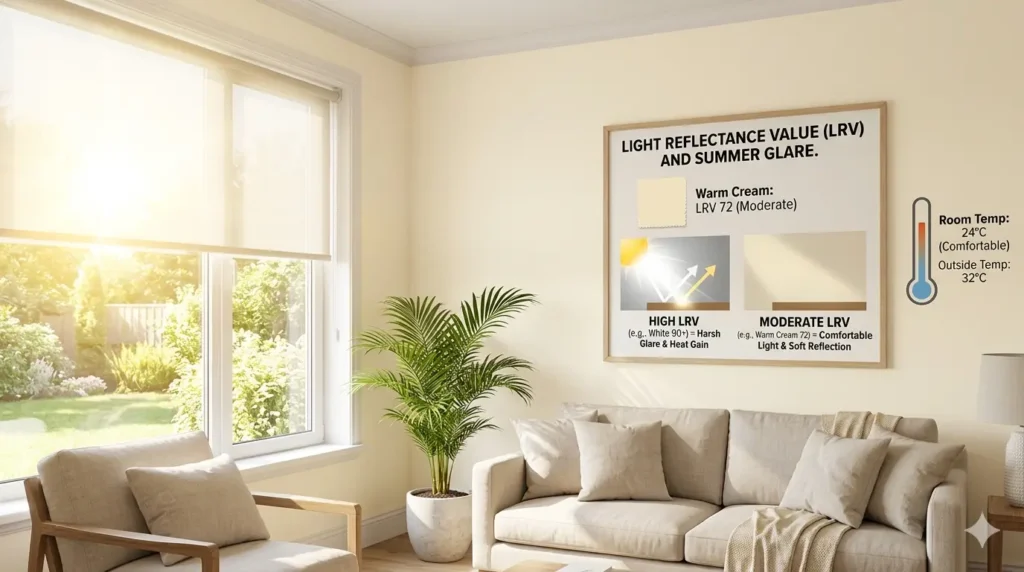
Mankapur’s housing stock has a range of orientations that makes it impossible to prescribe a single colour approach. What can be prescribed with confidence is the principle: warm undertones in every primary wall colour, assessed in the actual room light before commitment, with accents introduced deliberately on single walls rather than dispersed across the room.
For the primary wall surfaces in Mankapur apartments and houses: warm whites and soft neutral creams in the LRV 74 to 86 range. These handle Nagpur’s intense summer light without glaring, read as warm and welcoming in the evening under warm-white LED lighting, and provide the neutral background that allows furniture and objects to be seen clearly.
For accent walls: the earth palette that performs reliably across Nagpur’s conditions. Warm terracotta in its more muted, dusty forms. Soft ochre for south-facing rooms with consistently warm light. Muted sage for east-facing rooms where the morning light benefits from a colour with some green connection. Deep warm navy or a rich warm brown used very selectively in rooms with adequate volume — these can work in the right conditions but require more careful assessment.
The one consistent warning for Mankapur interiors: cool grey. It appears on mood boards and in design magazine references constantly, and it looks genuinely beautiful in those contexts, which are almost universally photographed in northern European or air-conditioned studio light. In a Mankapur apartment receiving the morning light of a May sun through east-facing windows, cool grey on the primary walls looks cold, slightly sad, and difficult to furnish around without the whole room feeling cheerless. It’s a colour that simply doesn’t suit this city’s light.
Living Spaces: Designing Around the Family’s Real Schedule
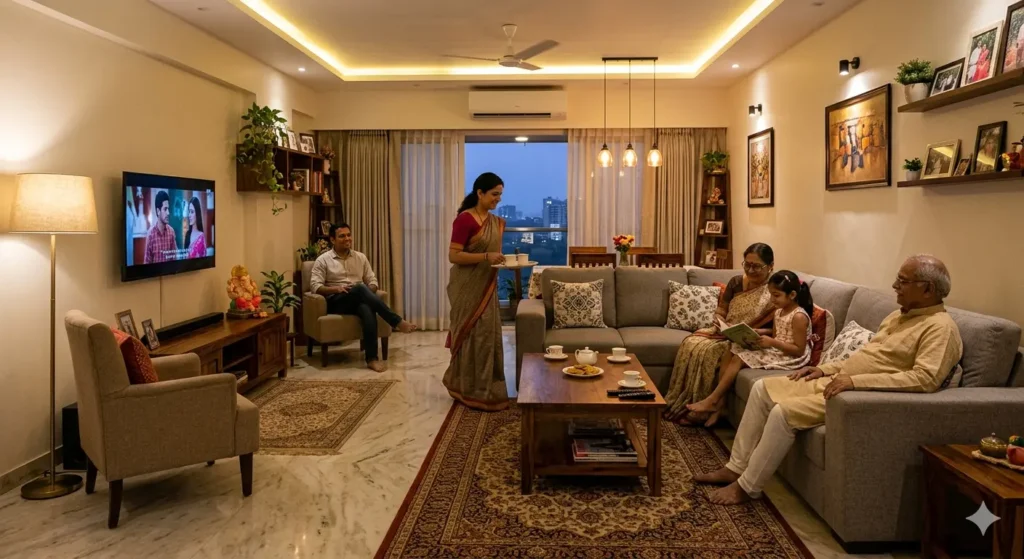
One of the most useful conversations an interior designer can have with a Mankapur family at the beginning of a project is asking about the family’s actual daily schedule at home. What time does everyone get up? When does the kitchen get used most heavily? Who is at home during the afternoon? When does the living room get its most intensive use?
The answers to these questions shape design decisions that might otherwise be made generically. A family where the living room is most actively used in the evening benefits enormously from a layered lighting design that creates warmth and atmosphere under low artificial light — the cove LED at low intensity, the downlights on a dimmer, a reading light in the corner. A family where the living room gets afternoon sun through west-facing windows needs window treatments designed as part of the room, not added as an afterthought, because the afternoon light management question is a daily reality that affects the room’s usability.
The furniture scale question is worth raising at the beginning rather than after the furniture has been purchased. The most common source of a Mankapur living room feeling cramped is not the floor plan — it’s furniture that’s sized for a larger room and makes the actual room feel like it’s been filled rather than designed. A correctly scaled sofa group, a dining table that fits the zone comfortably without consuming all the circulation space, and built-in storage that takes the objects off the surfaces — these decisions open up the room more than any paint colour or ceiling design.
Kitchens in Mankapur: The Brief Behind the Brief
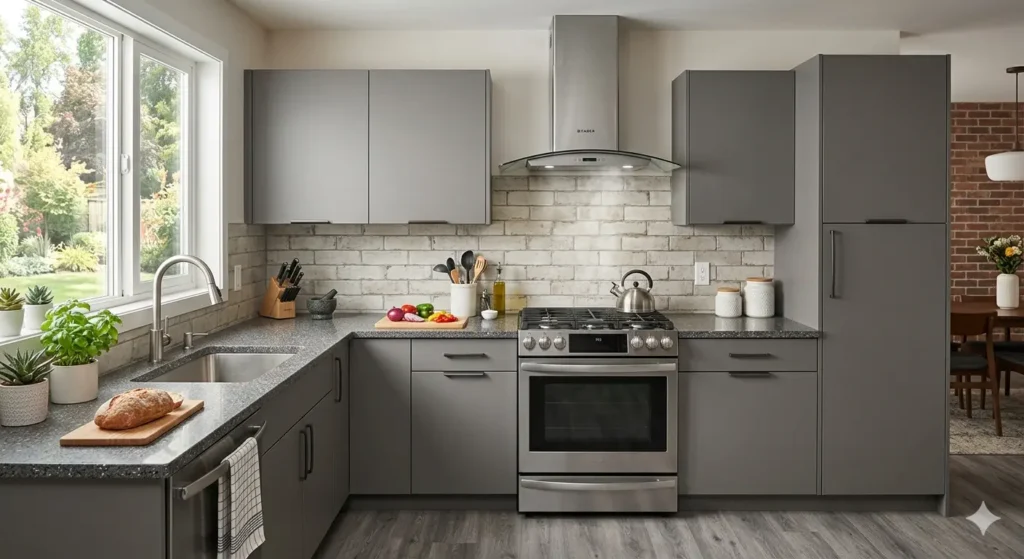
The stated brief for a kitchen renovation in Mankapur is usually “we want a new modular kitchen.” The actual brief, once the conversation goes deeper, is usually more specific: “the current kitchen doesn’t have enough counter space, we can never find anything in the storage, the chimney doesn’t actually clear the smoke, and the whole room looks exhausted.”
These are four separate problems, and a good modular kitchen design addresses all four. Counter space is a layout and dimension question — not just how many linear metres of counter exist, but whether the counter is in the right places relative to the cooking sequence. Storage is a planning question — starting from an honest audit of what the kitchen contains and designing specifically for that inventory. The chimney is a specification question — matching the extraction capacity to the actual cooking load. The visual exhaustion is a material quality question — the difference between finishes that hold up well over years of use and finishes that start showing wear within eighteen months.
Solving all four problems simultaneously, in a design that holds together visually and functionally, is what a genuinely good modular kitchen design achieves. It’s also what separates a kitchen that the family is still happy with five years later from one they’re already thinking about redoing after three.
Mid-range modular kitchen for a Mankapur home: ₹2 to ₹4 lakhs. Premium specification: ₹4 to ₹7 lakhs.
Bedrooms: The Full-Height Wardrobe Argument
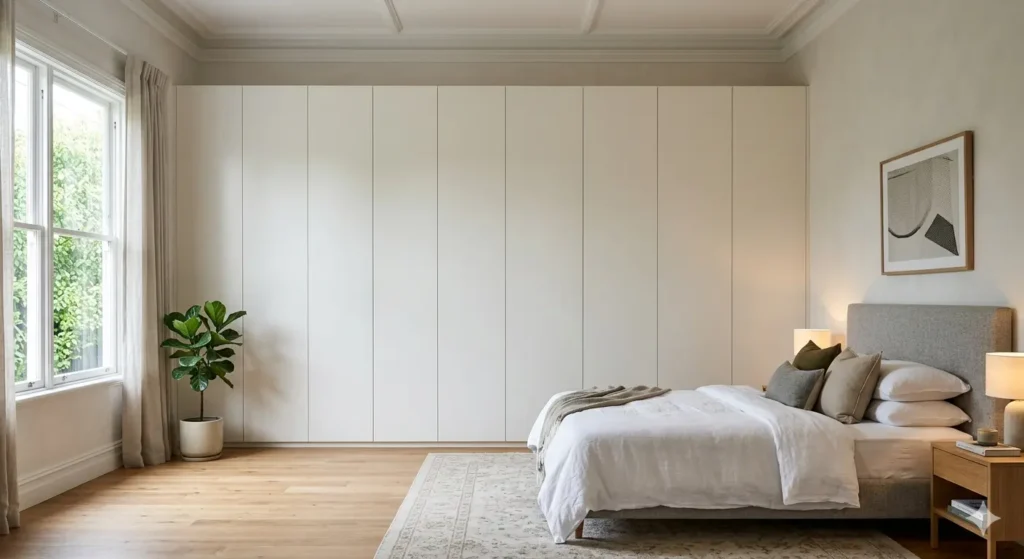
There is one interior design recommendation that QC Interiors makes consistently to every Mankapur family designing a bedroom, regardless of budget level, room size, or design style: the full-height wardrobe.
The argument is straightforward. A wardrobe that runs floor to ceiling uses the room’s full vertical dimension — which in most Mankapur apartments is being wasted by the standard 7-foot unit with a dead space above it. It provides more storage volume in the same wall width. It makes the room feel taller by drawing the eye upward to the ceiling line. And when the shutter design is handled with some care — a warm veneer tone, a profile detail that gives the flat surface some depth — it becomes the room’s primary architectural statement rather than a box sitting in front of the wall.
The additional cost of a full-height wardrobe over a standard height unit, in the context of the total bedroom fit-out, is modest. The difference in how the room looks and functions is not modest at all.
Complete Investment for a Mankapur Interior
2BHK apartment, mid-range specification: ₹7 to ₹12 lakhs.
3BHK, mid-range specification: ₹11 to ₹18 lakhs.
3BHK at premium specification with flooring, bathroom renovation, and architectural lighting: ₹20 to ₹33 lakhs.
Older independent house, comprehensive renovation: ₹17 to ₹30 lakhs.
Free consultation with QC Interiors. Come talk about your Mankapur home.
Transform your home with a trusted Interior Designer in Nandanvan Nagpur who delivers smart, stylish, and functional spaces.
