
Ask anyone in Nagpur about where the city’s residential growth has been happening over the last decade and Besa-Manewada will come up within the first few minutes. New apartment projects, plotted developments, villa communities — they keep appearing along this stretch at a pace that signals real confidence in the area. Families are choosing Besa and Manewada because they offer more space than Dharampeth or Sadar, good connectivity to Sitabuldi and the inner city, access to schools and hospitals that have expanded alongside the residential growth, and a general sense of a neighbourhood that is going somewhere.
The homes being built and sold here reflect that energy. Larger configurations — 3BHK and 4BHK flats, independent row houses, bungalows on modest plots — that attract families who are thinking about the next twenty years, not just the next two. And those families, once they take possession, invariably face the same question: how do we make this feel like ours?
This is where interior design becomes essential. A builder flat in Besa-Manewada, handed over with standard finishes, is a canvas. What you do with that canvas determines whether the home becomes one that energises your family every time you walk in, or one that simply provides shelter without any particular joy.
Interior Design for Besa-Manewada Nagpur
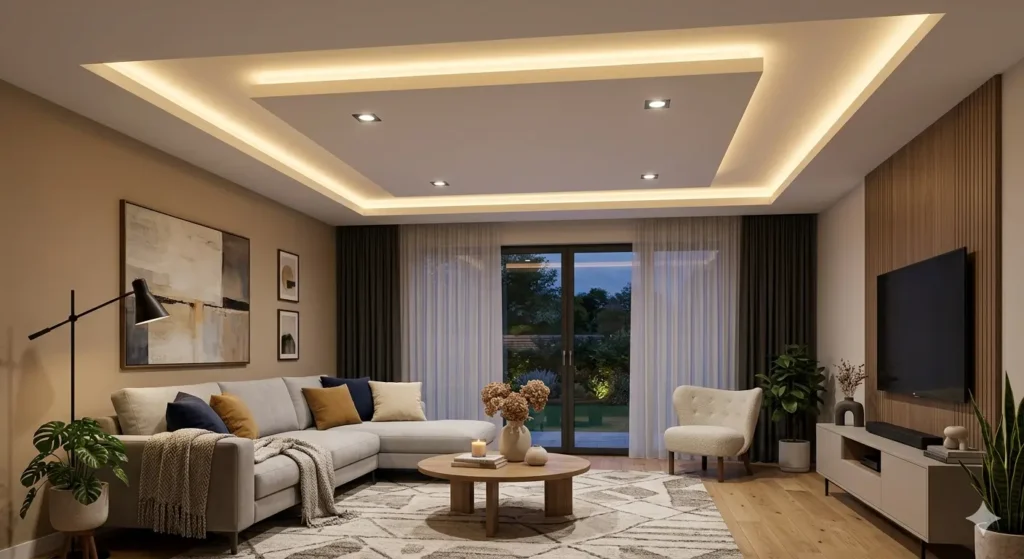
Begin With a 3D Design Session — Always
Regardless of the size of the home, the budget, or how clear a picture the family thinks they have of what they want, every QC Interiors project in Besa-Manewada begins with a full 3D visualisation of the space. This is non-negotiable for us, and once families experience the process, they understand why.
Besa-Manewada homes come in a wide range of configurations. We have worked on compact 1BHK investments where a young professional needs to maximise every square foot, on large 3BHK family flats where a joint family with three generations needs clearly defined zones, on independent bungalows where the design challenge is both aesthetic and structural. Each of these requires a different approach, and that approach can only be defined clearly once the space has been fully modelled and visualised.
The 3D session transforms a vague brief — “I want it to feel modern but warm,” “I want a kitchen that actually works,” “I want the kids to have their own space” — into a specific, agreed-upon visual reality that everyone in the family can see and respond to. Disagreements about design preferences (and there are always some) get resolved in the 3D session rather than on the construction site, where every change has a cost.
The Besa-Manewada Resident: What the Design Should Reflect
Families choosing this part of Nagpur tend to share certain characteristics that shape what a good interior design brief looks like for them.
They are typically value-conscious — they want quality, but they want to understand why things cost what they cost. They are not interested in paying a premium for a brand name on a tile they will never think about again. But they are absolutely willing to invest in a modular kitchen that makes daily cooking better, or a wardrobe design that genuinely solves the storage problem they have been living with for years.
Many are joint families or families in transition to joint-family living — where grandparents have come to stay, or where the elder son and his family have moved in alongside the parents. These multi-generational households have complex needs: a master bedroom that offers the couple genuine privacy and quiet, a second bedroom configured for elderly parents with specific accessibility considerations, children’s rooms that support study and play without disturbing the rest of the household.
The design for these families needs to be both functional and beautiful, in that order. A home that looks magnificent but does not work well for the way the family actually lives is a failure of design, regardless of how expensive the materials are. We start every Besa-Manewada project by listening — really listening — to how the family lives, before we start proposing what the home should look like.
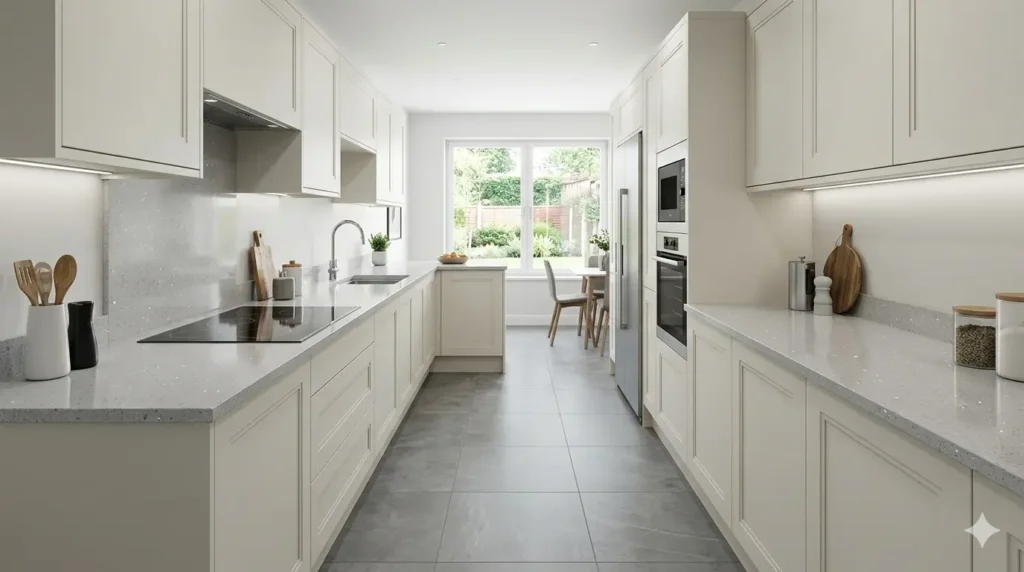
Modular Kitchens: The First Thing Every Besa-Manewada Family Asks For
The pattern is remarkably consistent. In almost every initial consultation with a family in Besa or Manewada, the kitchen comes up first. Not the living room, not the master bedroom — the kitchen. And it makes sense. The kitchen is where the family spends the most cumulative time. It is where the morning starts, where the evening meal is prepared, where children come for a snack after school, where the first cup of chai happens. A kitchen that does not work creates friction at the most fundamental level of daily life.
Builder-provided kitchens in most Besa-Manewada flats are essentially a slab with a sink and perhaps a chimney provision. There is no storage organisation, no thought given to the cooking workflow, no adequate electrical infrastructure, and often inadequate lighting. The countertop — whether granite or marble — may look decent initially but is typically not sealed or maintained to the standard required for longevity in Nagpur’s climate.
A QC Interiors modular kitchen design for a Besa-Manewada flat starts with the cooking workflow — where the raw materials enter the kitchen, where they are prepped, where cooking happens, where cooked food is plated and served. The layout is designed around this flow rather than around what fits most efficiently into the available space. The internal accessories — pull-out shelves, corner solutions, cutlery trays, waste management systems — are specified based on the actual cooking habits of the family.
For a mid-range modular kitchen in this area, the investment is typically ₹2.5 lakhs to ₹4.5 lakhs, covering a full layout with quality shutters, an engineered stone or granite countertop, a chimney and hob provision, and all the internal storage accessories. The difference in daily cooking experience between a well-designed modular kitchen and a builder slab is genuinely life-changing — ask any family who has made this change.
Wardrobes That Actually Solve the Storage Problem
The second thing Besa-Manewada families mention — after the kitchen — is storage. And specifically, the lack of it. Families accumulate. Clothing grows with children and seasons and life events. Festival items, extra bedding, children’s school supplies and project materials, sports equipment, medicines, kitchen overflow, suitcases — all of it needs to live somewhere. Builder-provided storage in most flats here is woefully inadequate for the Indian family’s real storage needs.
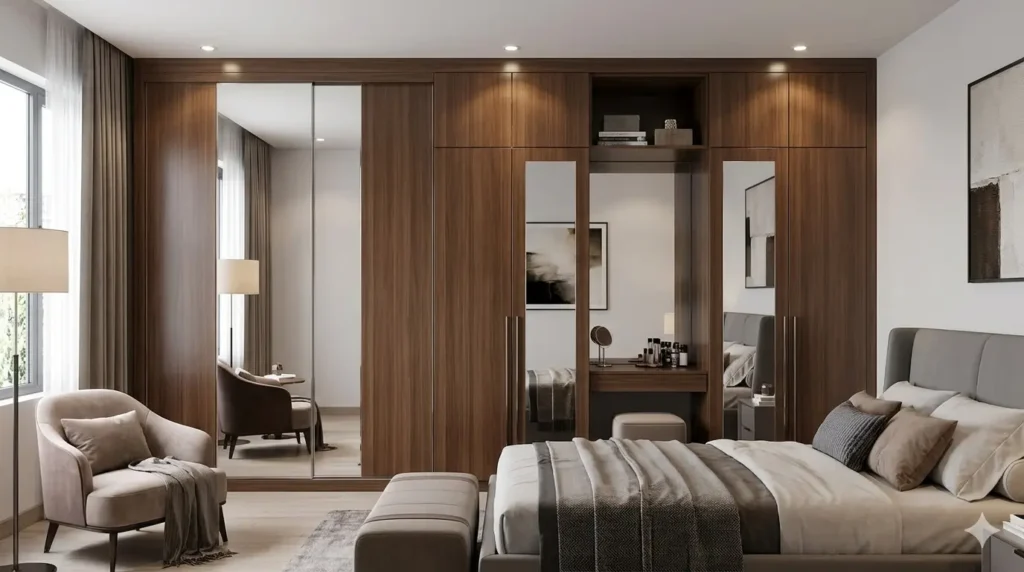
Custom wardrobes — designed specifically for the dimensions of your actual rooms, floor to ceiling where the height allows, wall to wall where the layout permits — are the most effective storage intervention available. Not furniture-shop standard-size units, but wardrobes designed and built for the specific space they will occupy and the specific storage needs of the family who will use them.
A master bedroom wardrobe for a couple in Besa-Manewada typically includes: a long-hang section for formal clothing, a short-hang section for everyday wear, a drawer unit for folded items, accessories, and lingerie, shelf sections in varying heights for folded sweaters, handbags, and boxes, and an integrated dressing mirror that eliminates the need for a separate piece of furniture. All of this in a floor-to-ceiling unit that uses the full height of the room and makes the bedroom feel calm and organised rather than perpetually untidy.
For children’s rooms, the wardrobe often integrates with a study unit — a combined piece of furniture that gives the child organised storage for clothing, books, stationery, and school materials in one continuous, purpose-built unit. In smaller rooms, this integration is the difference between a room that works and one that is always in a state of organised chaos.
Flooring, Ceilings, and Paint: The Three Elements That Change Everything
There are three elements of any room that determine how it feels more than any individual piece of furniture or decoration. The floor underfoot. The ceiling overhead. And the colour and texture on the walls. Get these three right, and the room works even before the furniture is in. Get them wrong, and no amount of careful furniture placement or decoration will compensate.
In Besa-Manewada homes, builder flooring is often plain vitrified in standard sizes or, in older buildings, a low-grade marble that has started to look worn. Replacing this with a premium large-format vitrified tile — 800x800mm or 600x1200mm — in a light, warm tone immediately shifts the feel of the space. The scale of the tile matters as much as the colour: a larger format makes the room look bigger, fewer grout lines, cleaner.
False ceilings are one of the most effective investments per rupee in any Besa-Manewada flat. A well-designed gypsum false ceiling with recessed lighting in the living and dining areas — combined with a cove lighting channel at the perimeter — transforms a plain builder ceiling into an architectural feature. The warm light of the cove in the evening, reflecting off the upper wall, changes the entire mood of the room. Families who have experienced this in their homes consistently say it is the change that impresses guests most.
Paint colours in Nagpur need to account for the climate. Light, warm tones — off-whites, warm creams, soft greens, sandy beiges — reflect rather than absorb heat and make rooms feel both cooler and more spacious. We always do colour selection with physical samples placed on the actual walls of the family’s home, in the actual light conditions of that space, before any final decision is made. The colour that looks beautiful in our office may look entirely different on your north-facing bedroom wall.
A Real Besa-Manewada Project: The Deshpande Family’s 3BHK
A family in a society near Besa came to us with a 3BHK they had taken possession of eighteen months earlier but never fully fitted out. They had been living with builder finishes, a basic kitchen, and furniture from their previous flat that did not quite fit the new space. The couple had a clear aesthetic preference — clean, modern, but warm and not cold — and a very clear functional priority: their joint family needed better storage and a kitchen that could handle serious daily cooking.
We did a complete 3D design across four sessions, refining the layout and material choices until the family was fully confident. The final design included a full modular kitchen with a parallel layout — unusually, this flat had enough kitchen width for it — with membrane-finish shutters, a quartz countertop, and a chimney integrated into a false ceiling panel in the kitchen. Wardrobes in all three bedrooms, with the master bedroom wardrobe incorporating a dedicated section for the mother-in-law’s saris. A living room with a custom TV wall in fluted wood and stone, with integrated storage cabinets below. A false ceiling with cove lighting throughout the main living and dining areas.
The project was completed in eleven weeks and came in at ₹13.2 lakhs. When the family did the final walkthrough, the father-in-law, who had been quietly sceptical about the whole process until that point, walked through every room twice and then said, simply, “Thoda jyaada lag gaya, par lagane layak hai.” That — “it cost more than I expected, but it was worth spending” — is one of the best things we hear.
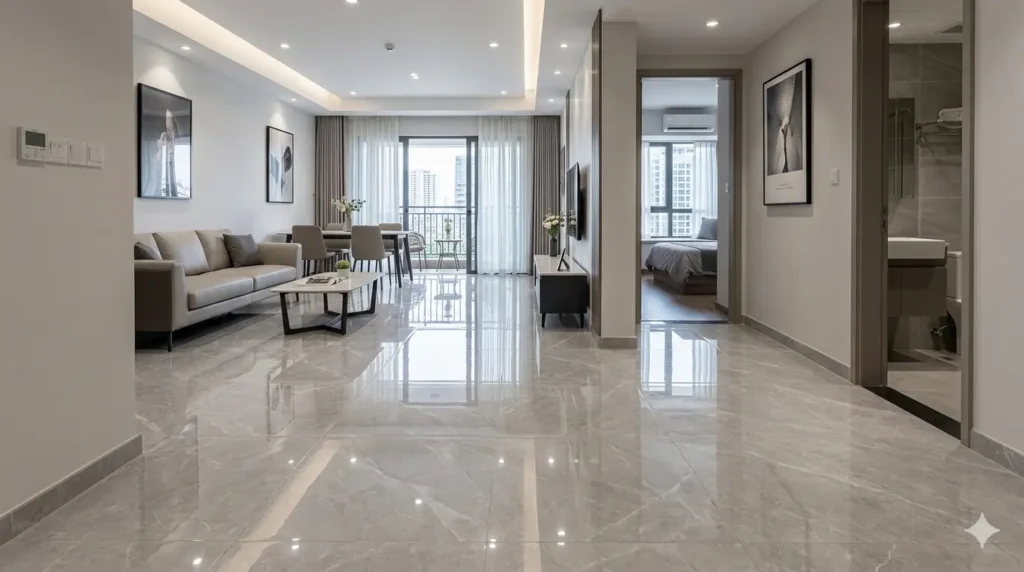
What a Full 3BHK Interior Project Costs in Besa-Manewada
For a complete interior design and fit-out for a 3BHK flat in Besa or Manewada — covering modular kitchen, wardrobes in all three bedrooms, false ceiling and lighting in living and dining areas, complete painting, bathroom upgrades, TV unit and living room furniture, and all the finishing details — the realistic range is ₹9 lakhs to ₹18 lakhs.
For families taking possession of a new flat with nothing fitted out, starting from ₹9 lakhs will give you a complete, functional, and genuinely beautiful home with mid-range materials and solid execution. Starting from ₹15 lakhs and above gives you premium materials throughout, more detailed design work, higher-grade lighting, and finishes that will look as good in ten years as on day one.
For partial projects — kitchen and wardrobes only, or kitchen and living room — the range is typically ₹5 lakhs to ₹9 lakhs. We always present an itemised estimate so families can see exactly where the investment is going and make informed decisions about priorities.
Let’s Start With a Conversation
QC Interiors has worked on dozens of homes in the Besa-Manewada corridor over the past decade, and we understand what works in this part of Nagpur — the climate considerations, the typical flat configurations, the lifestyle needs of the families who choose to live here.
If you have recently taken possession of a flat in this area, or if you have been living in one that is ready for its upgrade, start with a free site visit. Come with your brief — your priorities, your aesthetic preferences, your budget — and our team will come with ideas, honest costs, and a design process that will take your home from where it is to where you want it to be.
