
Interior Designer in Nandanvan Nagpur: A Neighbourhood That’s Earned Its Reputation the Slow Way.
Nandanvan is one of those Nagpur localities that residents tend to be quietly proud of without making much noise about it. It’s not flashy. It doesn’t dominate real estate conversation the way some of the newer corridors do. But spend any time talking to families who’ve lived here — or to families who grew up here and came back to raise their own children in the same neighbourhood — and you understand fairly quickly why it holds the place it does in Nagpur’s residential landscape.
The locality has good bones. Established roads, mature neighbourhood infrastructure, schools and medical facilities at a proximity that families with children and elderly parents value enormously. The residential character is predominantly family-oriented — households who are here for the long run, not for the appreciation cycle.
This character shows up directly in how interior design conversations in Nandanvan tend to go. These families aren’t designing for resale value or Instagram. They’re designing for life. For the next decade of cooking in that kitchen, sleeping in that bedroom, hosting relatives in that drawing room. The brief tends to be specific, practical, and grounded in the reality of how the family actually spends its time at home.
That’s the kind of brief that produces the best interior design outcomes. Genuinely.
Interior Designer in Nandanvan Nagpur
Understanding the Housing in Nandanvan
The residential stock in Nandanvan is a mix that reflects the neighbourhood’s development across several decades. There are older independent houses — properties from the 1980s and early 1990s that were built when plot sizes were more generous and room dimensions reflected a domestic scale that contemporary developer construction has largely abandoned. There are mid-rise apartment complexes from various eras, with unit configurations ranging from 2BHK apartments in the 900 square foot range to larger 3BHK units of 1,200 to 1,400 square feet. And there are a number of row houses and plotted developments from more recent years.
The older independent houses are architecturally interesting in a way that’s easy to underestimate. They tend to have ceiling heights of 10.5 to 11.5 feet in the principal rooms — a dimension that makes an enormous difference to how spacious those rooms feel and what’s possible with the interior design. They have room sizes that genuinely accommodate proper furniture at the right scale. And they often have covered outdoor spaces — a front veranda, a rear utility area with some shelter — that are valuable and underused.
The renovation brief in these older Nandanvan homes is almost always the same at its core: the family loves the house but the interior finishes haven’t kept pace with how the family’s life and expectations have evolved. The kitchen needs to be completely rethought. The bathrooms need upgrading. The flooring is dated. The electrical layout doesn’t support the appliance and air conditioning load of a contemporary household. And someone, at some point over the years, made a series of piecemeal decisions about the living room that have resulted in a space that feels neither here nor there.
The renovation that fixes all of this simultaneously — rather than doing it room by room over ten years in a way that never quite achieves a coherent result — is the project that makes the most sense. And it requires a designer who can hold the whole home in view at once rather than optimising each room in isolation.
Light and Colour: The Nandanvan Reality
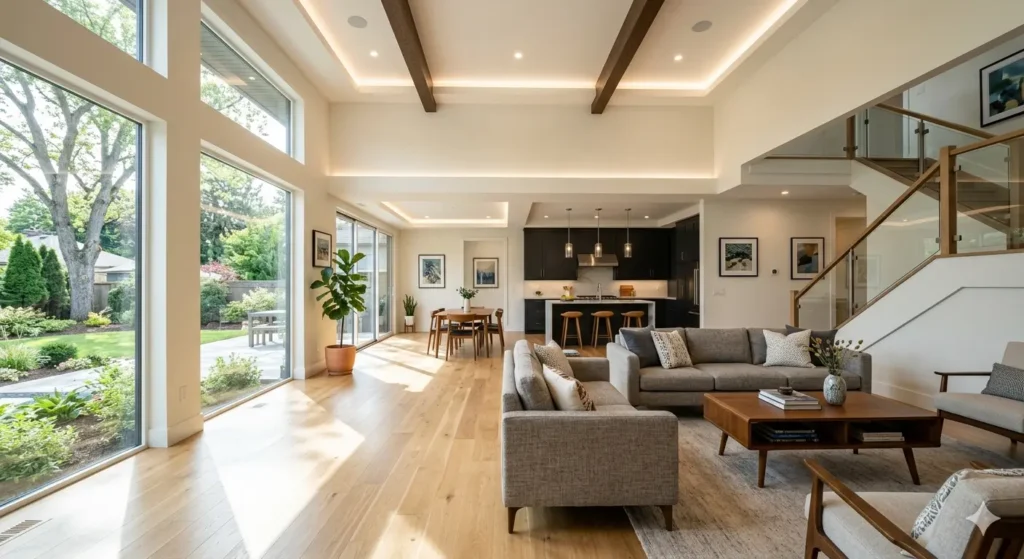
The housing in Nandanvan spans a range of orientations and floor levels that makes light behaviour quite variable across different properties. An upper-floor apartment in a building with good open space around it gets generous, direct natural light for much of the day. A ground-floor unit in a complex where buildings are closely spaced might receive almost entirely diffused ambient light, with direct sun only in certain conditions.
For the well-lit upper-floor apartments: Nagpur’s summer light arrives intensely and reveals colour undertones without mercy. Warm whites — specifically whites with a yellow or cream lean rather than a blue or green one — perform reliably here. On paint systems like Asian Paints, the Magnolia and Off White family; on Berger, the warm tones in the Brilliant White range. Accents in dusty terracotta, soft ochre, or muted warm sage introduced on single feature walls rather than spread across the room.
For the lower-floor or north-facing apartments that receive consistently diffused light: there’s slightly more latitude to introduce colour. Richer warm tones on primary walls — a deep cream, a warm putty — can be used without the risk of them looking heavy or oppressive, because the light quality that reaches these rooms won’t amplify their intensity the way direct summer sun does. But cool tones — the grey-blues and cool greens that photograph beautifully in north-facing London apartments — remain a mistake in Nandanvan regardless of floor level. There’s just not enough warmth in the light to carry them.
Living Rooms: The Space That Sets the Register for the Whole Home
The living room in a Nandanvan home is the space that guests experience first and the space where the family spends the most varied portion of its time at home. It needs to function simultaneously as a guest reception space, a daily family sitting room, and often — particularly in households with school-going children — a homework and activity space in the after-school hours.
Designing for this multiplicity requires honest conversation about priorities. In a Nandanvan family home where the living room genuinely serves all these functions, the furniture layout should support both the formal guest-reception use and the casual daily use — which usually means a flexible seating arrangement rather than a single fixed configuration, and built-in storage that can absorb the homework materials and daily objects that would otherwise accumulate on every available surface.
The false ceiling design in a Nandanvan living room should account for the air conditioning layout from the beginning — not as an afterthought that creates the visual awkwardness of an AC diffuser in an unexpected position or a duct that runs visibly along a ceiling surface. The designer and the AC contractor need to coordinate before the ceiling is designed, not after.
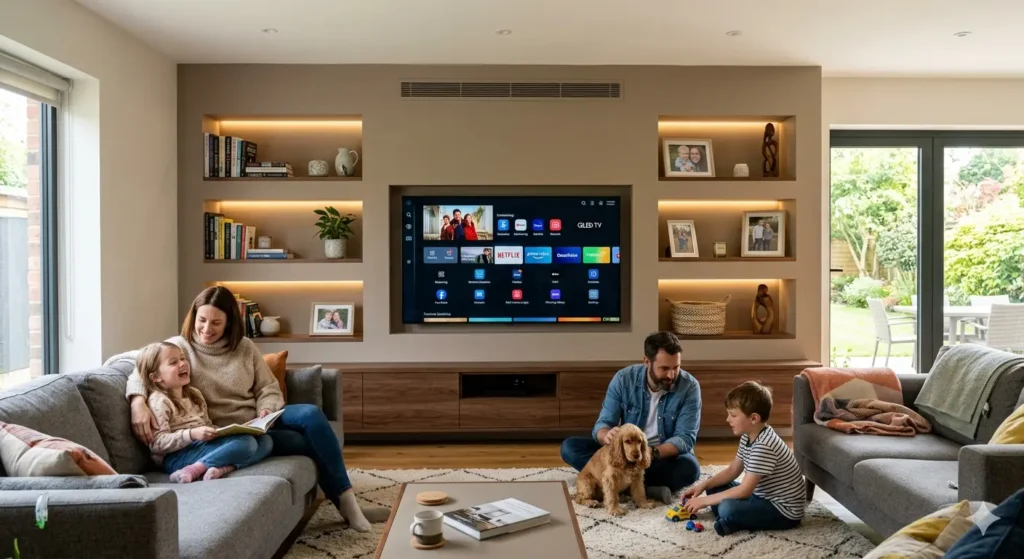
The TV wall treatment: in a Nandanvan home where the living room is genuinely used for daily family life, the TV wall should be designed for daily use rather than for impressiveness. Recessed shelving on either side of the panel creates storage for the objects that naturally accumulate near a television — the remotes, the set-top boxes, the occasional book or magazine that ends up there. Integrating this storage into the architectural treatment of the wall from the beginning is considerably more effective than trying to manage the clutter with freestanding accessories after the fact.
Kitchens: Where Nandanvan Families Spend Real Time
The kitchen in a Nandanvan family home is used seriously. Three meals a day, most days, for a household that typically includes multiple generations with different dietary requirements and meal-time schedules. This is not the kitchen of someone who reheats takeaway. This is a kitchen where proper cooking happens, and the design needs to reflect and support that reality.
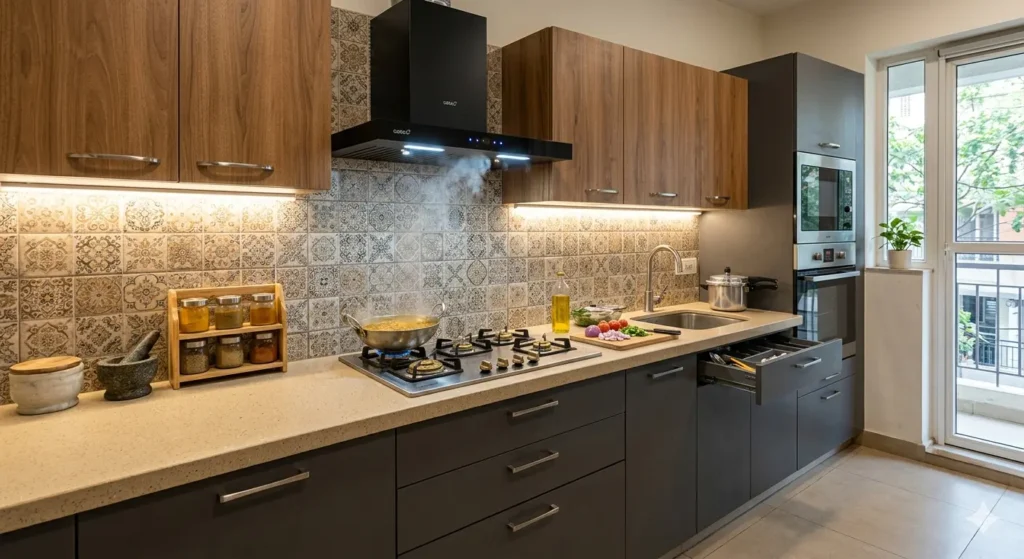
The modular kitchen for a Nandanvan home should start from a genuine site survey — measuring the actual kitchen dimensions carefully, not working from developer drawings that are sometimes inaccurate by enough to matter. It should include a serious storage audit: what does this family’s kitchen actually contain, and where does each category of item need to live to be accessible when it’s needed? And it should address the chimney specification from the beginning, because a chimney chosen for visual proportion rather than extraction capacity is a mistake that the family will live with unhappily for the life of the kitchen.
For the countertop: quartz is the right choice for most Nandanvan kitchens. It handles heat reasonably, is genuinely easy to maintain, doesn’t require sealing the way natural stone does, and is available in warm, neutral tones that work with the colour palettes that suit Nagpur homes. Laminate countertops look adequate when new and show their limitations within a few years of genuine Indian cooking use.
Modular kitchen at mid-range specification for a Nandanvan home: ₹2 to ₹4 lakhs. Premium specification with stone countertops, quality hardware, and properly specified chimney: ₹4 to ₹7 lakhs.
Bedrooms and the Wardrobe Question
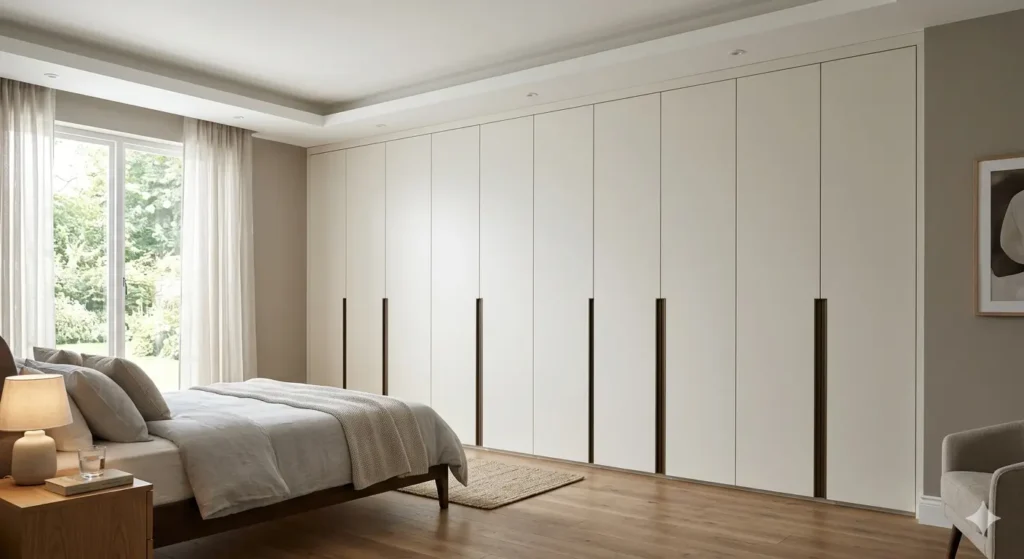
Wardrobes come up in almost every Nandanvan bedroom conversation, and they come up for a good reason. The standard provision in most apartment buildings — two swing-door compartments of inadequate depth — doesn’t begin to address the storage needs of a typical Indian family bedroom. Clothes accumulate. Seasonal items need somewhere to go. The suitcase has to live somewhere. The bedside table has a drawer that fills up. The area under the bed becomes the storage option of last resort.
A full-height wardrobe that runs wall to wall, designed with compartments sized around what the family actually stores — not around what a standard catalogue unit offers — solves all of this. It does it architecturally, which means the solution looks like it belongs to the room rather than looking like additional furniture crowding the space.
The internal organisation is as important as the external design. A wardrobe with adequate hanging depth — 580mm minimum for folded clothing, 600mm for hanging — divided between sections for different clothing types, with drawer provision at comfortable heights and shelf space calibrated to the actual items that need shelving, is a genuinely different thing from a standard wardrobe unit, even if they look similar from the front.
Master bedroom complete — wardrobe, ceiling treatment, bedhead wall, painting: ₹1.4 to ₹2.8 lakhs at mid to premium specification.
Complete Project Investment in Nandanvan
2BHK apartment, mid-range specification, complete interior fit-out: ₹7.5 to ₹13 lakhs.
3BHK at mid-range specification: ₹11 to ₹18 lakhs.
3BHK at premium specification with flooring upgrade, bathroom renovation, architectural lighting: ₹20 to ₹34 lakhs.
Older independent house, comprehensive renovation: ₹18 to ₹32 lakhs at mid-range specification.
Book a free consultation with QC Interiors to talk about your Nandanvan home.
