
Interior Designer in Trimurti Nagar Nagpur: Designing Homes in One of Nagpur’s Most Quietly Respected Neighbourhoods.
Trimurti Nagar doesn’t announce itself. It doesn’t have the colonial history of Civil Lines or the buzzy new-development energy that some of Nagpur’s outer corridors generate. What it has is something more dependable — a settled, genuinely liveable residential character that families who’ve spent real time in Nagpur tend to recognise and appreciate without needing it explained to them.
The neighbourhood sits in a part of the city where the infrastructure has matured without the area becoming congested in the way that some of Nagpur’s more centrally located localities have. Schools nearby. Hospitals accessible. Markets that work daily without drama. The kind of social fabric that makes ordinary life run smoothly, and that most families only fully appreciate after they’ve lived without it somewhere else.
Property rates in Trimurti Nagar have been holding at approximately ₹5,800 to ₹6,200 per square foot in recent years — a number that reflects stable, consistent demand from end-users rather than speculative activity. The people buying here are buying to live here. That distinction matters, because families who buy to live somewhere permanently make interior design decisions with a completely different timeframe in mind than families treating a property as an investment asset.
When a Trimurti Nagar family sits down to design their home, they’re typically designing for the next fifteen years of their life. That seriousness shows up in how they approach the brief. Transform your home with expert Interior Design near Hingna Road Nagpur that perfectly balances comfort, style, and practicality.
Interior Designer in Trimurti Nagar Nagpur
The Homes in Trimurti Nagar: Honest Assessment of the Stock
The residential mix in Trimurti Nagar is predominantly apartment buildings — mid-rise complexes ranging from four to eight floors, with 2BHK and 3BHK units that are, on average, somewhat more generously planned than equivalent apartments in the newer outer developments. Unit sizes typically run from 950 to 1,350 square feet for 2BHK and 3BHK configurations respectively, and the better-built complexes have layouts with a logical relationship between zones that makes interior design relatively straightforward to execute well.
There are also older independent houses in parts of the neighbourhood — properties from the 1980s and 1990s that represent the earlier residential development of the area. These tend to have the characteristics of Nagpur’s better older construction: solid build quality, room sizes that are generous by contemporary standards, ceiling heights that give the interior design more to work with than the standard 10-foot clearance of newer apartments.
The apartments in Trimurti Nagar come to interior designers in two typical conditions. The first is the newly purchased unit — fresh from the developer, with standard builder finishes, a kitchen platform that nobody has cooked on yet, and the particular blankness of a space that has never been anyone’s home. The second is the renovation project — a home that’s been lived in for eight to fifteen years, where the original finishes have aged, where the family’s understanding of what they actually need from the space has evolved considerably from what they thought they needed when they first moved in, and where the brief is as much about correction as it is about creation.
Both are genuine interior design projects. The approaches are different, but the underlying principle is the same: understand how this family lives, and design a home that makes that life better.
How Light Works in Trimurti Nagar and Why It Matters
The mid-rise apartment buildings that characterise most of Trimurti Nagar’s housing stock tend to have reasonable access to natural light on the upper floors and progressively more constrained light on the lower floors, depending on the spacing between buildings in the complex.
In Nagpur’s conditions — summer light between 5,500 and 6,500 Kelvin, intense and directional from late March through June — the light management question in a Trimurti Nagar apartment is specific to each unit’s orientation and floor level. An east-facing unit on the fifth floor of a complex with good open space around it will be dealing with direct, high-intensity morning light that demands a different palette and window treatment response than a north-facing unit on the second floor that receives only diffused ambient light for most of the day.
This specificity is exactly why paint colour should never be chosen from a chip or a reference image without first assessing how the light actually behaves in the specific room at different times of day. The warm white that reads beautifully in a south-facing Trimurti Nagar living room can look slightly cold in a north-facing bedroom in the same building. The terracotta accent that glows warmly in a room with filtered afternoon light can feel aggressive in a room that receives direct unfiltered western sun through large windows.
Taking thirty minutes to observe the light in a room before committing to a palette is not an optional extra — it’s the foundation of a colour decision that will still be right five years from now.
Living and Dining Areas: The Heart of a Trimurti Nagar Home
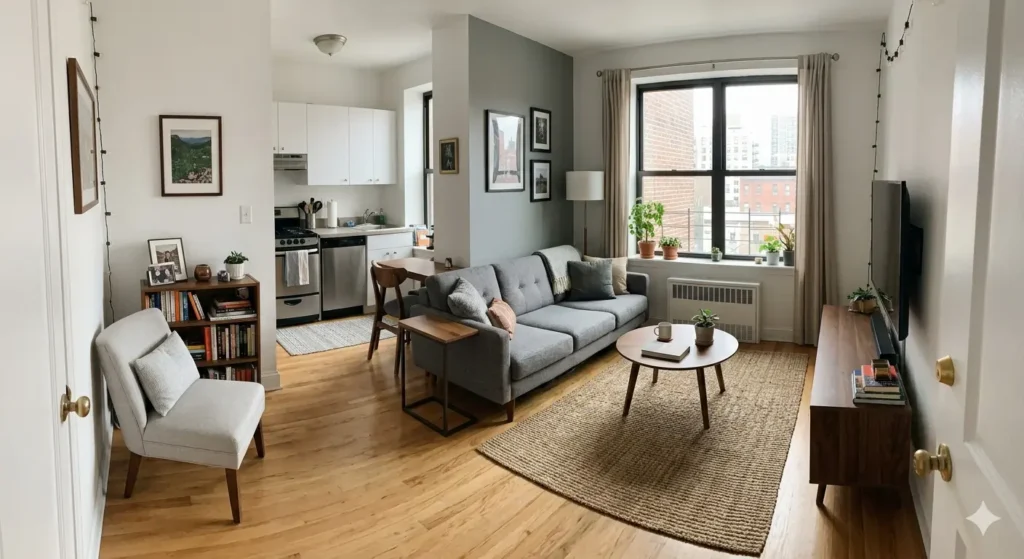
The combined living and dining space in a Trimurti Nagar 3BHK apartment is typically 300 to 420 square feet — a reasonable size that allows for a proper sofa group, a dining table that seats six comfortably, and adequate circulation between the two zones, provided the furniture is chosen and arranged with some intelligence.
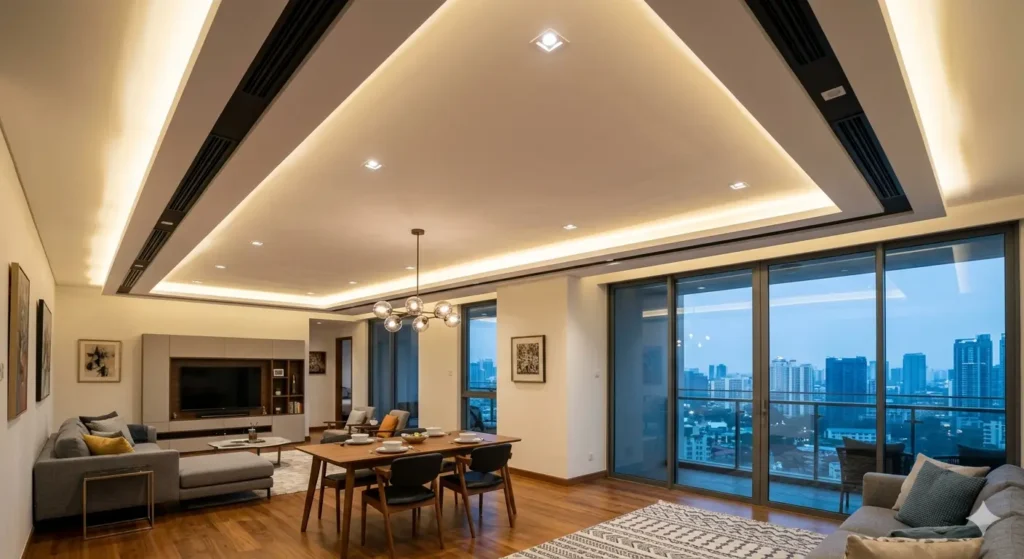
The false ceiling design for these rooms tends to follow a logic that has proven itself in Nagpur’s residential market over the past decade: gypsum ceiling with a defined perimeter cove for LED strip lighting, recessed downlights positioned over the specific zones they need to illuminate rather than distributed uniformly, and any air conditioning linear diffusers integrated into the ceiling design rather than surface-mounted on the structural ceiling as an afterthought.
What this ceiling specification actually achieves beyond aesthetics is worth spelling out. The perimeter cove lighting, when dimmed to its lower intensity in the evening, creates a warmth and softness in the room that a flat ceiling with standard light fixtures simply doesn’t produce. The zone-positioned downlights mean the dining table is properly lit without the sofa group being harshly illuminated, and the reading end of the sofa gets a focused light without the whole room being at task-lighting intensity. These are not decorative decisions — they’re functional ones that affect how the room feels to be in every evening.
The focal wall — TV wall in most Trimurti Nagar living rooms — should be designed as a full architectural element rather than a surface with a television mounted on it. A floor-to-ceiling treatment in fluted wood veneer, or a combination of stone-effect panel in the TV zone with veneer panels flanking it and recessed niches above, creates the visual weight the room needs and gives it a finished, considered quality that no amount of furniture selection can substitute for.
One practical note on furniture scale: the single most common mistake in Trimurti Nagar apartments — and in Nagpur apartment interiors generally — is oversized furniture. A sofa that looks appropriately substantial in the furniture showroom can occupy a disproportionate amount of a 320-square-foot living room and leave the space feeling crowded rather than generous. Measure first. Always.
Kitchens in Trimurti Nagar: Functional Reality vs Catalogue Fantasy
The modular kitchen industry in Nagpur has produced a generation of kitchens that look excellent in showrooms and photographs and work adequately in practice — but adequate isn’t the standard that a family who’s going to cook three meals a day for the next fifteen years should be settling for.
The gap between a catalogue kitchen and a kitchen that works for an Indian family at Nagpur scale usually comes down to a few specific things that the catalogue doesn’t address honestly.
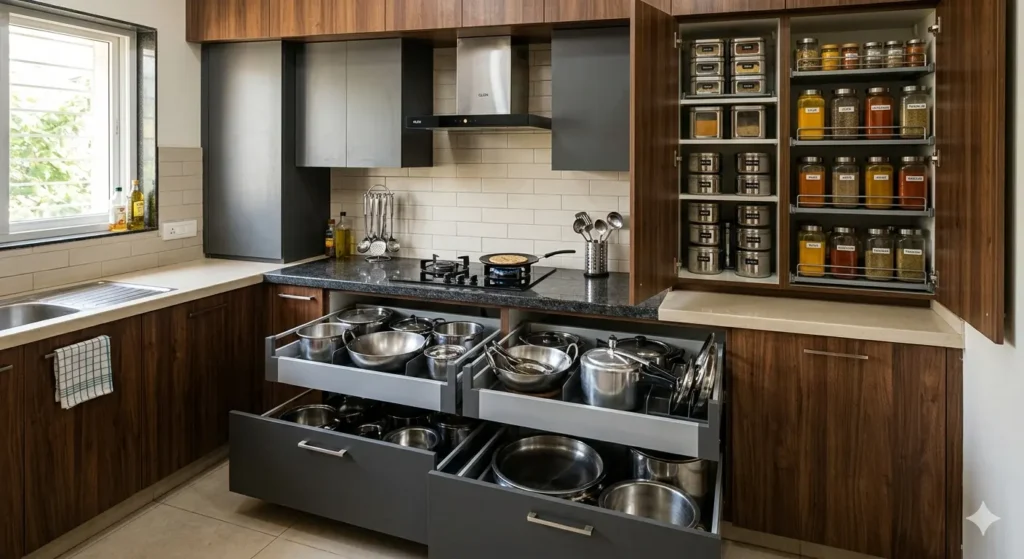
Storage planning is the most significant. The standard modular kitchen storage package — upper cabinets, lower cabinets with shelves, one or two pull-outs — significantly underestimates what an Indian household kitchen actually contains. The spice collection alone in a typical Nagpur kitchen might run to thirty or forty varieties. There are large vessels — pressure cookers, kadais, stockpots — that don’t fit in the standard lower cabinet storage configuration. There’s a flour and grain storage requirement that most modular kitchen planners don’t account for. Getting the storage right requires starting from an honest inventory of what the kitchen contains, not from a catalogue template.
The chimney is the second most common failure. An undersized chimney in a Nagpur kitchen where serious Indian cooking happens — high-heat cooking, oil at volume, strong spice aromas — is a daily frustration that no amount of good counter design compensates for. The extraction capacity specification should be driven by cooking reality, not by what creates a clean visual composition in the kitchen elevation.
Counter height is worth a separate conversation. The standard 860mm height that most modular systems default to is not right for every cook. In households where the primary cook is shorter than average, a 820 or 840mm counter height makes a genuine difference to how comfortable extended cooking is. This is a five-minute conversation that saves fifteen years of unnecessary physical strain.
Mid-range complete modular kitchen for a Trimurti Nagar apartment: ₹2.2 to ₹4.5 lakhs. Premium specification with stone countertops, quality hardware, appropriate chimney, and genuinely designed storage: ₹4.5 to ₹7.5 lakhs.
Bedrooms: Getting the Fundamentals Right
The master bedroom in a Trimurti Nagar 3BHK apartment typically runs between 150 and 210 square feet — workable dimensions that reward intelligent design and suffer noticeably when the design is generic.
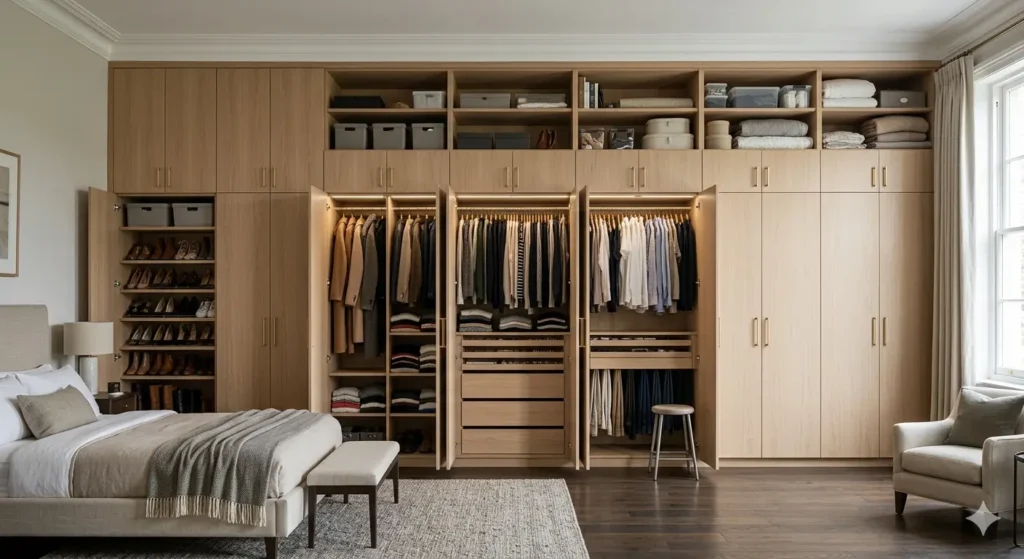
The full-height wardrobe is the design decision with the greatest impact on how the master bedroom functions and feels. A wardrobe that runs wall to wall and uses the full floor-to-ceiling dimension — designed with genuinely thought-through internal organisation rather than a standard shelf-and-hanging configuration — solves the room’s primary storage problem completely, makes the room feel taller, and becomes the room’s main architectural statement. The shutter design matters: warm-toned veneer shutters or profile-routed MDF in a lacquer finish feel materially appropriate in a Nagpur bedroom in a way that stark white acrylic handleless shutters sometimes don’t.
The bedhead wall treatment — painted accent in a warm, quiet tone, or a textured panel in fabric or wallpaper — creates the focal point the sleeping zone needs without requiring significant expenditure. A well-chosen paint colour costs almost nothing compared to the visual improvement it delivers.
Bedside lighting is consistently underdesigned in Nagpur bedrooms. A single central ceiling light — the standard builder provision — serves neither task lighting nor ambient lighting well. Wall-mounted reading lights at the correct height, cove lighting in the ceiling perimeter that provides warm ambient illumination in the evening, and a dimmable control for at least the ambient layer give the bedroom the lighting flexibility it needs.
What a Complete Project Costs in Trimurti Nagar
2BHK apartment, mid-range specification, covering living and dining false ceiling and focal wall, modular kitchen, both bedrooms with full-height wardrobes, painting: ₹8 to ₹13 lakhs.
3BHK at mid-range specification: ₹12 to ₹19 lakhs.
3BHK at premium specification with engineered wood flooring in main areas, architectural lighting, premium kitchen hardware, bathroom renovation: ₹22 to ₹36 lakhs.
Older independent house in Trimurti Nagar, comprehensive renovation at mid-range specification: ₹18 to ₹30 lakhs.
QC Interiors works in Trimurti Nagar and across Nagpur’s residential neighbourhoods. Book a free consultation to discuss your home specifically.
