
Best Interior Designer in Dharampeth Nagpur: What Nagpur’s Most Established Neighbourhood Asks of Its Homes.
There are neighbourhoods in every city that carry a particular weight. Not just in terms of property value — though Dharampeth certainly carries that — but in terms of expectation, history, and a kind of residential seriousness that you feel the moment you spend any real time there. Dharampeth is that neighbourhood in Nagpur. It has been the address of the city’s professional class, its educators and doctors and established business families, for long enough that it has developed an identity that transcends any individual property or development cycle.
As of early 2025, property prices in Dharampeth had reached an average of around ₹43,000 per square foot in some parts of the locality — a figure that reflects not just location but the accumulated desirability of a neighbourhood that consistently delivers on what it promises. The families who live here know what a well-designed home looks like. Many of them have lived in one for years. When they hire an interior designer, they’re not starting from scratch — they’re continuing a conversation about quality that’s been going on for some time.
That context matters. It changes how the design process needs to work.
Best Interior Designer in Dharampeth Nagpur
The Homes of Dharampeth: What You’re Actually Working With
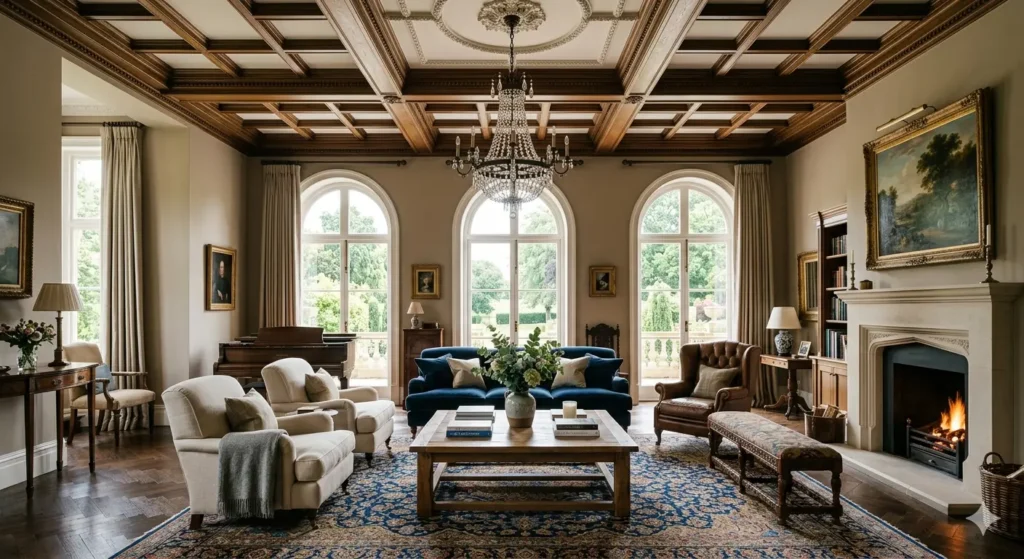
Walk the streets of Dharampeth and the variety of its housing stock becomes apparent pretty quickly. There are older bungalows and independent houses on substantial plots — properties built when Dharampeth was still developing and the available land allowed for a generosity of scale that contemporary construction in prime Nagpur locations simply cannot replicate. There are mid-rise apartment buildings from the 1990s and 2000s, larger than their equivalent in newer parts of the city, with the solid construction that characterised better residential development of that era. And there are newer luxury apartment projects — five and six-storey buildings developed in the last decade as the locality’s premium positioning attracted developer investment.
Each category presents a genuinely different design situation.
The older bungalows are the most interesting and the most demanding. These are homes with 11 to 13-foot ceiling heights in the original rooms, with verandas that shade the main living spaces from direct summer sun, with a planning logic oriented around how Indian families lived several decades ago — separate kitchen and service areas, a formal drawing room, a family sitting space, bedrooms that are properly scaled rather than compressed. The architecture is often genuinely good. The challenge is modernisation that works with this architecture rather than against it.
The apartments from the 90s and early 2000s are solid and spacious but dated. The original kitchen fittings are usually overdue for replacement. The bathrooms look their age. The flooring — often mosaic or basic vitrified tile — is functional but unremarkable. The design brief here is renewal: bringing the interior quality up to where the location and the family’s current expectations both sit, without losing what makes these apartments worth living in.
The newer luxury apartments are, in some ways, the most straightforward canvas. They come with developer-standard interiors — inoffensive, generic, and ready to be made personal by a designer who takes the brief seriously.
Why Colour Choices in Dharampeth Are Different
The mature trees that line many of Dharampeth’s streets do something genuinely useful for the homes set back from them: they filter the summer sun in a way that softens the quality of natural light entering the main rooms. This is not a small thing in Nagpur. The difference between filtered and unfiltered summer light in a room is the difference between light that you can design with and light that you’re constantly fighting.
In a Dharampeth bungalow whose main rooms face a tree-lined street, you have access to colour possibilities that simply aren’t available in a fully exposed apartment on an upper floor. Slightly richer tones — a warm aged terracotta on a drawing room wall, a deep warm sage in a library or study, a muted gold on the dining room accent wall — read beautifully in the soft, filtered light that these rooms receive through much of the day. They create depth and warmth rather than looking heavy or aggressive.
This is exactly the kind of site-specific colour knowledge that separates a designer who works in Nagpur from one who applies a standard palette regardless of conditions. The right colour for a Dharampeth bungalow drawing room is not the right colour for a fully exposed west-facing apartment in a newer complex. They’re different light environments, and they need different thinking.
For the newer Dharampeth apartments with standard exposure: warm whites in the LRV 75 to 85 range remain the most reliable primary wall choice. Accents in warm, slightly muted tones — dusty terracotta, soft ochre, muted olive — introduced on single feature walls rather than spread across the room.
Drawing Rooms in Dharampeth: Rooms That Have to Do Several Things at Once
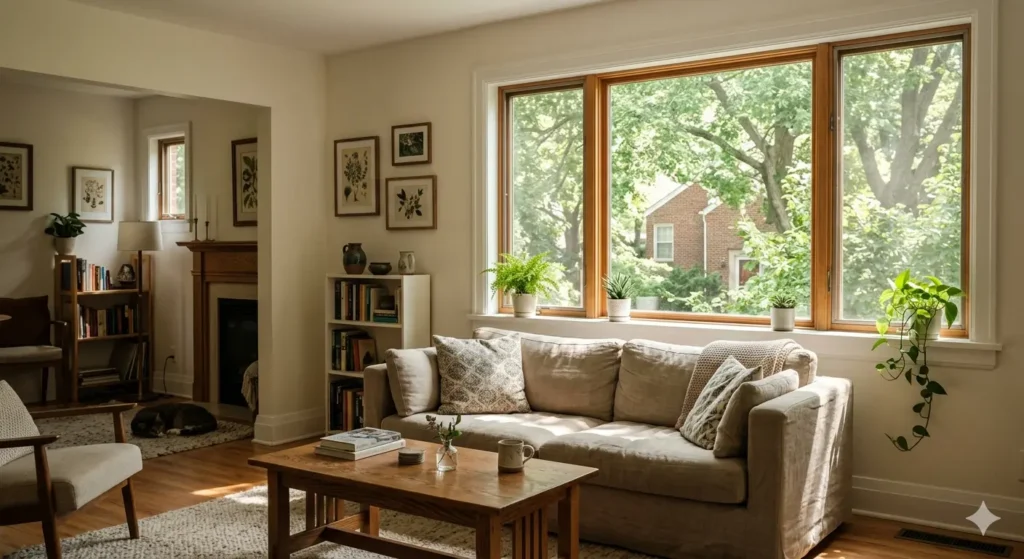
The drawing rooms in Dharampeth’s older homes are large by any standard — 380 to 600 square feet is common in a well-proportioned bungalow, and some of the larger properties have formal rooms that exceed even this. This scale creates design challenges that are quite different from the challenge of making a compact apartment living room feel generous.
The primary challenge in a large Dharampeth drawing room is intimacy. A room of 500 square feet, furnished with proportionally appropriate furniture and lit with a standard central light, can feel like a waiting room rather than a family home. Creating the sense of warmth and habitability that a drawing room needs — despite its scale — requires specific design decisions.
Furniture arrangement is the most powerful tool. The main seating group should be sized to create a conversational zone with appropriate human scale — people sitting across from each other at a distance where speaking at normal volume is comfortable. In a very large room, this means accepting that the furniture group won’t touch the walls and that there will be significant open floor area around the seating. This openness should be treated as a quality rather than a problem.
Rugs define zones in large Dharampeth rooms in a way nothing else does as effectively. A good rug under the main seating group, sized correctly — typically with the front legs of all seating pieces on the rug — creates a room within the room. The definition it creates is both visual and psychological: the seating zone feels like a place to be rather than furniture floating in space.
For the ceiling: a coffered plaster ceiling design at the original room height is significantly more appropriate in a high-ceilinged older Dharampeth home than a dropped gypsum ceiling that reduces the height to a standard 9 feet. The coffered design uses the height as an architectural asset. The dropped ceiling discards it.
Kitchens: The Conversation That Usually Surprises People
When families in older Dharampeth homes finally sit down to plan a kitchen renovation, the first conversation is usually about modernisation — replacing old fittings with a contemporary modular system. But the more interesting conversation, once it gets going, is about layout.
Many older Dharampeth kitchens were designed around a domestic staffing model that fewer households maintain today. Large rooms with separate washing, preparation, and cooking zones; separate pantry storage areas; servant quarter access. These rooms are often 180 to 250 square feet or more — substantially larger than the kitchen in most contemporary apartments.
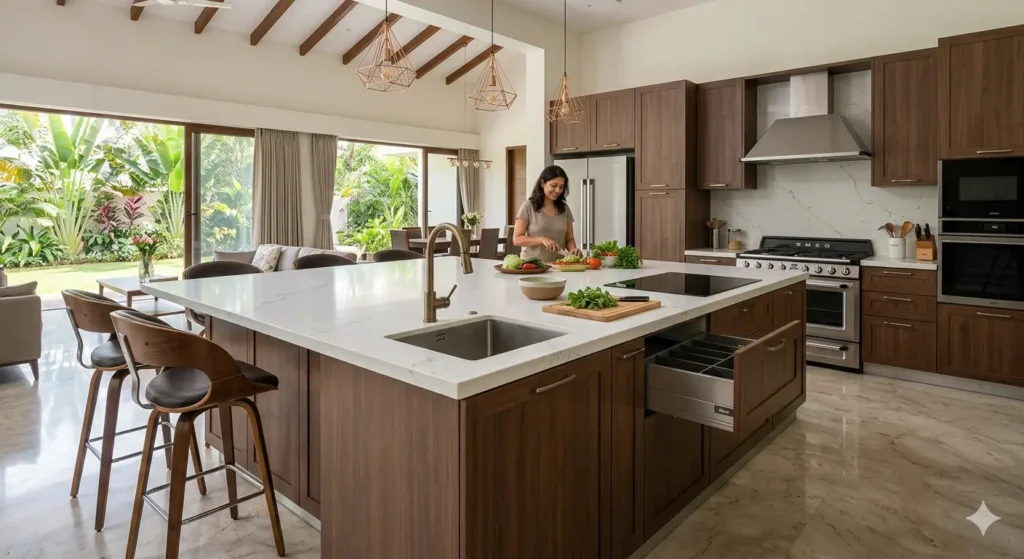
A modular kitchen that simply fills this large space with standard units misses the opportunity. The space allows for a proper island counter — which in the context of an Indian household is not a luxury feature but a genuinely useful design element that supports how families actually gather in the kitchen. It allows for a dedicated breakfast counter and seating. It allows for appliance integration that a compact kitchen layout can’t accommodate.
The material specification should match the neighbourhood. Quartz or granite countertops. Cabinet shutters in quality acrylic or veneer rather than economy laminate. Hardware from Hettich or Blum — brands whose mechanisms work smoothly for a decade rather than developing a characteristic rattle after eighteen months. A chimney with adequate extraction power for Indian cooking at family scale.
Premium kitchen for a Dharampeth home: ₹4.5 to ₹9 lakhs. For a larger kitchen in an older bungalow with island configuration and comprehensive appliance integration: up to ₹12 lakhs.
Bathrooms: Possibly Dharampeth’s Biggest Interior Design Opportunity
If there’s one space in older Dharampeth homes that’s most consistently underinvested relative to the property’s overall quality, it’s the bathrooms. The original fittings are often thirty or forty years old. The tiles are dated. The storage — always inadequate by contemporary standards — has become more so. The shower provision, in homes where a separate shower was never part of the original design, is a retrofit that usually looks exactly like what it is.
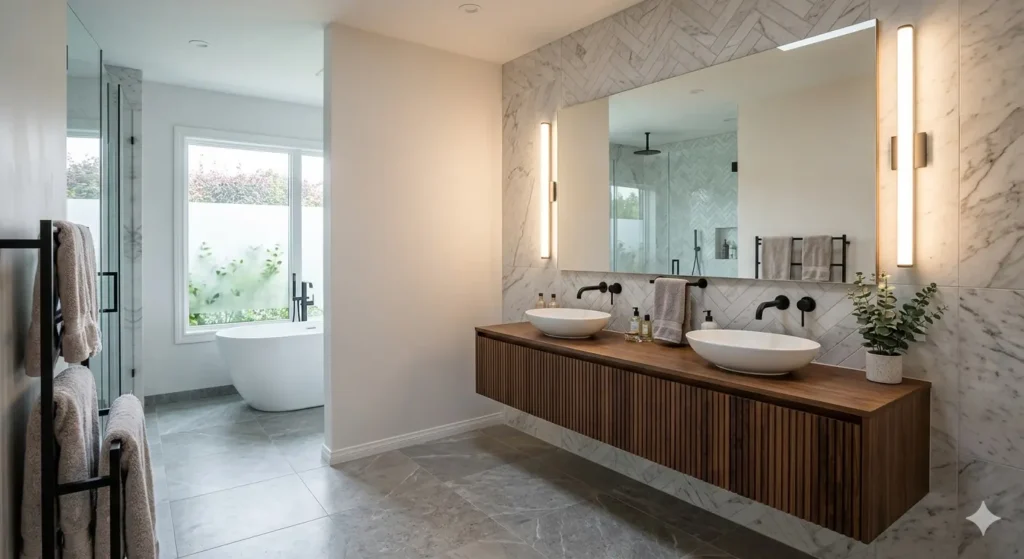
A comprehensive bathroom renovation in a Dharampeth home is one of the highest-impact investments available. Large-format floor and wall tiles in warm neutral tones — lighter than the room, with minimal grout lines to keep the surface easy to maintain. A wall-hung WC and basin, which frees floor space, makes cleaning genuinely simple, and looks considerably more refined than floor-mounted equivalents. A frameless or semi-frameless shower enclosure. Vanity storage designed for how the bathroom is actually used rather than what fits aesthetically.
The lighting in a bathroom renovation deserves particular attention. Overhead downlights alone create a lighting quality that is both unflattering and insufficient for the task. Side lighting at face height — from wall lights flanking a mirror, or from a backlit mirror with even perimeter illumination — is what actually makes a bathroom function properly for grooming.
Bathroom renovation at mid-range specification for a Dharampeth home: ₹1.8 to ₹4 lakhs per bathroom. At premium specification with quality imported fittings, custom vanity, and proper mirror lighting: ₹4 to ₹7 lakhs.
Complete Investment for a Dharampeth Interior
3BHK apartment in a newer Dharampeth complex, mid-range specification, full interior fit-out: ₹14 to ₹24 lakhs.
Older Dharampeth bungalow or independent house, comprehensive renovation at premium specification — all principal rooms, kitchen, bathrooms, flooring, painting, lighting design: ₹38 to ₹75 lakhs depending on size and depth of scope.
QC Interiors works in Dharampeth and understands what these homes need. Book a free consultation.
Transform your home with the expertise of the Best Interior Designer in Civil Lines Nagpur for a perfect blend of luxury and functionality.
