
Best Interior Designer Civil Lines Nagpur: When the Address Sets the Standard.
There are very few places in Nagpur where the land itself tells you something about the history of the city. Civil Lines is one of them. It was laid out during the British administration — wide roads, deep setbacks from the street, large plots, overarching trees that have had a century to grow into the kind of canopy that no landscaping budget can replicate — and the neighbourhood it created has outlasted every development trend that Nagpur has cycled through in the decades since.
Today, Civil Lines holds Nagpur’s highest average property prices — somewhere around ₹10,000 per square foot as of early 2025, with a trajectory that has been consistently upward. The families who own property here didn’t buy because it was a bargain. They bought because Civil Lines represents something that isn’t available anywhere else in the city: a combination of scale, maturity, connectivity, and residential prestige that has been accumulating for over a hundred years.
Designing interiors for Civil Lines homes is a responsibility of a specific kind. The homes here are not blank canvases waiting for a contemporary interior to be applied to them. They have architecture. They have proportions. They have, in many cases, decades of family history embedded in them. The designer’s job is to bring these homes into their next chapter with intelligence and restraint — not to impose a style, but to reveal and enhance what’s already there.
Best Interior Designer Civil Lines Nagpur
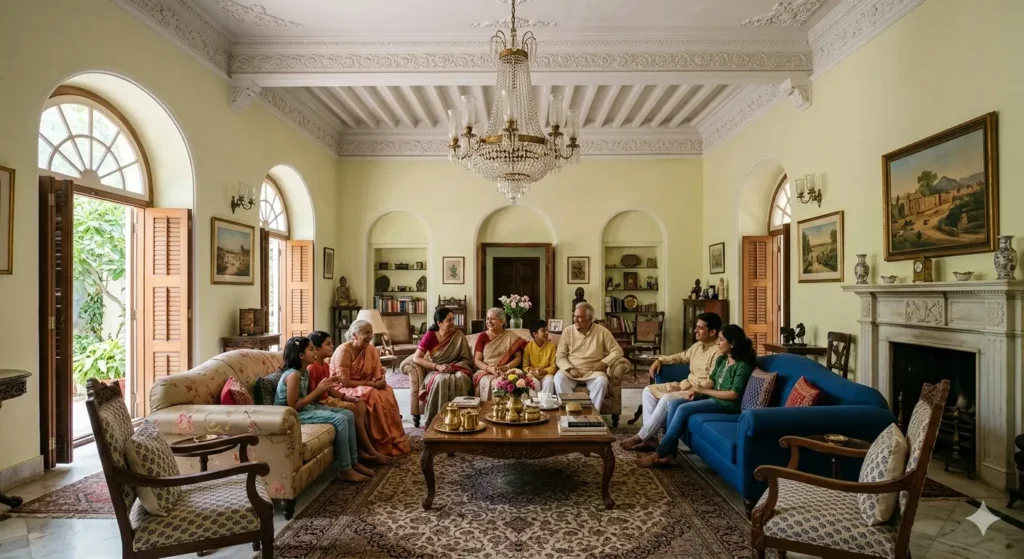
The Properties: Scale, History, and What They Need
The defining quality of Civil Lines homes — the older bungalows and independent houses, in particular — is scale of a kind that contemporary construction doesn’t produce. Plots of 1,000 square metres or more. Main houses of 3,000 to 5,000 square feet, sometimes considerably larger. Room heights of 12, 13, even 14 feet in the original construction.
That ceiling height changes everything. A room with a 13-foot ceiling is not just a room with a higher ceiling than normal — it’s a fundamentally different spatial experience. The proportions of furniture that suit it, the lighting that works in it, the colours that read correctly in it, the relationship between the occupants of the room and the architecture around them — all of these shift when you’re working with genuine height rather than the standard 10-foot clearance of a contemporary apartment.
The architecture of the older Civil Lines bungalows also reflects a sophisticated understanding of Nagpur’s climate that deserves respect. Wide verandas on the south and west faces shade the main rooms from direct afternoon sun. Deep overhangs above windows admit diffused light while blocking the direct rays that would make the rooms uninhabitable in summer. The room orientation and the relationship between interior and exterior were thought through with the specific conditions of this city in mind.
A designer who arrives at a Civil Lines bungalow with a contemporary apartment interior template is making a category error. These homes require a different approach — one that starts by understanding what the architecture is doing and designs in support of it.
Colour and Material at Civil Lines Scale
Working with 13-foot ceilings and rooms of 400 to 600 square feet opens up colour possibilities that most Nagpur interiors simply can’t access. Deep, warm tones that would make a standard apartment room feel oppressive become possible — even beautiful — when there’s enough volume for them to breathe.
A drawing room in a Civil Lines bungalow with west-facing windows and mature trees outside them receives light that is both filtered and warm in the afternoon. On the primary walls, a deep warm cream or a rich aged white reads as luminous rather than flat in this light. On the accent wall — the wall opposite the main entry, or the wall that backs the primary seating — a colour with real substance: a warm brick red, a deep warm sage, an earthy burnt sienna at low saturation. These tones, in rooms of this scale and with this quality of light, create an atmosphere of settled, serious luxury that no amount of contemporary decorative detail can substitute for.
The material vocabulary that suits Civil Lines homes leans toward the natural, the handcrafted, and the durable. Natural stone floors — warm Kota, Indian sandstone, or a honey-toned marble rather than the cool imported varieties that feel more at home in contemporary minimal interiors. Teak and sheesham wood for joinery and furniture — materials that improve with age rather than dating. Lime plaster or textured hand-applied finishes on accent walls rather than laminate cladding, whose perfection is somehow wrong in rooms that have been accumulating character for decades.
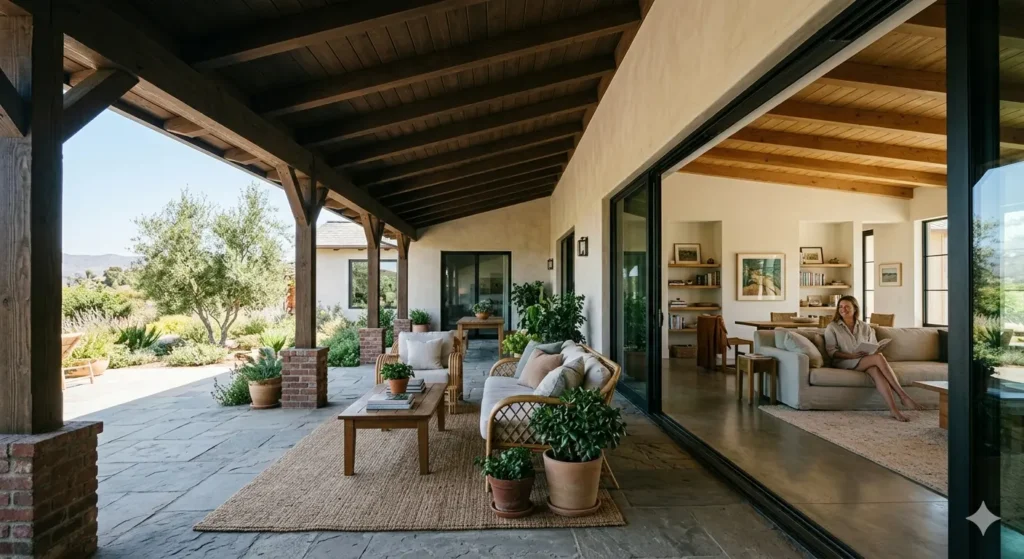
The Drawing Room: Designing a Room That Has Already Lived
The drawing room in a well-proportioned Civil Lines bungalow is often 400 to 700 square feet — a room that exceeds most Nagpur apartment floor plans entirely. Designing it well requires thinking at an architectural scale about the relationship between the room’s elements, not just furnishing a large space.
In a room of this scale and quality, the television should not be the focal point. It can be present — most families need it to be — but it should be subordinate to the room’s real anchors: the ceiling, the fireplace in homes that have one, a significant artwork or collection, or the architectural treatment of the main wall. Civil Lines drawing rooms that are organised entirely around a television and a sofa group facing it miss the potential of the space almost entirely.
The furniture grouping should create intimacy within the room’s scale. A large sofa group centred on a coffee table, positioned in the middle of the room rather than pushed against the walls, with enough space around it to circulate comfortably — this creates a conversation zone with human scale inside the larger room. Secondary seating at the periphery handles overflow without dominating the space.
For the ceiling of a Civil Lines drawing room with original height: resist the temptation to drop it. A coffered plaster design, a restored and repainted original ceiling treatment, or a carefully designed new plaster ceiling that references the room’s architectural period uses the height as the dominant statement of the room. A central chandelier chosen with the same seriousness as a significant piece of furniture — for its visual quality as much as its light output — anchors the vertical dimension that the height creates.
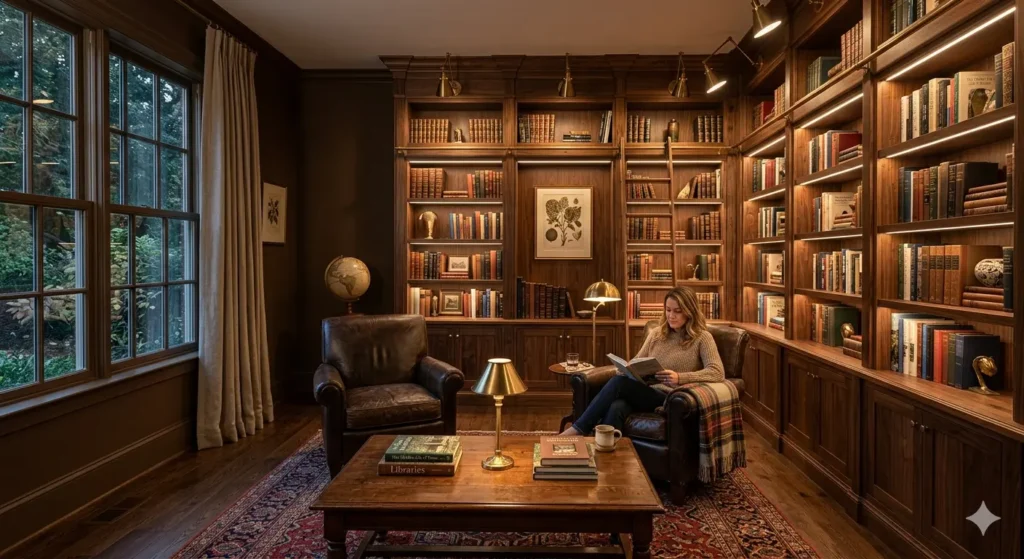
The Library, Study, or Home Office
Many Civil Lines bungalows include a dedicated library or study — a room type that has become increasingly desirable as working-from-home arrangements have changed what families expect their homes to contain. These rooms, when they exist in older Civil Lines properties, are often among the most beautiful spaces in the house: proportioned for quiet work and conversation, with natural light from a single direction, shelving that has accumulated a family’s reading over decades.
Designing or renovating a Civil Lines library requires understanding what the room is for. It’s a place for serious work and serious reading. The materials and the atmosphere should support this: warm-toned wood shelving, desk surfaces at proper working height and depth, seating that supports extended sitting, and lighting designed for the dual purposes of ambient illumination and task lighting over the desk and reading chairs.
The colour palette for a Civil Lines library can go deeper than almost anywhere else in the home. A warm dark green, a rich tobacco brown, a deep blue-grey — these tones, in a room of correct proportions with appropriate natural light from a single window, create the concentrated atmospheric quality that a library needs. They’re not appropriate in most Nagpur interiors, but in a room of this type, at Civil Lines scale, they’re exactly right.
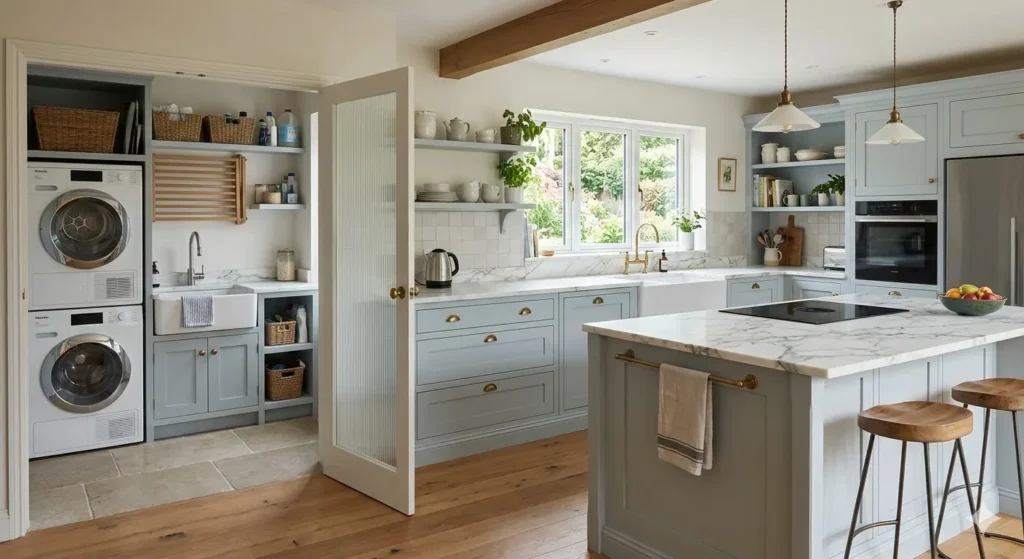
Kitchens and Service Areas: Modernising Without Losing the Logic
Civil Lines bungalows typically have kitchen and service areas that were designed around a domestic staffing model — separate kitchen, utility, and pantry areas; access from the service entrance; a spatial separation between the family’s living areas and the domestic working areas that reflected how these households operated.
As family structures and staffing arrangements have changed, these service areas need rethinking. But the rethinking should be intelligent rather than wholesale. The separation between kitchen and living area that seems old-fashioned by contemporary open-plan standards is actually a feature in a house where serious Indian cooking happens — it contains the cooking smells, the heat, and the visual disorder of a kitchen in active use.
The kitchen renovation in a Civil Lines bungalow should bring the cooking area up to a proper contemporary specification while preserving the functional logic of the layout. A well-planned modular kitchen with genuine quality — proper island counter if the space allows, stone countertops, quality hardware, a chimney matched to actual cooking use — combined with a renovated utility area that handles laundry and storage functions properly.
Premium kitchen for a Civil Lines bungalow: ₹7 to ₹15 lakhs, depending on size.
The Complete Investment
A comprehensive interior renovation of a Civil Lines bungalow — all principal rooms, kitchen, bathrooms, flooring in main areas, external verandas, painting and material treatments throughout — is a project in the range of ₹50 to ₹90 lakhs for a property of typical size and scope. Larger properties or those requiring more extensive structural intervention can exceed this.
For a newer luxury apartment in Civil Lines at premium specification: ₹30 to ₹50 lakhs.
These are significant investments. But a Civil Lines property whose interior matches its architecture and address is a different proposition in every respect — in daily livability, in how it hosts, in what it communicates about the family that lives in it — from one that’s been left to accumulate piecemeal decisions for decades.
QC Interiors works at this level of project complexity. Book a consultation to talk about your Civil Lines property.
