
Best Interior Designers in Ramdaspeth Nagpur: A Neighbourhood That’s Been Living Well for a Long Time.
Ramdaspeth sits at the kind of address in central Nagpur that makes everything convenient without making the neighbourhood itself feel urban in an uncomfortable way. It’s close to the city’s main commercial and institutional areas — which matters for the professionals and business families who tend to live here — but it has kept the residential quiet and the established social character that families who’ve been in Nagpur for generations understand and value.
The people who live in Ramdaspeth tend to be people who’ve thought seriously about where they want to live. Some of them were born into the neighbourhood — grew up in family homes here, inherited them or bought out other family members, and have renovated them across successive decades to keep them current. Others chose Ramdaspeth deliberately, from a field of options across the city, because they understood what the neighbourhood’s central location and established character actually represent in daily life.
Either way, they arrive at the interior design process with more knowledge than the average homeowner. They’ve seen well-designed homes. They know what quality materials feel like. They have a sense — sometimes quite precise, sometimes more intuitive — of what they want their home to be. The interior designer who works in Ramdaspeth needs to meet this knowledge seriously.
Best Interior Designers in Ramdaspeth Nagpur
The Homes Here: Variety, History, and Genuine Character
The housing stock in Ramdaspeth spans a wider range than it might appear from the outside. There are older independent houses that have been in the same family for two or three generations — properties whose structural bones are excellent but whose interiors have accumulated decades of piecemeal decisions and genuinely need a coherent design vision applied to them. There are apartment buildings from the 1990s and early 2000s: solidly built, spaciously planned by contemporary standards, with layouts that are functional but finishes that have aged and now feel dated rather than lived-in. And there are newer premium apartment developments — the buildings that went up in the last five to eight years as Ramdaspeth’s central location and premium positioning attracted developer investment.
Each category represents a different kind of project, and the design approach needs to shift accordingly. Transform your home with the expertise of the Best Interior Designer in Gokulpeth Nagpur for a perfect balance of style and comfort.
The older independent houses are the most complex and, in many ways, the most rewarding to work with. The scale is usually generous — rooms with 11-foot ceilings, generous window openings, the kind of spatial quality that developers stopped building as land prices made it economically impossible. The family’s attachment to the house is usually deep and specific — there are rooms that must remain as they are, there are certain things that belong here that must be accommodated, there are associations that the family holds about particular spaces that the designer needs to understand before making any recommendations about changing them.
The apartment buildings from the 90s and 2000s are in many ways the most practically demanding. The renovation scope is usually comprehensive — kitchen, bathrooms, flooring, electrical — but the structure and layout are fixed, so the design has to work creatively within constraints that can’t be changed. The quality level to which the renovation needs to be brought is high, because the neighbourhood doesn’t tolerate a half-hearted result.
The newer apartments are the most standard canvas, but standard doesn’t mean easy. Families in Ramdaspeth’s newer buildings have the same expectations as families in the older properties — they want interiors that are genuinely considered, personally specific, and built to a quality that the neighbourhood’s character justifies.
Colour in Ramdaspeth: More Possibility Than You Might Expect
The mature tree cover along many of Ramdaspeth’s streets does something for the homes set back from them that’s genuinely useful: it softens and warms the quality of natural light entering the main rooms. In Nagpur’s summer, this matters considerably. The difference between filtered and unfiltered light in a room at 2 PM in May is not subtle — it’s the difference between light you can design around and light that you’re constantly compensating for.
In Ramdaspeth homes where the main rooms benefit from this filtered light, the colour palette can afford slightly more depth and warmth than would be wise in a fully exposed apartment. Warm creams and aged whites on primary walls — not the stark, blue-shifted whites that glare under direct sun — create a background that feels settled and warm in the filtered afternoon light. Accents in dusty terracotta, warm ochre, or a muted deep sage on feature walls gain the depth and atmosphere in this light quality that they’d look merely heavy in under harder, more direct exposure.
For the newer Ramdaspeth apartments in buildings with full sun exposure on upper floors: the palette logic returns to the reliable Nagpur standard — warm whites in the LRV 75 to 85 range, accents kept to single feature walls in tones that are warm enough to handle the summer light without being overwhelmed by it.
The point in either case is the same: the palette should be determined by the actual light conditions of the specific home, assessed at different times of day, not selected from a reference image on a screen.
Living Rooms Designed for Real Hospitality
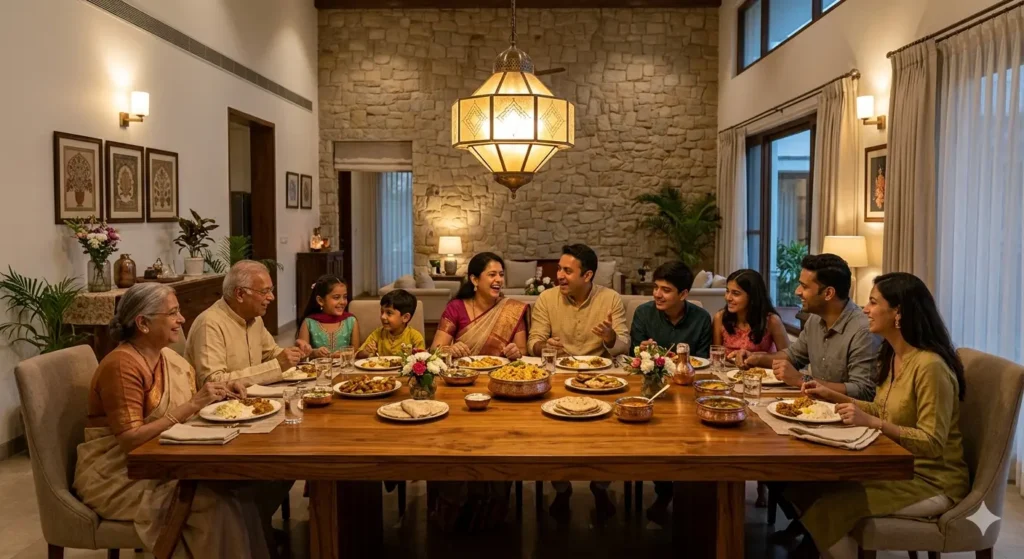
Ramdaspeth families entertain at home in a way that shapes how living spaces need to be designed. This is not merely a style observation — it’s a functional brief. The dining table needs to seat the number of people who actually gather here, not the minimum that fits the floor plan. The seating in the living room needs to accommodate the gathering that happens when extended family visits, not just the daily household.
Built-in seating — a continuous upholstered bench along one wall, or a window seat that serves as overflow seating for gatherings — provides for larger numbers without requiring additional freestanding chairs that crowd the room on ordinary days. This is design that anticipates the actual social life of the family rather than design that looks good in a photograph of an empty room.
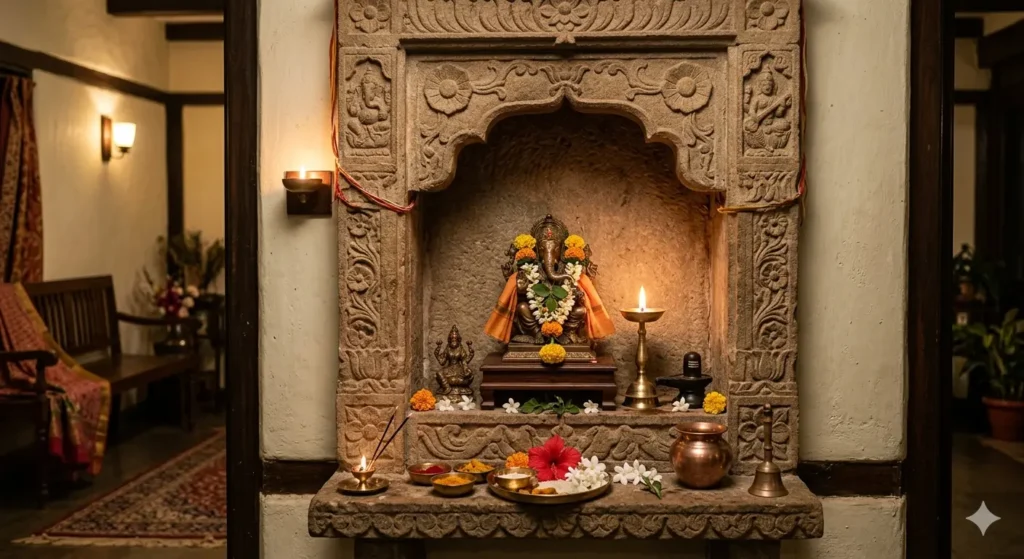
The pooja space deserves particular mention here, because in Ramdaspeth homes — as in most traditional Nagpur family homes — it is a space the family cares about genuinely, not a decorative gesture. A proper pooja alcove or dedicated room with appropriate marble or stone for the platform, warm soft lighting rather than the harsh overhead fixture that so often ends up in religious spaces, storage for ritual materials that keeps the space ordered without feeling clinical — this is a design element that the right interior designer takes as seriously as the kitchen.
The living room focal wall in a Ramdaspeth home needs to match the neighbourhood’s standard. A full-height treatment in fluted wood veneer or a combination of cladding and integrated open shelving — books, objects, the family’s accumulated things — creates the architectural weight that a room designed for serious hospitality needs. The wall should communicate something about the family when guests see it. It usually does, whether or not the family has designed it intentionally.
The Rooms That Often Get Less Attention Than They Deserve
In the focus on the kitchen and the master bedroom — the two rooms that tend to dominate interior design conversations — a few spaces in Ramdaspeth homes tend to get underdesigned relative to their importance.
The dining room, or dining area, is one. In a neighbourhood where families eat together regularly and meals are genuinely social occasions rather than functional refuelling stops, the dining space matters. The table size, the chair comfort for extended sitting, the lighting quality over the table — a pendant hung at the correct height creating a warm focused light over the dining surface without glaring at the people seated around it — all of these contribute to whether meals feel like an occasion or just a routine.
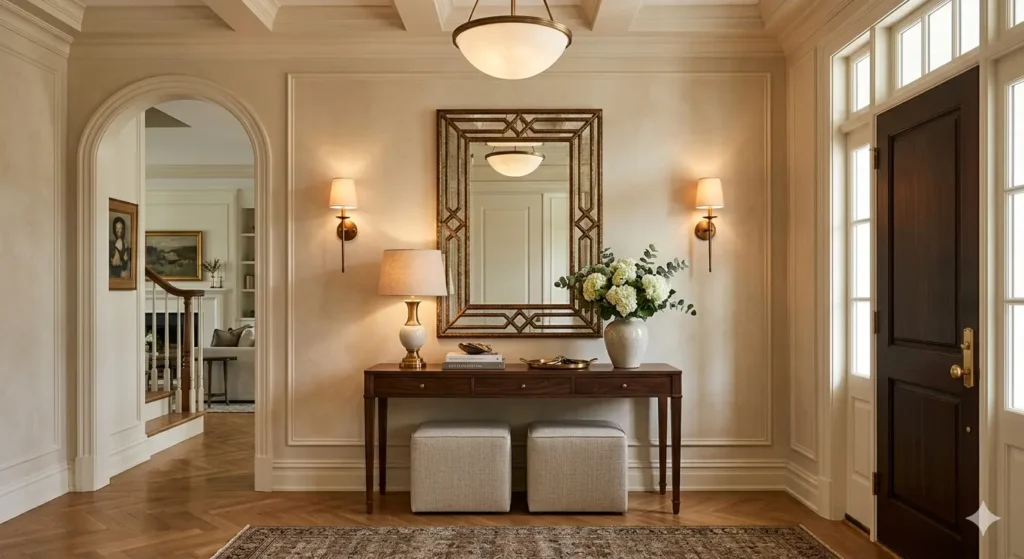
The entry foyer is another. In older Ramdaspeth homes with proper entry spaces — not just a corridor that opens immediately into the living room, but an actual anteroom or entrance hall — the design of this space sets the register for the entire home. What people see and feel the moment they cross the threshold communicates the quality of everything that follows, before they’ve seen any of it.
A console table, a considered mirror, warm lighting from a wall fixture rather than overhead glare, and a deliberate flooring choice — these are modest investments in the entry space that disproportionately affect the impression the home makes.
Bathrooms: The Space That Tells the Truth About a Home
Older Ramdaspeth homes have bathrooms that were built to the standards of their era, which means small-format tiles in patterns that date them immediately, wall tiles to waist height with painted plaster above, fittings that have had a long life and are showing it, and storage that has never been quite enough and is less so now.
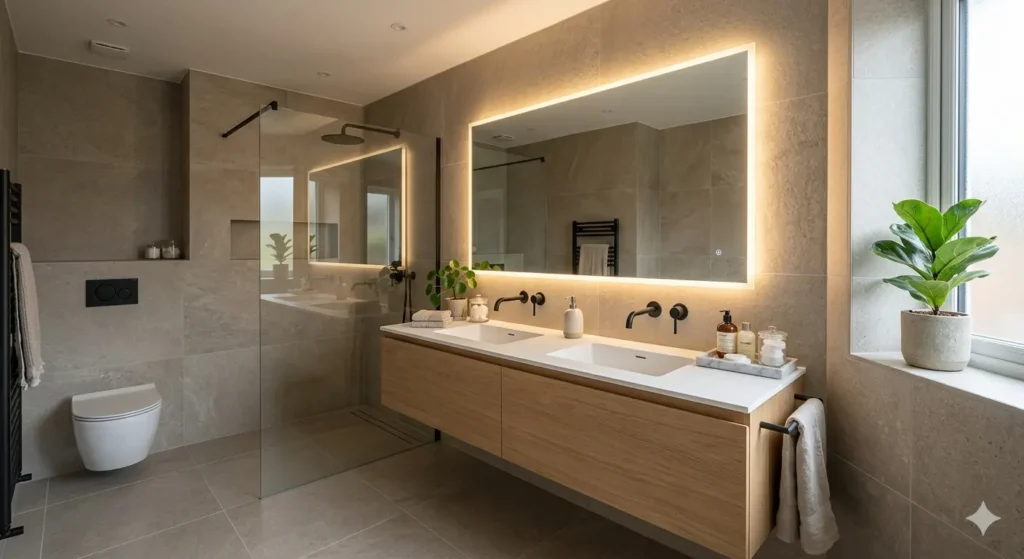
The bathroom renovation in a Ramdaspeth home is an investment that repays itself every day in the simple satisfaction of using a space that works properly and looks like it belongs to the rest of the home’s quality. Large-format tiles in warm neutral tones — 600×1200 or larger, laid with minimal grout lines — make the space feel clean and generous. A wall-hung WC and basin free the floor and make cleaning straightforward. A proper shower enclosure with a quality thermostatic fitting. Vanity storage designed for the actual contents of the bathroom, not the generic assumption of what a bathroom contains.
Mirror lighting is a detail that most bathroom renovations in Nagpur underinvest in. A backlit mirror with even perimeter illumination, or wall-mounted lights flanking the mirror at face height, creates a lighting quality that is both functionally correct for grooming and atmospherically appropriate for a well-designed bathroom. Overhead downlights alone — the standard — do neither well.
Bathroom renovation at mid-range specification: ₹1.6 to ₹3.5 lakhs per bathroom. Premium specification with quality imported fittings, custom vanity design, and proper mirror lighting: ₹3.5 to ₹6 lakhs.
Complete Investment for a Ramdaspeth Interior
3BHK apartment in a Ramdaspeth complex, mid-range specification, full interior fit-out: ₹14 to ₹22 lakhs.
Older Ramdaspeth independent house, comprehensive renovation at premium specification — all principal rooms, kitchen, bathrooms, flooring in main areas, electrical and lighting, painting throughout: ₹42 to ₹80 lakhs depending on size.
Newer Ramdaspeth apartment at premium specification — engineered wood or stone flooring in principal areas, architectural lighting, premium kitchen, full bathroom renovation: ₹26 to ₹45 lakhs.
A Last Thought
Ramdaspeth homes carry something that’s harder to quantify than square footage or property price. They carry the evidence of lives that have been lived in them seriously — families that have eaten and argued and celebrated and grown in these rooms. The designer’s job, in a neighbourhood like this, is to bring the home forward without erasing what makes it worth living in.
That’s the kind of work QC Interiors does. Book your free consultation, and let’s talk about your home.
Transform your home with premium Luxury Interiors in Seminary Hills Nagpur designed for elegance and modern living.
