
Top Home Architects in Ghatanji — What Families Here Need to Know Before Building Anything
Ghatanji doesn’t make headlines. It sits in the southern part of Yavatmal district, a town that the district’s larger narratives tend to pass over quickly. But anyone who has spent real time here knows what it actually is — a town with a functioning commercial life, strong community bonds, and families who take the business of building homes with the same seriousness they bring to every other significant decision. The agricultural economy of this part of Vidarbha moves in cycles, and when the cycles are good, the money finds its way into construction. When families here build, they build with intention.
That intention deserves a design process that matches it. And in too many cases in Ghatanji, it doesn’t get one. What it gets instead is a contractor with a set of drawings that have worked twenty times before, a draftsman who knows how to fill a plot efficiently, and an approval process that produces a signed document without producing a designed home. The house that results is solid enough. It keeps the rain out. The rooms are where rooms are supposed to be. But it was never thought through — never subjected to the kind of spatial intelligence that turns a building into a home that serves the specific family living in it.
This article is for the families in Ghatanji who sense that there should be more to the process than this, and who want to know what the right kind of architectural engagement actually looks like.
Top Home Architects in Ghatanji
Why Ghatanji’s Climate Has to Come First
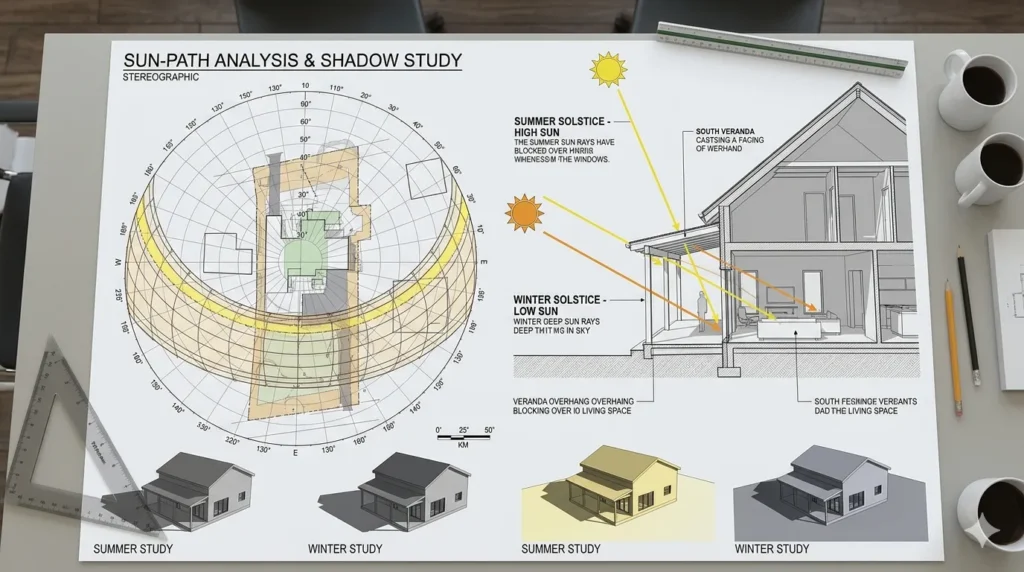
Architecture in Ghatanji begins with climate or it begins wrong. The summers in this part of Yavatmal district are among the most severe in Maharashtra — temperatures that push past 44 and sometimes 45 degrees through April and May, a sun angle in the late afternoon that drives heat into west-facing rooms with an intensity that makes them almost uninhabitable without mechanical cooling, a roof surface in direct summer sun that becomes a heat radiator pressing down on the rooms below it.
These are not background conditions to be managed after the home is designed. They are the primary design conditions — the constraints that a skilled architect builds the entire spatial organisation of the building around. Which direction do the main living rooms face? Where do the windows go, and how large are they? How deep is the roof overhang, and is it calculated to shade the walls and glass below it from the high summer sun while still allowing the lower winter sun to enter and warm the rooms? How is the roof itself designed — sloped for ventilation and waterproofing, or flat in the way that saves money at construction but costs comfort for every summer of the building’s life?
A contractor-led design process answers none of these questions deliberately. A qualified architect in Ghatanji answers all of them, because they understand that a home’s comfort is structural — it is built into the building at the design stage — and cannot be retrofitted after the fact with enough air conditioning.
The monsoon also demands attention. Ghatanji receives significant rainfall through the June to September period, and a building without proper roof pitch, adequate overhangs, good drainage provision, and quality waterproofing at vulnerable junctions will develop problems that reveal themselves in the first monsoon season and compound thereafter. These are not expensive problems to prevent. They are expensive problems to fix.
The Veranda — Non-Negotiable in Ghatanji
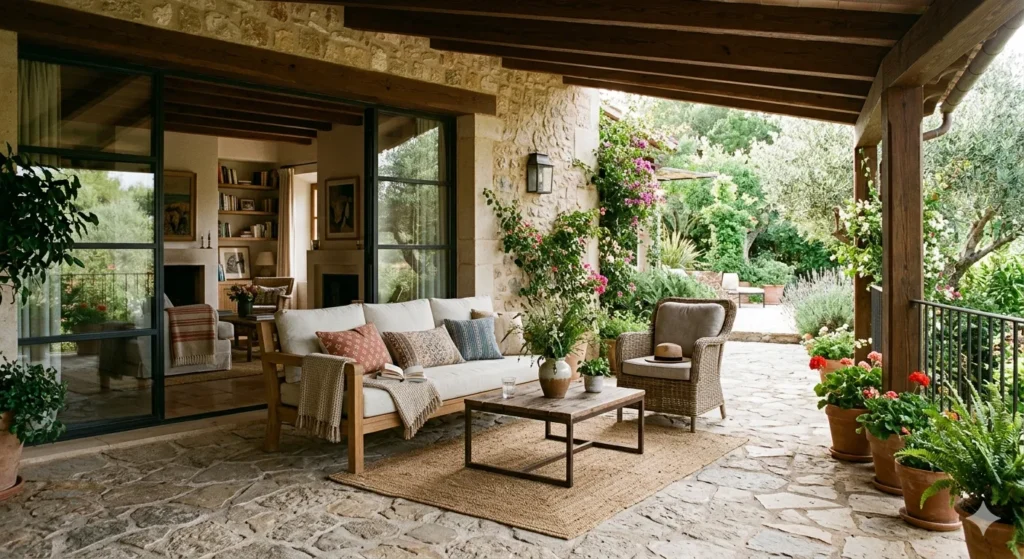
If there is one design element that separates a home that works in Ghatanji’s climate and culture from one that merely exists in it, the veranda is that element. A covered outdoor space running along the appropriate face of the house — typically south-facing, or east-facing where the plot orientation demands it — does more for the daily livability of a Ghatanji home than almost any other single design decision.
In the summer, the veranda shades the walls and windows behind it from direct sun. The physics of this are straightforward: a roof overhang that projects far enough to block the high summer sun angle from striking the glass reduces the heat entering those rooms dramatically. The rooms behind a properly designed veranda are measurably cooler than those without one.
In the months from September through March — the months when Ghatanji’s climate is at its most pleasant — the veranda is the most-used space in the house. It is where the evening gathering happens, where the morning unfolds, where guests sit informally and family members congregate. It is the transitional space that every piece of Vidarbha’s vernacular domestic architecture understood intuitively: the space between the public world outside and the private world within, where the two overlap in a way that is specific to this climate and this culture.
An architect who includes a proper veranda in a Ghatanji home design is not adding a luxury. They are including the single most functional outdoor space the building can have.
How to Evaluate and Choose an Architect in Ghatanji
The pool of architects working in Ghatanji is smaller than in the district headquarters, which means the evaluation process is both more limited and more important. You cannot simply pick from a large competitive field. You need to assess carefully what is available.
Start with Council of Architecture registration. In Maharashtra, any architect signing drawings for municipal submission must be COA-registered. This is a legal requirement, not an optional credential. Ask for the registration number and verify it on the COA website. This takes five minutes.
After that, visit completed projects. Not photographs — actual buildings. Walk through a home the architect has designed and pay attention to the things photographs don’t show. How does the light enter the main living room? Does the kitchen layout make sense for the way cooking actually happens in a Vidarbha household — the large vessels, the extended cooking sessions, the multiple people often working simultaneously? Does the entry sequence feel welcoming, or does it feel like a door in a wall? Do the bedrooms have the quality of quiet and privacy they need?
Ask specifically about the design process. How does the architect begin a new residential project? If the first thing they describe is drawing the floor plan, something is missing. The first thing should be understanding the family — who lives in the house, how they use the different spaces, what the specific needs and aspirations of this household are. Design that begins with the family produces homes that serve families well. Design that begins with the floor plan produces standard houses.
Ask about their knowledge of Ghatanji’s local approval process and the Nagar Panchayat’s documentation requirements. An architect who knows this process well moves through it efficiently. One who is learning it on your project creates delays.
What Architecture Costs in Ghatanji
Construction in Ghatanji in 2025-26 ranges from approximately ₹1,800 to ₹2,500 per square foot depending on specification. Architectural fees run five to nine percent of construction cost. For a 2,200 square foot home at ₹2,000 per square foot — ₹44 lakhs construction — the architectural fee is approximately ₹2.2 to ₹4 lakhs. This is a modest fraction of the total investment, and it is the fraction that determines whether the larger investment is spent well or merely spent.
FAQs
Q1. Is a licensed architect legally required for home construction in Ghatanji?
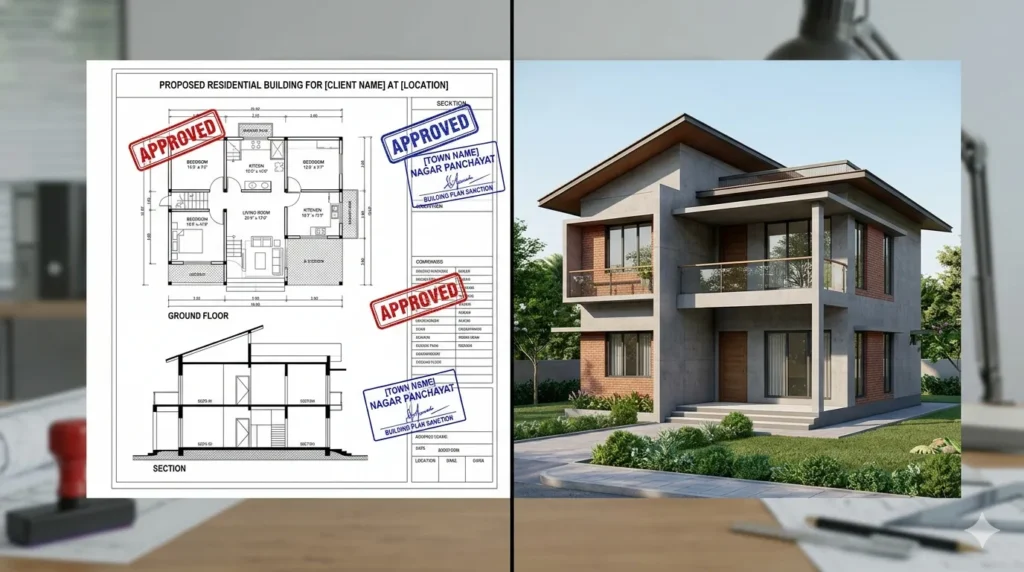
Yes. Maharashtra’s building regulations require COA-registered architect-signed drawings for plan sanction at the local body. Proceeding without approved plans creates complications for property registration and resale that affect the family’s relationship with the asset for years.
Q2. Can I bring my own layout ideas to an architect in Ghatanji and have them work from those?
Yes, and many families approach it this way. A good architect will engage critically with your ideas — pointing out where they create problems you may not have anticipated, suggesting alternatives, and improving the layout based on their spatial design experience. The conversation between a family’s functional brief and an architect’s spatial intelligence is where the best residential designs come from.
Q3. Should I hire a Ghatanji-based architect or consider someone from Yavatmal?
Both can work. A local architect has the advantage of knowing the site conditions, the approval process, and the local contractor ecosystem intimately. An architect from Yavatmal or Nagpur may bring a wider range of design experience. The decisive factor is proven design quality — visit completed projects regardless of where the architect is based.
Q4. How do I know if an architect genuinely understands Ghatanji’s climate requirements?
Ask them specifically about roof design, veranda orientation, and window placement for this climate. A designer with real local knowledge will have immediate, specific answers. One working from a generic template will give generic answers.
Built Strong. Designed Smart.
In Ghatanji, building a home goes beyond construction; it’s about crafting a space that performs wonderfully under extreme heat and heavy monsoons, while making you feel at ease for the long haul.
QC Interiors brings together a perfect mix of smart planner, sturdy structure and organized modern design with solid local know-how. Every measure is taken to ensure your home stands strong, looks polished and serves your family for many happy years.
Why settle? Build with clarity, build great, build well.
QC Interiors
Serving: Ghatanji, Yavatmal
Qualification: Interior Design | Architectual Planing | Turnkey Renovation
📞 +91 7798153303
Book your appointment now, and experience your house in realistic 3D walkthrough—before construction.
