
Interior Design for Row Houses in Nagpur. The row house occupies a quietly preferred position in Nagpur’s residential landscape. Not the compactness of an apartment, with its shared walls on four sides and its borrowed air and borrowed light. Not the full independence of a standalone bungalow, with its compound on all sides and its maintenance demands. The row house sits between these two — sharing one or two party walls with neighbours, but owning the ground from the front compound to the rear court, with a staircase inside and a bedroom upstairs and a porch that faces the street. It is a house. A proper one. And it deserves to be designed as one.
Row houses in Nagpur appear in several different residential formats. The older row house colonies — particularly in areas like Dharampeth, Civil Lines, and the planned residential sectors developed in the 1970s and 1980s — have a particular architectural character: solid construction, generous room sizes by contemporary standards, and a spatial logic that reflects how Nagpur families lived in an era when the home was the primary social world. The newer row house developments — the gated row house communities that have appeared in areas like Besa, Manas Nagar, Wanadongri, and along the Wardha Road corridor — have a more contemporary architectural shell but often require the same interior design process: taking a well-constructed but plainly delivered home and transforming it into something that reflects the family who lives in it.
Interior Design for Row Houses in Nagpur
Starting with What You Have
A row house in Nagpur, regardless of its age or location, brings certain consistent characteristics to the design brief.
The ground floor is the social floor: the entrance, the living room, the dining area, and the kitchen. In older row houses, these may be distinct rooms separated by walls. In newer ones, they are increasingly open-plan or semi-open, with a visual connection between living and dining that the kitchen serves from one side. Either configuration can produce a well-designed home. The open plan requires careful acoustic and visual zoning through ceiling design, lighting, and material changes rather than walls. The traditional room layout simply needs each room designed well and the connections between them considered.
The upper floor is the private floor: the bedrooms, the bathrooms, the dressing areas. In a typical Nagpur row house, there are two or three bedrooms upstairs and the master bedroom’s bathroom. The staircase connects the two floors and is — as in a duplex — an architectural element that deserves design attention, not just functional treatment.
The front and back are the outdoor connections: the front porch or veranda that faces the street and receives guests, and the rear courtyard or utility area that handles washing, storage, and the informal daily life of the household. Both should be included in the design brief.
The Front Elevation: The Home’s Face to the World
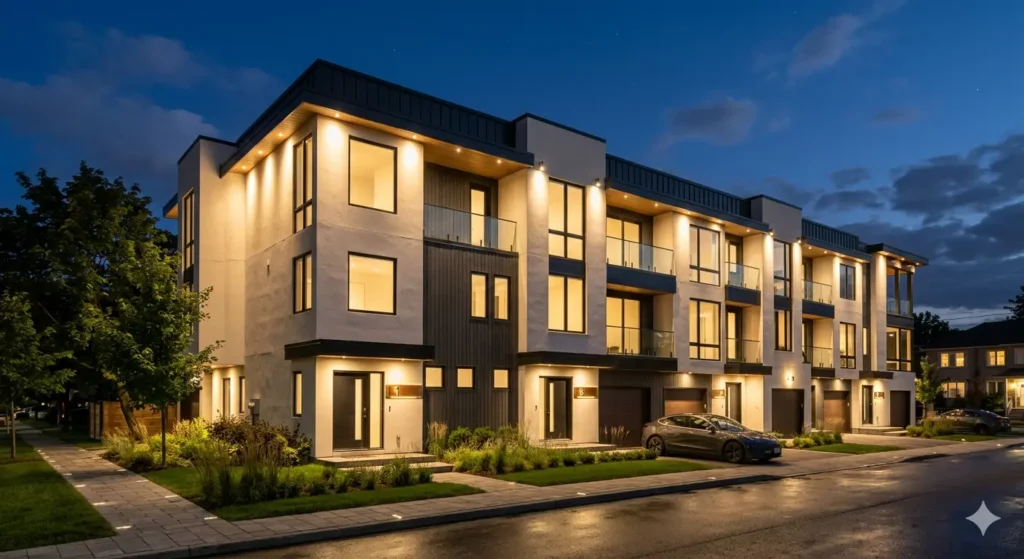
The row house façade — the elevation visible from the street — is the design element that most immediately communicates the care and character of the home. In a row of similar houses, the one that has been designed thoughtfully announces itself: in the quality of the surface treatment, the detail of the porch, the planting in the compound, the lighting that illuminates the front elevation in the evening.
For an older Nagpur row house, the facade renovation might involve re-plastering the exterior surface with a textured finish, painting in a considered colour that responds to both the house’s architecture and the surrounding street character, replacing a standard compound gate with one whose design is in proportion with the house, and adding LED wall-wash lighting on the front elevation for evening character.
For a newer row house in a gated community, the scope for facade differentiation is usually constrained by the community’s design guidelines. Within these constraints, the investment in quality compound planting, a well-detailed porch light, and high-quality ironwork on the compound gate makes a significant difference to the home’s street character.
Cost for a row house front elevation treatment: ₹60,000 to ₹2.5 lakhs depending on the scope of work and the materials specified.
The Ground Floor: Social Living Designed for Nagpur
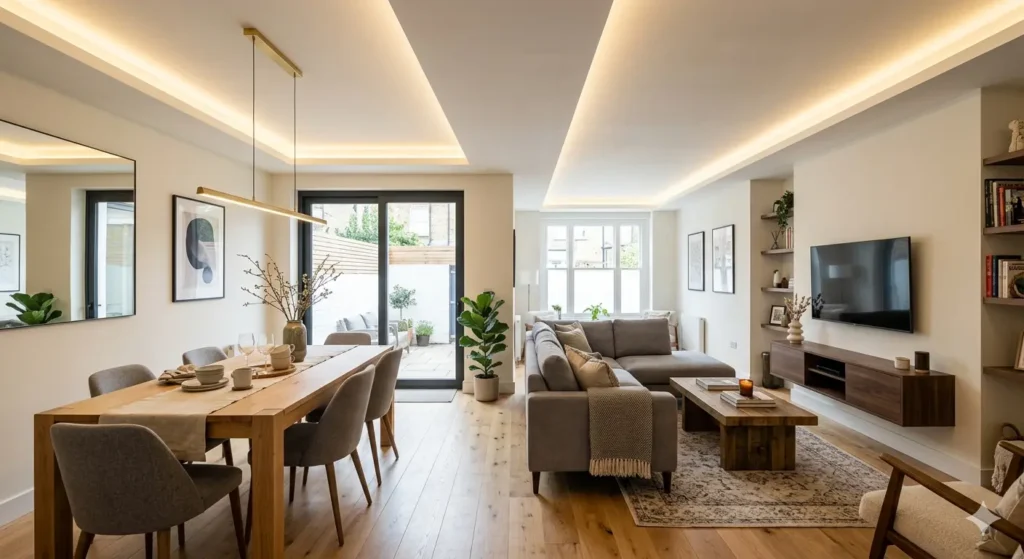
The ground-floor living and dining area of a Nagpur row house should be designed as a single connected social space, even when the rooms are physically separated by walls. The visual connections, the flooring continuity, the ceiling design, and the palette should create a sense of flow that makes the ground floor feel spacious and considered.
The false ceiling is the most important single intervention in the ground-floor living area. In a row house with a ceiling height of 10 to 11 feet — the typical height in most Nagpur row houses, both old and new — a gypsum false ceiling with a perimeter cove LED channel and positioned recessed downlights transforms the room from a plain builder-delivered space into a properly designed one. The warm light of the cove in the evening is the quality that families consistently describe as the most important change the renovation made to their daily experience of the home. Cost for a drawing room false ceiling with cove and downlights: ₹68,000 to ₹92,000.
The kitchen in a Nagpur row house is typically larger than an apartment kitchen — 100 to 160 square feet — with a layout that may be straight, L-shaped, or U-shaped depending on the room’s dimensions. The design priorities are the same as for any serious Indian cooking kitchen: organised storage, adequate counter space, a chimney ducted to the outside, and proper task lighting. But the greater footprint of a row house kitchen allows for a more complete solution — a full set of overhead units, a proper pantry pull-out, and in some layouts, a small island or breakfast counter that creates the informal family gathering point that Indian households naturally use the kitchen for.
Complete modular kitchen for a Nagpur row house: ₹2.2 to ₹4 lakhs at mid-range specification. At premium specification: ₹4 to ₹7 lakhs.
The Staircase: Connection and Character
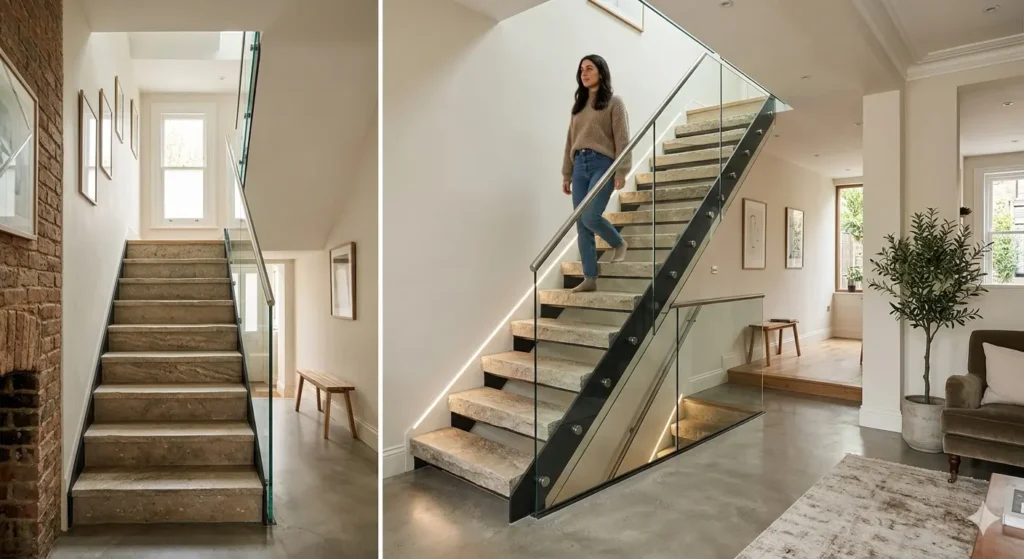
The internal staircase in a Nagpur row house is the vertical connection between the home’s public ground floor and its private upper floor. In most builder-delivered row houses, it is a plain reinforced concrete stair with a simple iron railing — functional but absent of character.
The renovation of the staircase — tread cladding in natural stone or a quality porcelain, a contemporary railing in glass and stainless steel or wrought iron, and a feature wall treatment alongside the stair run — is the investment that most clearly transforms the row house from a delivered unit into a designed home. The staircase is seen and used multiple times per day, by every member of the family. Its quality reads directly as the quality of the home.
Cost for staircase renovation in a Nagpur row house: ₹80,000 to ₹2.2 lakhs depending on the stair’s dimensions and the materials chosen for treads, railing, and feature wall.
Upper Floor: Bedrooms That Support Private Life
The bedrooms in a Nagpur row house upper floor have, in most configurations, a slightly larger footprint than apartment bedrooms and the added advantage of windows on more than one wall — natural cross-ventilation that most apartment bedrooms do not have.
The master bedroom design in a row house should include proper dressing provision — a dressing table area or, if the room’s dimensions allow, a dedicated dressing alcove with fitted wardrobes on both sides. The layout of the furniture, the position of the bed relative to the windows and the AC, and the ceiling design all contribute to a master bedroom that is genuinely restful and private.
Full-height wardrobes for a row house master bedroom and second bedroom: ₹65,000 to ₹1.2 lakhs depending on the room dimensions and the specification.
Bedroom false ceilings with cove and positioned downlights: ₹22,000 to ₹38,000 per room.
The Rear Court and Outdoor Utility
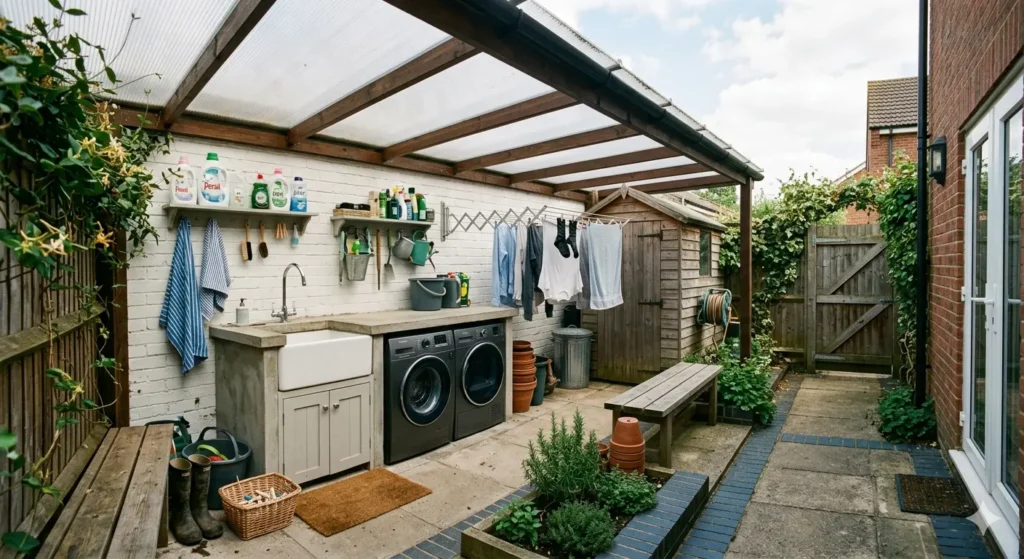
The rear courtyard of a Nagpur row house — typically a small area of 80 to 150 square feet accessible from the kitchen or a rear door — serves as the utility zone: washing machine, drying area, outdoor storage. Its design brief is practical rather than aesthetic, but getting it right — a proper wall-mounted drying rack, a utility sink at the correct height, a tap connection for the washing machine, a covered roof or shade element over the washing area so it functions during the monsoon — makes a meaningful difference to the daily utility of the home.
Complete Row House Interior Design Packages
Essential Package for a typical Nagpur row house (2 or 3 bedrooms, ground plus one): modular kitchen, wardrobes in all bedrooms, drawing room false ceiling with cove and downlights, complete painting with putty and premium emulsion, staircase tread cladding and railing upgrade. Total: ₹10 to ₹16 lakhs.
Comfortable Package: Essential scope plus one bathroom fully renovated, TV wall, upgraded kitchen specification, bedroom ceilings. Total: ₹16 to ₹24 lakhs. Plan your budget smartly by understanding the Bathroom Renovation Cost in Nagpur before starting your project.
Premium Package: Complete transformation — staircase feature wall, natural stone flooring in living areas, all bathrooms renovated, premium kitchen, architectural lighting design, front elevation treatment. Total: ₹24 to ₹38 lakhs.
Book Your Row House Interior Consultation
QC Interiors has designed interiors for row houses across Nagpur — from older established-colony homes to newer gated community row houses. We understand the specific opportunities this housing type presents and the specific design challenges it involves. Book your free site visit and consultation today.
Transform your space with expert Home Interior Design in Nagpur that combines functionality, comfort, and modern aesthetics.
