
A false ceiling can be one of the most transformative elements in a room or one of the most regrettable. I
have seen false ceilings in ordinary Nagpur flats that gave rooms a sense of architectural richness they had
no right to have given their size or shape. I have also seen ceilings that reduced ceiling height until the
room felt like a basement, created crack problems within two years of installation, and made the AC unit
blow cold air directly at whoever sat on the sofa.
The difference between these outcomes is not money. It is design thinking, material selection, and
execution quality. Here is what you need to know before any contractor shows up with a ceiling plan.
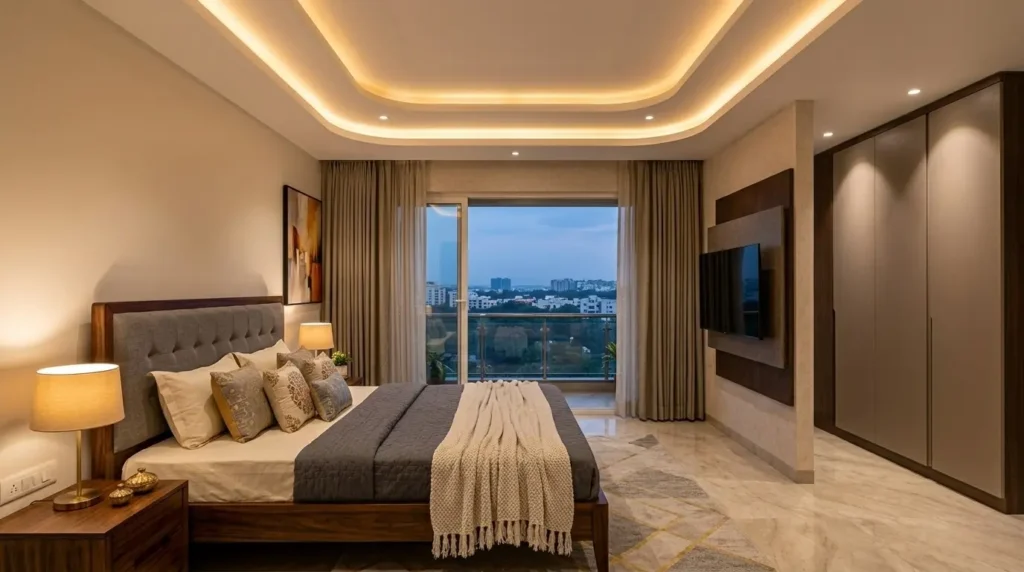
False Ceiling Design in Nagpur: Cost, Types
& Ideas
What False Ceilings Do Well — and Where They Go Wrong
The best uses of a false ceiling ideas are specific. They conceal the structural ceiling’s imperfections and service
elements — electrical conduits, junction boxes, AC ducts — behind a clean surface. They create the
structural support for integrated lighting that a plain ceiling cannot accommodate. And they give a room
architectural definition that changes how the space reads.
A well-executed false ceiling with thoughtful lighting makes a room feel two to three times more
considered than the same room without one. Warm cove light reflecting off the ceiling, a recessed
spotlight over the reading chair, a pendant hanging at the dining table — none of these are achievable
without a false ceiling infrastructure to support them.
Where false ceilings go wrong: they eat ceiling height. Standard Nagpur flats have floor-to-ceiling heights
of 9 to 11 feet. A false ceiling dropped by 10 to 14 inches reduces that to 7 feet 10 inches to 8 feet 4 inches.
In a room with heavy furniture, warm tones, and limited windows this can feel close. In a room that is
already 9 feet and has minimal natural light, a low false ceiling turns a space from manageable into
genuinely uncomfortable.
They can also interfere with ventilation in rooms without AC. And they will develop hairline cracks if the
structural ceiling above them experiences vibration, if the installation was rushed, or if the curing process
for POP was not respected. These are not rare outcomes — they are common ones when cost-cutting
drives the execution.
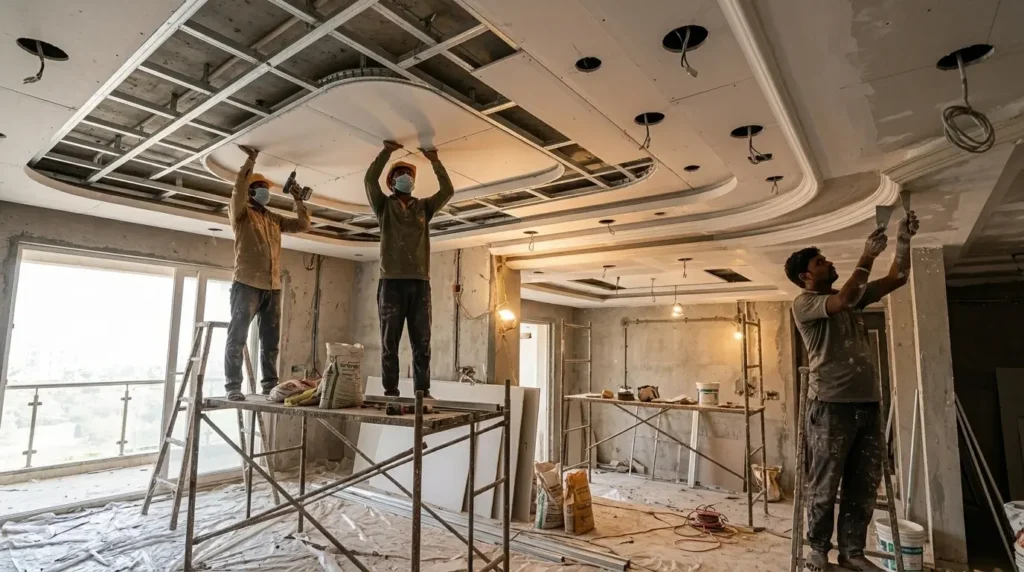
POP vs Gypsum Board: The Honest Comparison
POP (Plaster of Paris) — applied wet by a plasterer and shaped entirely on site. Its great advantage is
design flexibility. A skilled POP worker can create curves, flowing profiles, domes, three-dimensional
cornices, and decorative elements that gypsum board cannot replicate. POP work done by a genuinely
skilled craftsperson has a handmade quality that looks architectural. Its disadvantages: it needs to dry
and cure fully before painting — rushing this is the primary cause of later cracking — it is heavier than
gypsum board, it creates a wetter, messier worksite, and quality is completely dependent on the skill of
the individual plasterer. In Nagpur, a skilled POP artisan commands Rs. 80 to Rs. 120 per square foot
for basic work and significantly more for detailed custom profiles.
Gypsum board — manufactured panels installed on a suspended metal frame. Faster to install, drier
worksite, more predictable results, lighter load on fixing hardware, and less dependent on individual
worker skill. The disadvantage is design rigidity: gypsum board handles flat planes and clean geometric
forms well, but it cannot do the curves and flowing profiles that POP achieves naturally. Cost: Rs. 55 to
Rs. 90 per square foot for basic single-level work in Nagpur.
The Hybrid Approach
What we use at QC Interiors for most Nagpur projects: gypsum board for main ceiling surfaces (for the
speed and predictability) and POP for perimeter profiles, cove edges, and any decorative elements. This
combination captures the structural reliability of gypsum where it matters and the design richness of POP
where it shows.
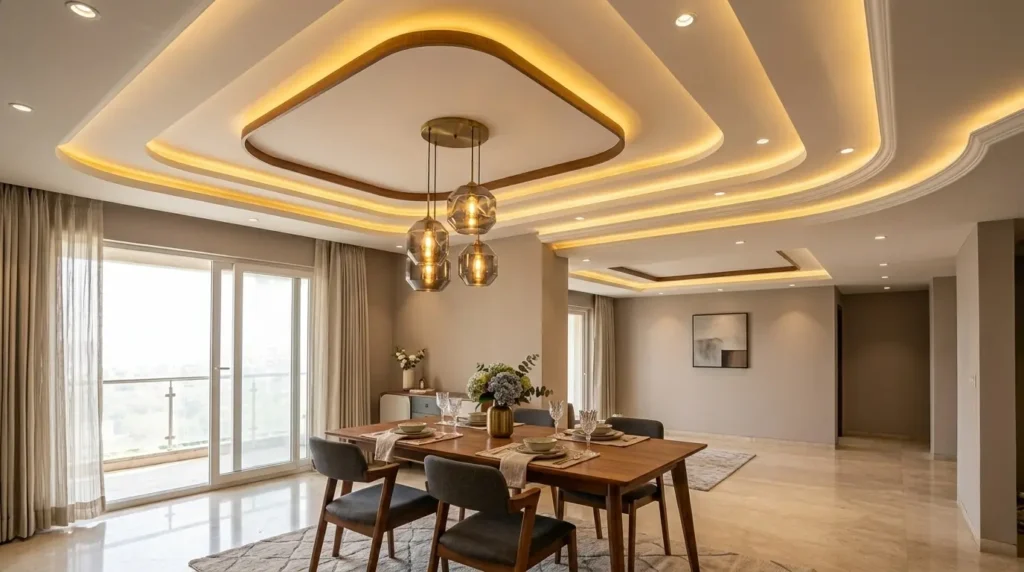
Design Concepts That Work in Nagpur Homes
Perimeter cove with flat centre — the most popular false ceiling design in Nagpur for good reason.
The perimeter drops 6 to 8 inches and conceals LED strip lights that cast warm indirect cove lighting
upward. The central ceiling section stays at full height. The result: a room that feels taller and more
sophisticated, with dramatically better lighting quality than any arrangement of direct overhead lights
can achieve. Suitable for living rooms and bedrooms.
Dining zone pendant drop — in combined living-dining spaces, common in Nagpur 2BHK and 3BHK
flats, a lowered ceiling panel specifically above the dining table creates visual separation between the
two zones without a physical partition wall. A pendant light drops through this panel. The dining area
feels intentional and intimate without requiring the room to be physically divided.
Bedroom cove with task light integration — a shallow perimeter cove in warm LED, plus recessed
spotlights over the wardrobe area and adjustable reading lights at the headboard. This multi-source
approach costs less than people expect and produces a bedroom that functions completely differently
from one with a single overhead light.
Pooja room feature ceiling — a dedicated coffered or dome section in POP above the pooja area, lit
with warm cove or spot lighting, gives the sacred space a visual significance appropriate to its function.
One of the most appreciated design details in the homes we have completed.
Cost Guide for Nagpur
Single-level flat gypsum ceiling: Rs. 55 to Rs. 75 per square foot installed.
Single-level with perimeter LED cove: Rs. 80 to Rs. 110 per square foot.
Multi-level with cove, spotlights, and POP profiles: Rs. 120 to Rs. 180 per square foot.
Custom POP decorative work: Rs. 150 to Rs. 250 per square foot depending on design complexity.
For a standard Nagpur living room of 180 square feet, a properly designed multi-level ceiling with
integrated lighting runs Rs. 18,000 to Rs. 32,000 for the ceiling work alone, before light fixtures. That
investment is visible every evening when you switch the lights on.
At QC Interiors, false ceiling design is one of the elements we put significant care into on every project.
Reach out for a consultation — we are happy to show you what the right ceiling design could do for a
specific room in your home.
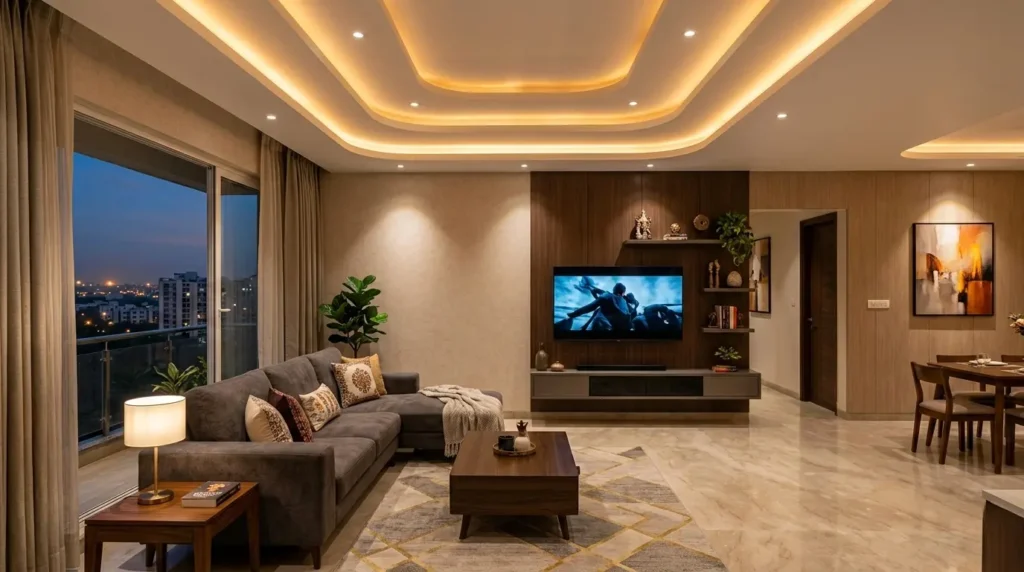
Lighting Temperature: The Detail That Changes Everything
One detail that changes everything and costs nothing extra to get right: the colour temperature of your
LED lights. Most Nagpur homes use whatever strip is included in the false ceiling package. Nobody
checks. And then the living room has cool white cove lighting that looks like a dentist’s waiting room in
the evening when you want to relax. This is entirely avoidable.
For bedrooms and living rooms: 2700K to 3000K. Warm. Orange-tinted. The kind of light that makes a
room feel like home in the evening. For the kitchen and study, where you need to see clearly and make
accurate judgements about colours and text: 4000K to 5000K. Cool. White. Task-appropriate. Using warm
white in a kitchen means you can’t accurately see the colour of what you’re cooking. Using cool white in a
bedroom means the room never feels like you can properly wind down in it.
One consistent temperature per room. Dimmable drivers wherever budget allows — the ability to take
bedroom lighting from 100% down to 20% in the evening costs roughly Rs. 800 to Rs. 1,500 extra per
circuit and fundamentally changes how usable the room is as a space that has to serve both daytime
activity and night-time rest.
Maintenance of False Ceilings in Nagpur’s Climate
False ceilings in Nagpur require more attention than in cities with milder climates. Our extreme summer
heat causes thermal expansion in ceiling materials and the structural ceiling above them. The monsoon
brings humidity that — if there is any seepage from the flat above or from the building’s terrace — can
manifest as water stains or bulging in a false ceiling before it is visible anywhere else.
