
Energy Efficient Home Interiors in Nagpur: Design That Genuinely Saves You Money Every Month.
Ask any Nagpur family about their electricity bill in June and you will see a particular expression — somewhere between resignation and pain. A 2BHK flat with two air conditioners running through June generates bills of ₹8,000 to ₹15,000 per month. Some larger homes do worse. This is the predictable cost of living in one of India’s hottest cities without a home that has been designed to resist that heat.
But here is the thing: most of that cost is not inevitable. It is the consequence of a home that was not designed with energy awareness — a home where the materials absorb heat rather than reflect it, where the windows let in solar radiation without any filter, where the lighting still uses technology from thirty years ago, and where the building envelope has no thermal intelligence.
Energy-efficient interior design in Nagpur is not about sacrificing aesthetics or comfort. It is not about turning off the AC and sweating through the summer. It is about making smart design decisions — in materials, lighting, layout, window treatments, and ventilation — that reduce the energy your home needs to be comfortable. The investment in these decisions is front-loaded. The savings come every month, for the lifetime of the home.
This is a comprehensive guide to the energy efficiency interventions available in Nagpur homes, from the most impactful to the most incremental, with realistic figures for both cost and savings.
Energy Efficient Home Interiors in Nagpur
The 3D Design Approach to Energy Efficiency
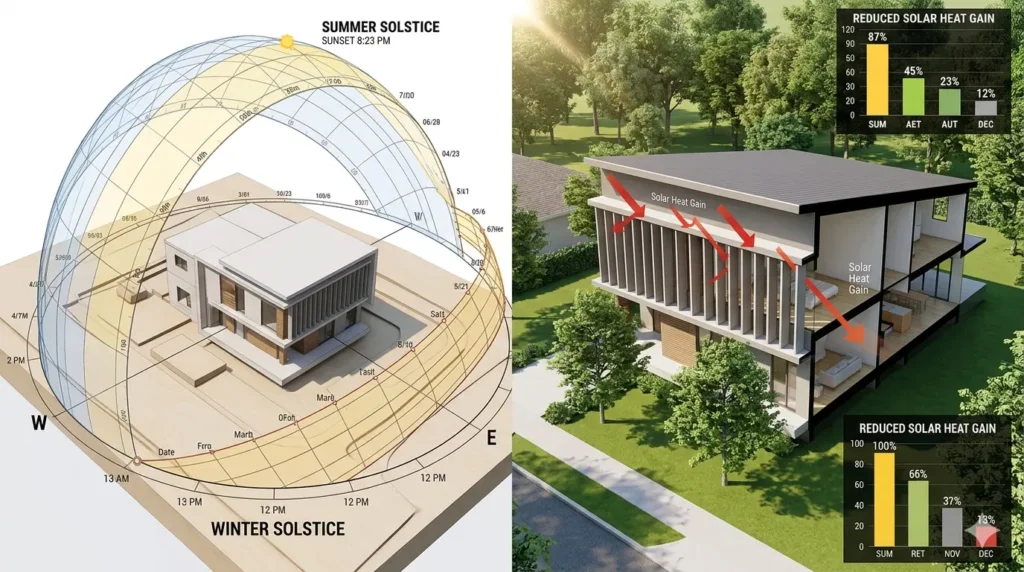
Energy efficiency in interior design is not a list of products to install. It is a design approach that begins with understanding how a specific home interacts with its environment — how the sun moves across it, where the heat enters, how air moves through it, and what the thermal mass of the construction is doing.
At QC Interiors, the energy efficiency assessment begins with the 3D design process. We model the sun orientation of every home we work on — not as an abstract exercise but as a practical tool for making material and layout decisions. A room that faces west in Nagpur needs different window treatments, different colour choices, and different material specifications than a room that faces north. These are not the same room, even if they are the same size. Designing them as if they were the same is the kind of inattention that produces high electricity bills.
The 3D design process allows us to predict where the heat problems will be in a specific home and design the solutions before the renovation begins. This is fundamentally more efficient than discovering the thermal problems after the renovation is complete and trying to address them with afterthought interventions.
LED Lighting: The Fastest, Cheapest, Most Impactful Change
If a Nagpur family has not yet shifted entirely to LED lighting throughout the home, that is the single change with the most straightforward return on investment available. The math is simple and compelling.
LED lights use 70 to 80 percent less electricity than the incandescent and halogen bulbs they replace. They produce far less heat — important in Nagpur, where incandescent and halogen lights add meaningfully to the internal heat load during the months when you are already paying heavily to cool the space. And they last 15,000 to 25,000 hours compared to 1,000 to 2,000 hours for incandescents — meaning replacement costs are dramatically lower over time.
For a typical 3BHK Nagpur home, the shift from mixed incandescent/CFL/halogen lighting to full LED — downlights, lamps, strip lights, and decorative fixtures — typically reduces the lighting contribution to the monthly electricity bill by ₹800 to ₹1,500 per month, depending on the number of fixtures and the hours of use. The upfront cost of replacing all fixtures with quality LEDs is typically ₹15,000 to ₹30,000 for a complete home.
At that cost and that monthly saving, the payback period for a full LED conversion is typically 1 to 2 years. After that, the savings are pure reduction in monthly cost, every month, for the 15 to 20 year lifespan of the LED fixtures. This is the closest thing to a no-brainer investment in home energy efficiency that exists.
False Ceilings and Thermal Insulation: The Design Element That Pays Back
The thermal insulation benefit of a false ceiling has been discussed in other sections of this guide series, but in the context of energy efficiency, it is worth quantifying what that benefit actually means in practical terms.
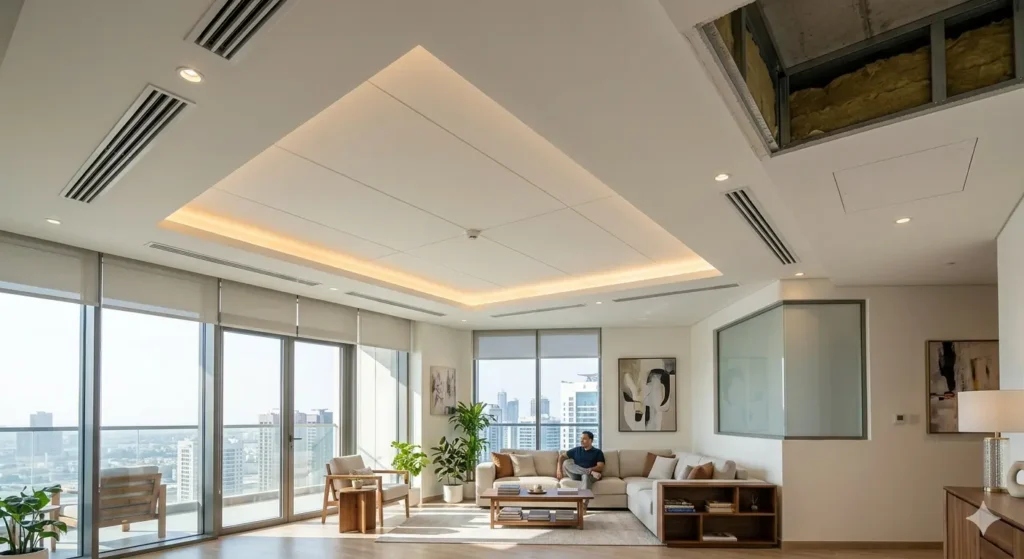
In a top-floor flat in Nagpur without a false ceiling, the hot structural slab overhead conducts heat directly into the living space throughout the peak summer afternoon. The air conditioning system must work against both the internal heat sources and the heat flowing in from the slab above. The result is a system that runs more frequently, at higher capacity, for longer periods.
A gypsum false ceiling with an adequate dead-air gap (12 to 18 inches) between the ceiling and the slab creates a thermal buffer that reduces this conductive heat transfer. The air conditioning system deals with less incoming heat and can achieve the set temperature with shorter run cycles. Independent assessments of before-and-after electricity consumption for top-floor Nagpur homes following false ceiling installation have shown reductions of 15 to 25 percent in AC electricity consumption during peak summer months.
For a family spending ₹12,000 per month on electricity in June, a 20 percent reduction represents a saving of ₹2,400 per month. Over four peak summer months, that is ₹9,600 in savings. The false ceiling investment of ₹80,000 to ₹1.2 lakhs pays back primarily in energy savings within five to seven years — and continues saving thereafter.
Heat-Reflective Exterior Paint: The Thermal Shield Most Families Ignore
The exterior paint on your home’s walls is the first line of defence against solar heat gain. In Nagpur, where exterior wall temperatures on south and west-facing surfaces can reach 50 to 55 degrees Celsius in summer, the difference between a standard exterior emulsion and a quality heat-reflective paint is meaningful.
Heat-reflective exterior paints contain ceramic microspheres or titanium dioxide compounds that reflect a higher proportion of the solar spectrum than standard paint pigments. The result is a wall that stays 5 to 10 degrees Celsius cooler on the exterior surface — which translates into a meaningfully reduced heat flow into the interior of the home.
Major Indian paint manufacturers — Asian Paints, Berger, Nerolac, Kansai Nerolac — all offer heat-reflective exterior ranges. The cost premium over standard exterior emulsion is typically 30 to 50 percent per litre. On a typical Nagpur home exterior (1,500 to 2,500 square feet of paintable area), the additional cost of specifying heat-reflective paint over standard paint is approximately ₹15,000 to ₹30,000. The annual electricity saving from reduced AC load — difficult to isolate precisely but estimated at 5 to 10 percent of summer AC consumption — repays this investment within two to four years.
Smart Fan Usage: The Energy-Efficient Cooling Strategy Most Families Underuse
A ceiling fan uses approximately 70 to 80 watts of electricity. A 1.5-ton air conditioner uses approximately 1,200 to 1,500 watts. The ratio is roughly 1:18 — a ceiling fan uses about 1/18th the electricity of an equivalent cooling air conditioner.
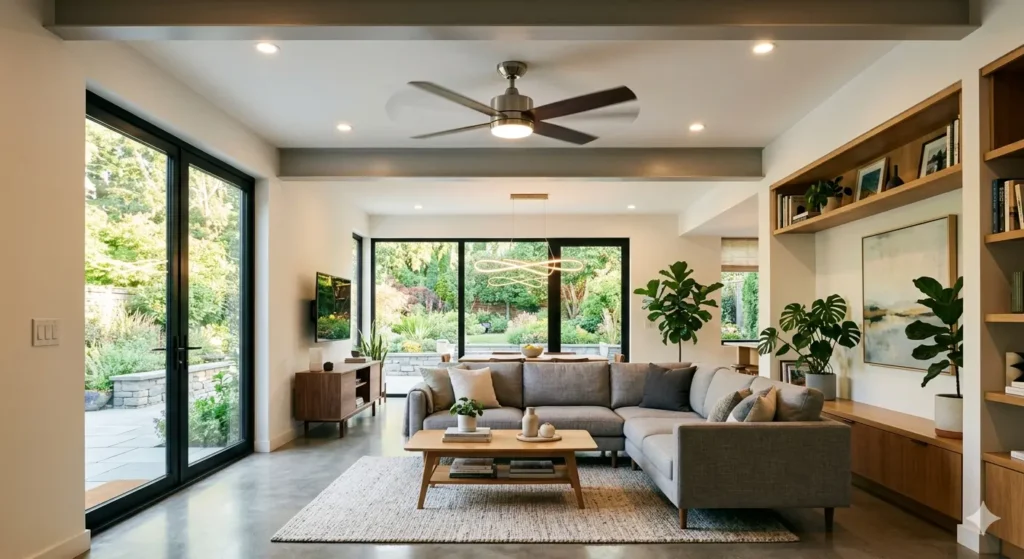
This comparison does not mean that fans replace air conditioning in Nagpur’s peak summer. At 47 degrees Celsius, no fan is going to make a room comfortable without AC. But it does mean that for the many hours during the Nagpur year when temperatures are at 32 to 38 degrees — which includes most of the early morning and evening period, and several months in the transitional seasons — a well-placed ceiling fan can maintain comfort without the AC running at all, or can extend comfort at a higher AC set-point temperature.
The energy-smart approach for Nagpur homes is: use fans aggressively during the morning hours (approximately 5 to 9 AM) when outdoor temperatures are at their lowest, during the transitional seasons (October through November and February through March), and during the post-sunset hours even in summer. Use AC only when the temperature and humidity make fan cooling genuinely insufficient.
For this strategy to work, fan placement matters. A ceiling fan positioned directly above the primary sitting or sleeping zone — not at the geometric centre of the room, which may be different — delivers its cooling effect directly to the people who need it. An undersized fan for a large room, or an oversized fan for a small room, is less effective than a correctly sized fan for the space. We plan fan placement and sizing as part of every QC Interiors design.
Windows, Films, and Curtains: Managing the Solar Load
Windows are responsible for a substantial proportion of unwanted solar heat gain in Nagpur homes — particularly west-facing windows that receive direct afternoon sun. Managing this gain through intelligent window treatment is one of the highest-return interventions available.
UV-filtering window film is the most cost-effective first step. Applied directly to the glass surface, quality window film (from established brands like 3M, Garware, or LLumar) blocks 40 to 60 percent of solar heat gain while maintaining visibility. The film costs approximately ₹80 to ₹150 per square foot installed — for a typical 3BHK with four to six windows, the total investment is ₹20,000 to ₹50,000. The reduction in solar heat gain on treated windows translates to a measurable reduction in AC load in those rooms.
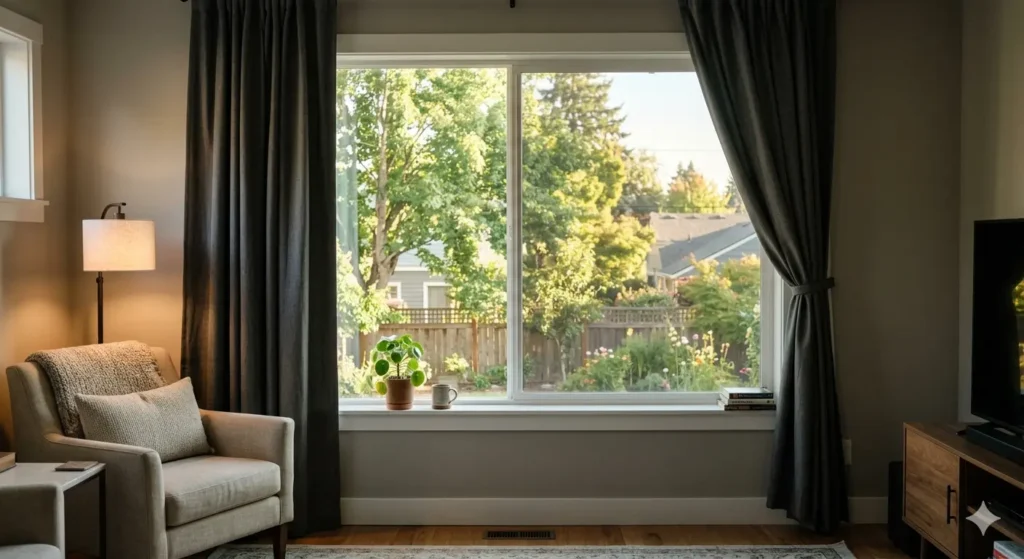
Blockout curtains are the next layer. On west-facing windows in particular, closing a quality blockout curtain during the peak afternoon period (2 PM to 6 PM) reduces solar heat gain by 40 to 50 percent compared to an uncovered window, even with film. The curtain traps the solar radiation in the fabric rather than allowing it to radiate into the room.
For families building or renovating, double-glazed windows — while more expensive than single-glazed alternatives — provide a permanent solution to solar heat gain through the glass. The air gap between the two glass panes acts as thermal insulation. The price premium for double-glazed windows is substantial (roughly three to four times the cost of standard aluminium frame windows), but the energy saving over the lifetime of the windows justifies the investment in a climate like Nagpur’s.
Energy-Rated Appliances: The Choice That Saves Money For Years
When designing modular kitchens and advising on appliance selection for Nagpur homes, we consistently recommend the highest BEE (Bureau of Energy Efficiency) energy rating that the family’s budget allows. The reason is simple arithmetic.
A 5-star rated refrigerator typically uses 30 to 40 percent less electricity than a 2-star rated equivalent in the same capacity category. For a refrigerator running 24 hours a day, 365 days a year — which is how refrigerators work — this is a continuous daily saving. Over five years of ownership, the difference in electricity cost between a 5-star and a 2-star refrigerator in the same category is typically ₹8,000 to ₹15,000. The premium for the 5-star model at purchase is typically ₹5,000 to ₹10,000. The 5-star refrigerator pays for its premium within the first two to three years of ownership and continues saving thereafter.
The same logic applies to air conditioners (where the rating difference is even more significant), washing machines, and water heaters. In Nagpur, where appliances run hard through a demanding climate, the energy rating is not a minor consideration — it is a meaningful financial decision.
Invest Once, Save Every Month for Decades
Energy-efficient design choices are front-loaded investments — they cost more at the point of renovation than the standard alternatives. But they pay back every month for the lifetime of the home, in reduced electricity bills, in a more comfortable living environment that requires less mechanical intervention to be pleasant, and in materials that last longer because they are appropriate for the climate they are in.
A home designed by QC Interiors with energy efficiency as an integrated design brief will cost less to run in the first month after you move in, and continue to cost less every month after that. The cumulative saving over ten years of living in an energy-efficient home versus a standard home in Nagpur’s climate is substantial — often exceeding the additional investment made in energy-efficient design choices.
Book a free consultation to discuss how we can design your Nagpur home to work intelligently from day one.
