
Cross Ventilation Interior Tips for Nagpur: How to Design a Home That Breathes.
Before air conditioning existed, Indian architecture had already solved the problem of surviving intense heat. Walk through the older houses in Civil Lines, Seminary Hills, or any of the established localities in Nagpur and you can see the solutions embedded in the buildings: wide verandahs that shade the walls from direct sun, high ceilings that keep the hottest air up and away from the living level, windows positioned on opposite sides of rooms to allow air to move through rather than stagnate, latticed screens that filter light and create airflow simultaneously.
These were not decorative choices. They were engineering decisions arrived at through centuries of experience with hot Indian summers. And they worked — the older bungalows in Nagpur’s established neighbourhoods stay measurably cooler than contemporary construction of comparable size, even without air conditioning, because they were designed with the intelligence of the climate in mind.
Modern construction has largely abandoned these principles in favour of the assumption that mechanical cooling will handle everything. The result is homes that are entirely dependent on air conditioning for comfort during Nagpur’s six months of heat, with electricity bills that reflect that dependency. Cross-ventilation design is the application of the same principles that made traditional buildings work — updated for contemporary construction and contemporary living. This article is a complete guide to applying those principles in Nagpur homes today.
Cross Ventilation Interior Tips for Nagpur
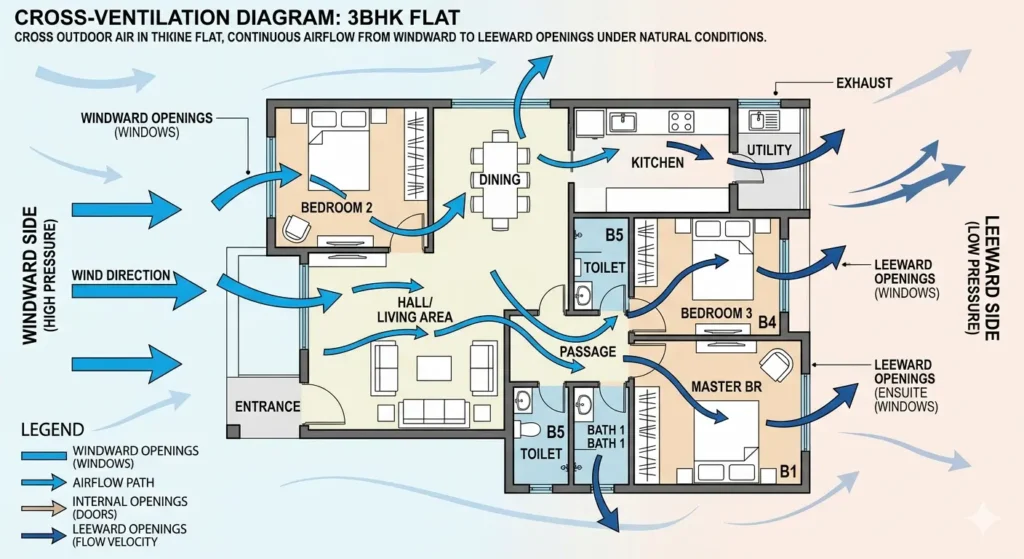
What Cross-Ventilation Actually Means and Why It Matters
Cross-ventilation is simply the movement of air through a space from one opening to another on the opposite or adjacent side of a room or building. The physics is straightforward: hot air is lighter than cool air and rises. As hot air rises and exits through upper openings, cooler air enters from lower openings to replace it. If you create the right arrangement of openings and the right internal spatial configuration, this movement happens continuously and passively — without electricity, without noise, and without cost.
A room with windows or openings on only one side is a thermal trap. Air enters from the single opening, picks up heat from the room, and then has nowhere to go except back out the same opening — often after picking up additional heat from the room surfaces. The room gets progressively warmer through the day.
A room with openings on two or more sides allows air to move through continuously. As the outdoor temperature drops in the evening, the movement of outside air through the room carries warmth out and brings cooler air in. The room cools more quickly than a single-sided room and stays cooler through the night.
In Nagpur, this difference is particularly meaningful. The daily temperature variation — between the peak afternoon temperature and the early morning minimum — is significant: often 10 to 15 degrees Celsius. A home that can take advantage of that cooler period through good ventilation design is genuinely more comfortable and requires significantly less mechanical cooling than one that cannot.
Assessing Your Nagpur Flat’s Ventilation Potential
The starting point for any ventilation improvement in a Nagpur home is an honest assessment of what the existing structure allows. When QC Interiors begins a project, one of the first things we do is map the orientation of the flat and identify the position of all existing windows, doors, exhaust provisions, and ventilation openings.
Nagpur’s prevailing summer winds come primarily from the west and northwest. This means that a flat with its main openings facing west — counterintuitive though it may seem, given the afternoon sun problem from the same direction — can actually capture significant natural breeze during the evenings and early mornings. A flat that has windows only on one side, or that has windows on multiple sides but internal partitions that prevent air from moving between those openings, will perform poorly for natural ventilation regardless of how many windows it has.
The typical builder flat in Nagpur — constructed with a focus on maximising the number of units per floor — often has compromised ventilation by design. The living room may have windows on one side only. The bedrooms may share an internal wall with the kitchen and have no windows on their outer wall. The bathrooms may have no external opening at all. These are structural conditions that can sometimes be improved (by adding ventilation provisions or modifying internal partitions) and sometimes must be managed through other means (exhaust fans, ceiling fan placement, window film to reduce heat gain).
A realistic assessment at the beginning of the design process allows us to identify which ventilation improvements are achievable and which require accepting the structural limitation and compensating through other design means.
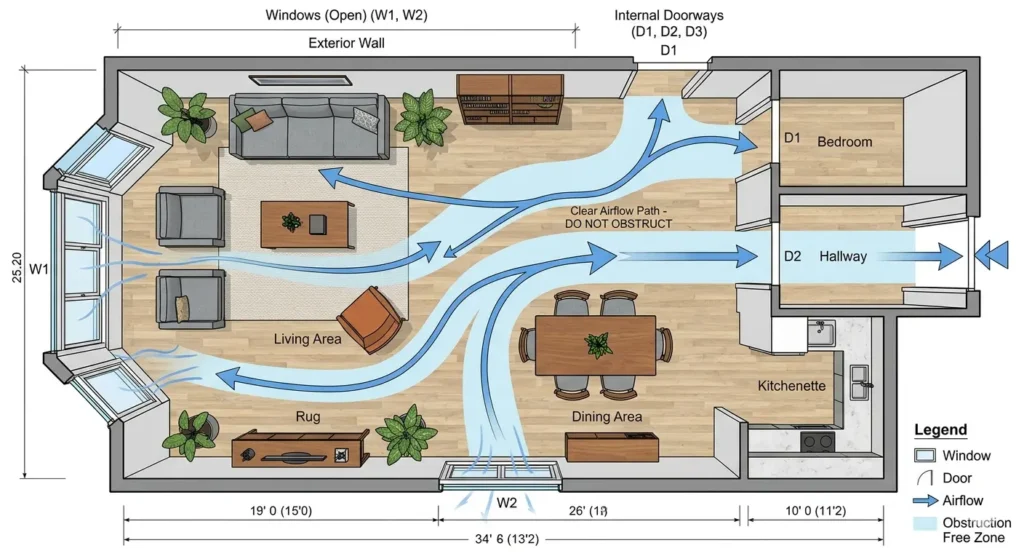
Furniture Layout for Airflow: The Design Decision Nobody Discusses
Even in a flat that cannot be structurally modified — no new windows, no modified partitions — the layout of furniture within the space has a significant effect on how air moves through the home. This is a design consideration that is almost never discussed in standard interior design advice, but it is real and it is actionable.
Consider the living room. If the main sofa is placed directly in front of the primary window — facing the television — it creates a physical obstruction in the path of air entering the room. Air enters from the window, immediately encounters the sofa, and either stagnates behind it or flows around the sides in a less organised pattern. Moving the sofa to a position that keeps the window-to-room airflow path clear — even if this requires a slightly less conventional furniture arrangement — allows air to move more freely through the space.
In the kitchen, a large island or a pantry cabinet placed across the natural airflow path between the exhaust window and the cooking area can prevent cooking heat from moving efficiently toward the exhaust, instead circulating it back into the adjacent rooms. The kitchen layout should be planned with both cooking workflow and heat exhaust in mind — which is exactly the approach we take at QC Interiors.
In bedrooms, the bed placement matters for ventilation as well as for the sleeping orientation. A bed placed perpendicular to the window, with the sleeping area in the path of the window breeze rather than perpendicular to it, gives the occupant direct access to whatever natural airflow is available. Combined with a ceiling fan positioned directly above the sleeping zone (not the centre of the room, which is often different), this layout makes the bedroom as naturally comfortable as the structure allows.
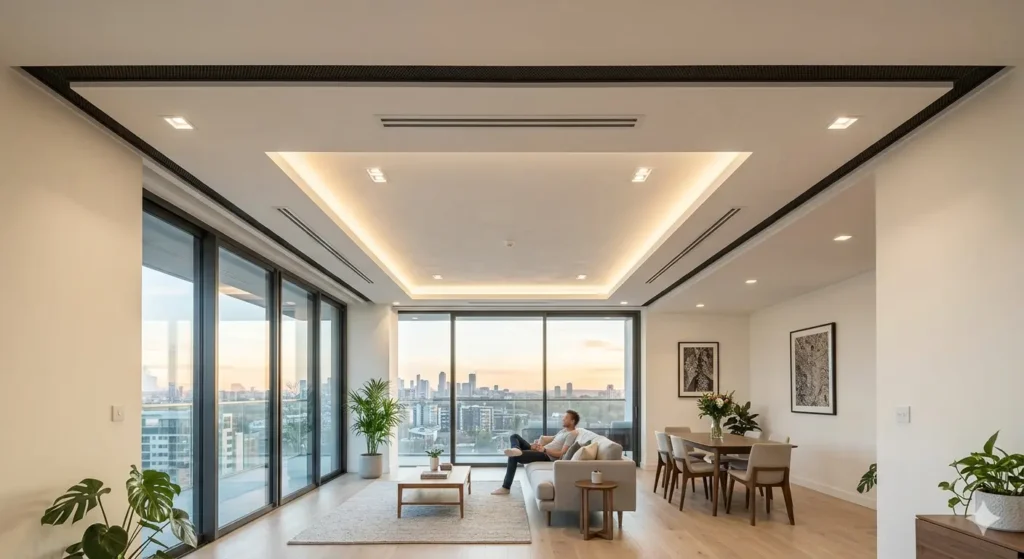
False Ceilings and Ventilation: Getting the Design Right
A poorly planned false ceiling can inadvertently turn a well-ventilated room into a thermal trap. This is a consequence that we work specifically to avoid in every QC Interiors project, and it is worth understanding why it happens.
When a false ceiling is installed completely sealed — no gaps, no provisions for air movement between the lower living space and the dead-air space above the false ceiling — it can prevent hot air from rising out of the living space through the upper part of the room. Hot air rises and looks for an exit. If the false ceiling creates a completely sealed boundary, the hot air accumulates in the upper living space and slowly radiates downward into the occupied zone.
The solution is straightforward but requires deliberate planning: design the false ceiling with ventilation provisions. These can take the form of small perimeter gaps between the ceiling edge and the wall, ventilation registers integrated into the ceiling design, or in top-floor applications, ventilation openings in the wall above the false ceiling level. The goal is to allow the dead-air space between the false ceiling and the structural slab to breathe — so that hot air can circulate within that space and exit rather than stagnating and overheating.
For top-floor flats and independent bungalows in Nagpur — where the roof heat load is most intense — we sometimes incorporate a small continuous gap at the perimeter of the false ceiling that allows hot air to rise naturally into the buffer zone and gradually dissipate through external ventilation provisions. This simple detail makes a measurable difference to the room temperature, particularly during the peak summer months.
Kitchen Ventilation: The Room Where It Matters Most
The kitchen is the largest single source of heat generation within any Nagpur home. Cooking on an open flame or an induction hob generates substantial heat. The refrigerator generates heat from its compressor. Cooking odours, steam, and hot air from the chimney all contribute to making the kitchen the most thermally demanding room in the house.
A kitchen that is poorly ventilated does not just make cooking uncomfortable — it pushes that heat into the adjacent rooms. If the living room is connected to an inadequately ventilated kitchen, the living room temperature will be measurably higher than if the kitchen heat were being efficiently removed. This is one of the reasons well-designed kitchen ventilation has an outsized positive effect on the thermal performance of the whole flat.
A chimney above the cooking range is essential — this is now standard knowledge in Nagpur homes — but it is not sufficient on its own. A chimney removes the cooking fumes and some of the heat directly above the cooking surface, but it does not provide the cross-ventilation that moves the residual cooking heat out of the kitchen volume. For this, a kitchen needs at least one open window or exhaust vent positioned on a wall different from the entry door, allowing air to flow through the kitchen space and carry heat toward an exit.
When we design modular kitchens in Nagpur, the ventilation plan comes before the cabinet layout. Where the exhaust window is determines where we can position certain cabinet configurations. A kitchen designed with the exhaust in mind from the beginning works significantly better thermally than one where the ventilation was an afterthought.
Bathroom Ventilation: Small Space, Big Impact
Bathrooms in Nagpur homes are frequently the worst-ventilated rooms in the building. Many builder flats have bathrooms with no external windows — ventilation is provided entirely by a small exhaust fan that may or may not be functional, placed in a position that may or may not effectively move air through the space.
A poorly ventilated bathroom in Nagpur does two things that affect the rest of the home. First, it stays hot — the enclosed space retains the heat and humidity of showers and bathing, making the bathroom deeply uncomfortable to use through the morning routine. Second, when the bathroom door is opened, the accumulated heat and humidity flows into the adjacent bedroom, raising the temperature and humidity of the sleeping space.
The best situation is a bathroom with an opening window on an external wall — even a small one — that allows genuine cross-ventilation when the exhaust fan is running. Where structural modifications allow, we sometimes add a ventilation panel or a louvered opening to a bathroom wall during renovation. Where this is not possible, a high-quality exhaust fan — one that moves sufficient air volume rather than just making noise — is the practical alternative.
Bathroom exhaust fans should be on a separate switch from the light, so they can run continuously for a period after the bathroom is used rather than being switched off with the light. This extended run-time is important for actually removing the accumulated heat and humidity from the space.
Practical Cross-Ventilation Actions You Can Take Right Now
For families in existing Nagpur flats who cannot undertake structural changes, there are practical actions that immediately improve natural ventilation within the existing structure.
Open windows in adjacent or opposite rooms simultaneously rather than one at a time. Many families open only the window in the room they are using. But for air to move through a space, it needs both an entry and an exit. Opening windows or doors on two sides of the flat simultaneously — even if the rooms are different rooms — creates the pressure differential that drives airflow through the entire flat.
Use ceiling fans to assist natural airflow rather than working against it. A ceiling fan set to the standard direction (counterclockwise when viewed from below) creates a downward airflow that enhances the convective cooling effect. Positioning the fan to draw air from the window side of the room toward the room’s exit increases the effectiveness of whatever natural ventilation is available.
Keep the kitchen exhaust running for a period after cooking is complete, not just while the cooking is happening. The residual heat from the cooking surfaces and from the hot food continues to warm the kitchen space for twenty to thirty minutes after the stove is off. Running the exhaust through this period significantly reduces the heat carried into the adjacent rooms.
In the evenings — from approximately 7 PM onward in Nagpur summer, when outdoor temperatures begin to drop — open windows and doors to take advantage of the cooler outside air. Many families keep their homes sealed and air-conditioned through the evening when the outdoor temperature has already dropped to a comfortable or near-comfortable level. The AC is not needed; the evening breeze is.
Design the Airflow Into Your Next Renovation
If you are planning a renovation — whether full or partial — ventilation design is one of the elements that should be built into the brief from the start. At QC Interiors, we assess the ventilation potential of every home we work on as part of the initial site visit and incorporate ventilation considerations into the 3D design before any other decisions are made.
A Nagpur home that breathes well costs less to keep comfortable, is more comfortable during the hours when the AC is off, and creates a better indoor air quality environment for the family year-round. These are not marginal benefits — they are meaningful quality-of-life improvements that last for the lifetime of the home.
Come in for a free site visit and let us map the ventilation potential of your specific space.
