
Best Residential Architects in Ghatanji — Understanding What Design Professionals Can Do for Your Home Project and How to Work With Them Well
Families in Ghatanji who are building or significantly renovating homes face a version of a universal challenge: how do you find the right professional, understand what they actually do, and work with them in a way that produces the outcome you want? In a larger city, the answer involves navigating a large and well-structured market of professionals. In a town like Ghatanji, it involves a smaller pool, more limited information, and a local professional services ecosystem that requires more careful navigation.
This article addresses that navigation directly. Not with generalities about architecture as a profession, but with specific guidance about what residential architects in Ghatanji and the wider Yavatmal district actually do, what the different types of professionals in this market offer, how to evaluate them, and how to structure a working relationship that gets you the home you’re trying to build.
Best Residential Architects in Ghatanji
The Residential Architect’s Role — Specific and Substantive
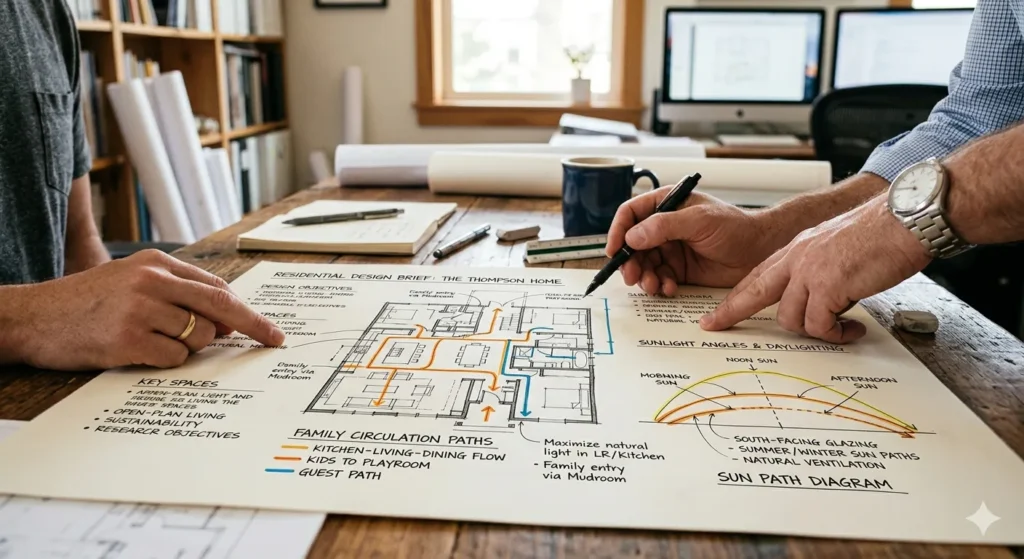
A residential architect in Ghatanji is, at their best, the person who translates your family’s life into a building. This sounds straightforward until you think about what it actually requires.
It requires genuine curiosity about how your family lives — not a quick question about bedroom count, but a real understanding of the household. How many people, what ages, what generational structure? Is there an elderly parent who needs a specific kind of ground-floor accommodation? Is there a home-based business that receives clients or stores materials? How significant is the puja space — is it a corner niche or a room of its own? Does the family cook in large vessels for frequent festival occasions? Does the household receive guests formally or informally, and does it need spaces designed for both? The answers to these questions are the raw material of the design brief.
It also requires genuine expertise in spatial thinking — the ability to translate that brief into a building organisation that serves the family’s life well. Not just room count and size, but the relationships between rooms, the quality of natural light in each space, the entry sequence, the relationship between indoor and outdoor spaces, the orientation of the building for climate performance. These are not decorative considerations. They are functional ones that affect the quality of daily life for the entire period of occupation.
The Difference Between an Architect and a Draftsman in Ghatanji
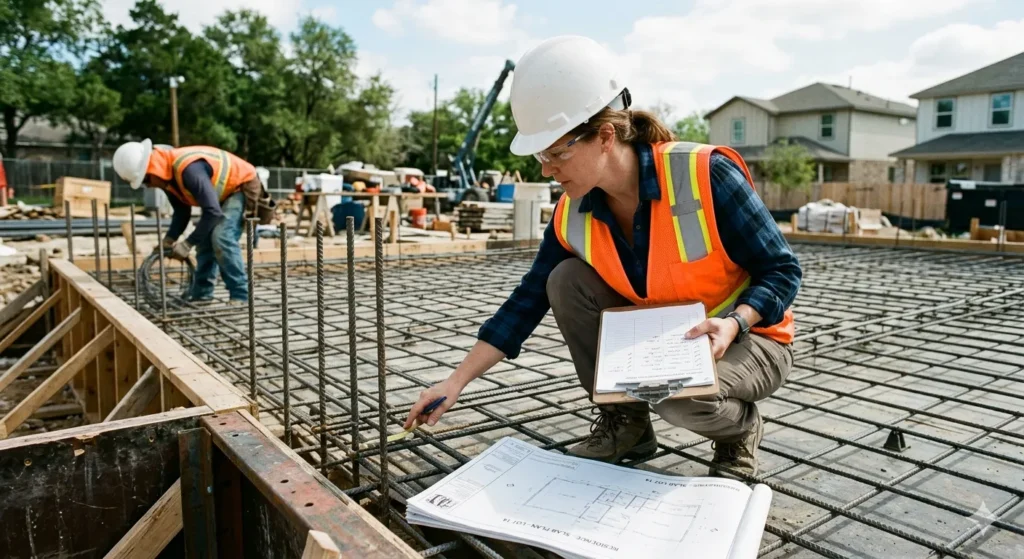
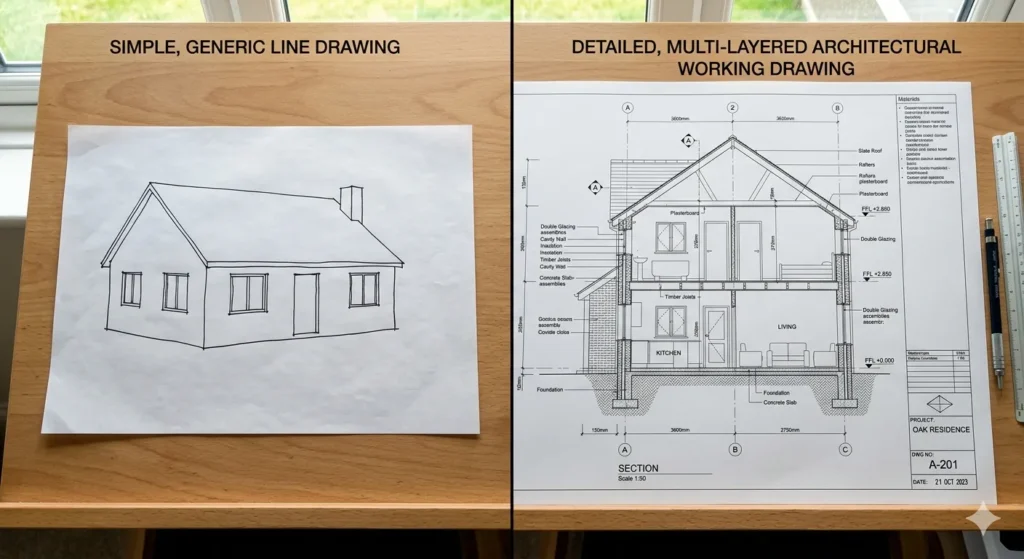
This distinction is genuinely important in the Ghatanji market and worth making clearly. A draftsman produces drawings. They are skilled at translating a spatial arrangement into the technical documents required for approval and construction. What they are typically not trained in is spatial design — the thinking about how spaces should be organised, oriented, and proportioned to serve the people who use them. A draftsman working from a brief produces documents. An architect working from a brief produces design.
In practice, many residential buildings in Ghatanji are produced through a process where a contractor manages the project, a draftsman produces the approval drawings, and a qualified architect’s signature appears on those drawings for compliance purposes without the architect having meaningfully shaped the design. The buildings that result from this process are legally compliant and structurally sound. They are not designed in any meaningful sense.
The question for a Ghatanji family building a home is which process they want. The compliance-only process is cheaper and faster. The genuine design process costs more in fees and time — but it produces a home that was actually thought through for the family that will live in it, and that difference is felt every day for the thirty or forty years the family occupies the building.
How to Structure a Good Working Relationship
Once you have selected a residential architect for your Ghatanji project, the working relationship itself needs to be set up well to produce good results. A few principles that experienced clients have found useful.
Be specific about your brief. The more precisely you can describe how your family lives — the daily patterns, the specific needs, the aspirations, the non-negotiables — the better equipped the architect is to design for you specifically rather than generically. Don’t say you want a comfortable living room. Say that you typically have eight to ten family members together in the evening, that the television is used frequently, and that you also receive formal guests several times a week who should feel they are in a properly designed reception space. That brief produces a different room from a generic one.
Engage critically with the architect’s proposals. A good architect wants you to push back on their ideas when you don’t understand the reasoning or when a proposal doesn’t match your life. The conversations where you explain why a design decision doesn’t work for your household — and where the architect explains the design logic behind it — are the conversations that produce the best designs. Passive acceptance of the architect’s proposals, or reflexive rejection of anything unfamiliar, both produce worse outcomes than genuine engagement.
Agree in advance on how construction supervision will work. In Ghatanji, the quality of the construction outcome depends heavily on whether the architect’s drawings are detailed enough for the contractor to build accurately from them, and whether the architect is present at key construction stages to verify that what is being built matches the design. Establish what supervision visits are included in the fee, and ensure they cover the critical construction stages — foundation, structure, roofing, first-fix services, and finishing.
What Residential Architecture Costs in Ghatanji
Architectural fees in Ghatanji for complete residential design services — from initial brief through to construction supervision — typically run five to nine percent of the total construction cost. For a home of 2,500 square feet at ₹2,100 per square foot construction cost — ₹52.5 lakhs total — the architectural fee is approximately ₹2.6 to ₹4.7 lakhs.
This fee should cover the complete design service: the design drawings, the approval documentation, the working drawings from which the contractor builds, structural design coordination, and agreed supervision visits. Ensure the scope is clearly defined in writing before work begins.
FAQs
Q1. What should a residential architecture brief for a Ghatanji project include?
Family composition and household structure, specific spatial needs and requirements, plot dimensions and orientation, construction budget, timeline constraints, any non-negotiables about the design, and your general aspirations for the home. The more specific the brief, the more specific and useful the design response.
Q2. How often should the architect visit the site during construction in Ghatanji?
At a minimum: foundation and DPC level, structural frame completion, roofing, first-fix services (electrical, plumbing rough-in), and finishing. For a complex project, more frequent visits are warranted. Agree on a specific supervision schedule with the architect before construction begins.
Q3. What happens if I disagree with the architect’s design direction?
Say so, clearly and specifically. Explain what you disagree with and why. A good architect will either explain why their design decision serves the brief better than your preferred approach, or revise the design to incorporate your feedback. This conversation is part of the design process. Avoiding it produces a design that serves neither the brief nor the client well.
Q4. Can a residential architect in Ghatanji also help with interior design?
Some can, some cannot. Ask specifically. An architect who also provides interior design services can deliver a more seamlessly integrated outcome — the interior and exterior design share a design language from the start. An architect who does not provide interior design services should be able to recommend qualified interior designers they have worked with successfully on previous projects.
Built Strong. Designed Smart.
In Ghatanji, building a duplex home goes beyond construction; it’s about crafting a space that performs wonderfully under extreme heat and heavy monsoons, while making you feel at ease for the long haul.
QC Interiors brings together a perfect mix of smart planner, sturdy structure and organized modern design with solid local know-how. Every measure is taken to ensure your home stands strong, looks polished and serves your family for many happy years.
Why settle? Build with clarity, build great, build well.
QC Interiors
Serving: Ghatanji, Yavatmal
Qualification: Interior Design | Architectual Planing | Turnkey Renovation
📞 +91 7798153303
Book your appointment now, and experience your house in realistic 3D walkthrough—before construction.
