
Best Interior Designers in Ghatanji — What Genuine Interior Design Delivers and How to Find Someone Who Actually Provides It
The interior design conversation in Ghatanji has been changing. Five years ago, the phrase interior design would have conjured a very specific and limited image in most local families’ minds — a showroom in Yavatmal, a catalogue of modular kitchen options, perhaps a visit to a tiles supplier who could suggest a colour scheme. The idea that interior design was a professional service distinct from product supply, one that could transform the quality of daily life inside a home in ways that went far beyond choosing between tile patterns, had not really arrived in the local conversation.
It is arriving now. The families building homes in Ghatanji today — particularly those who have spent time living or studying in larger cities, who have experienced well-designed interiors firsthand, and who have returned with higher expectations for their own homes — understand that there is something more to interior design than this. They can feel the difference between a designed interior and an assembled one. They want the former. And they need to know how to find the professionals who can deliver it.
Best Interior Designers in Ghatanji
The Gap Between Design and Decoration
The most important distinction in Ghatanji’s interior design market is the one between design and decoration. Decoration — choosing colours, selecting furniture from a showroom, arranging objects on surfaces — is the visible output of a design process. It is not the design process itself. A supplier who helps you choose a paint colour and recommends furniture pieces from their catalogue is providing a decoration service. They may have taste. The result may look reasonable. But they are not designing your interior.
A genuine interior designer begins their work before any product is selected. They begin with the space — the physical conditions of each room, the quality and direction of natural light, the proportions of the rooms and whether those proportions create problems that design can address, the way the home is organised and whether the circulation through it is logical. They begin with the family — who lives in the house, how different members use different spaces across the day, what specific activities need spatial support, what this household’s daily life actually looks like in its particular Ghatanji context.
From this understanding comes a design brief. From the brief comes the design — the spatial layout of each room, the material palette, the lighting scheme, the joinery for kitchens and storage, the furniture selection. Every decision in a properly designed interior relates back to the brief. This is what design coherence means, and it is what distinguishes a designed interior from an assembled one.
What Ghatanji’s Climate Means for Interior Decisions
Interior design in Ghatanji is not the same project as interior design in a coastal Maharashtra city or a hill station town. The climate here imposes conditions on material and design choices that a designer working from a generic national vocabulary may not account for.
Flooring is the clearest example. In a town where summer temperatures regularly exceed 44 degrees, the choice between natural stone and polished vitrified tile is not simply a visual preference. Natural stone — kota, kadappa, Indian granite varieties — stays measurably cooler underfoot in summer heat. Families who have lived with stone floors in Vidarbha know this from daily experience. A designer who understands Ghatanji’s conditions will factor this into the flooring specification. One applying a generic design vocabulary may default to whatever tile looks fashionable at the moment, and the family will feel the consequence on their bare feet through every summer morning.
Wall finishes need to perform through Vidarbha’s humidity cycle. The monsoon months bring moisture levels that affect paint adhesion, plaster integrity, and the performance of certain surface treatments in ways that dry-climate product data doesn’t predict. A designer with local experience will specify wall finishes they know from experience perform reliably through the seasonal cycle. One without this knowledge may specify products that look perfect at handover and deteriorate within two monsoons.
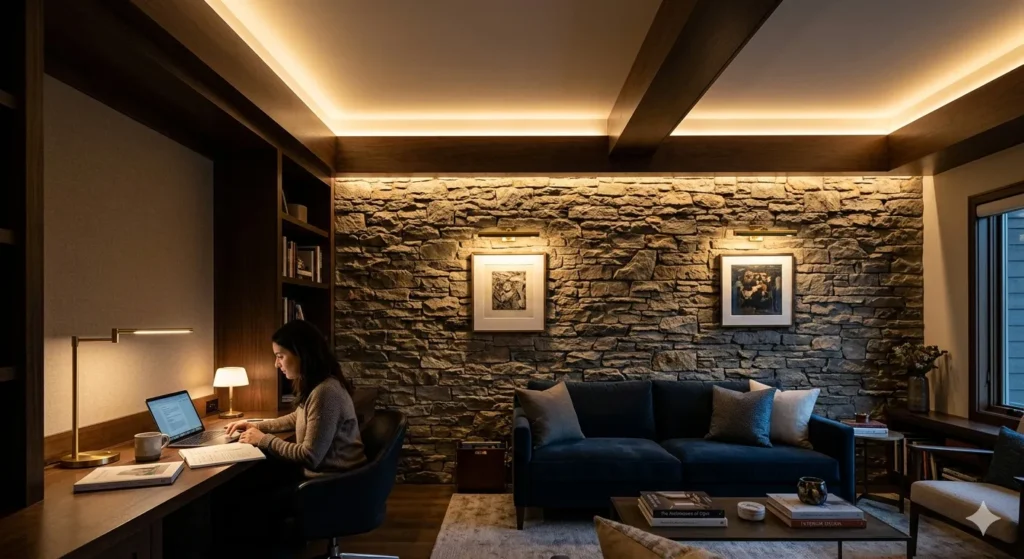
The relationship between indoor and outdoor spaces — particularly the veranda and the main living areas it connects to — is an interior design consideration specific to Ghatanji’s domestic culture. The best residential interiors in this town treat the veranda as a designed space continuous with the interior, not as an unfinished area outside the house. The flooring material that transitions from the living room to the veranda, the furniture that inhabits the veranda, the way light and air move between the two spaces — these are interior design decisions as much as architectural ones.
Lighting: The Most Powerful and Most Neglected Element
Of everything that interior design can bring to a Ghatanji home, properly considered lighting is simultaneously the most transformative and the most consistently ignored. Standard residential construction in this region defaults to a single ceiling-mounted panel fitting per room. It provides illumination. It creates no atmosphere, no differentiation between spaces used for different purposes, no quality that distinguishes one room from another.
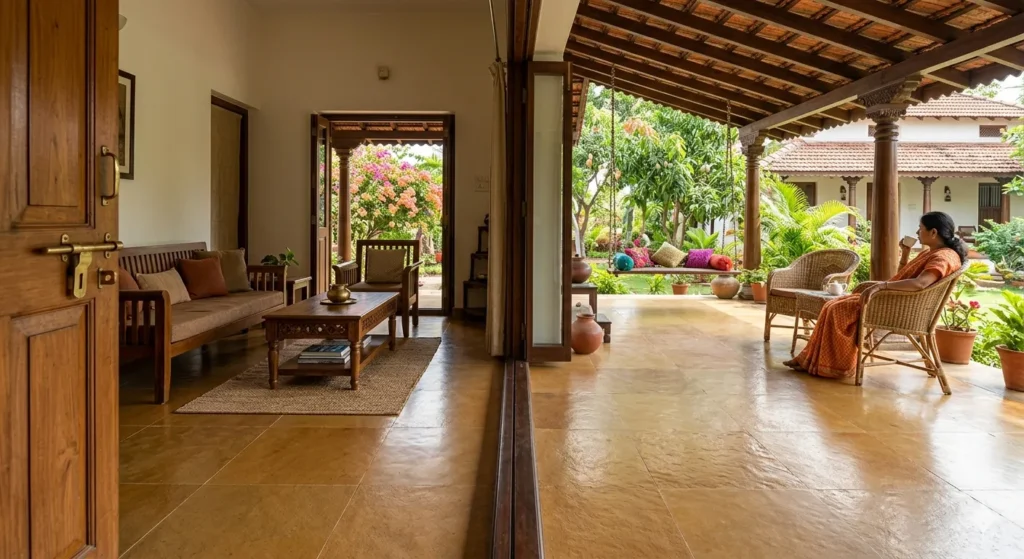
A designed lighting scheme works at several levels simultaneously. Ambient lighting provides general illumination for the whole room. Task lighting provides higher-intensity light at the specific points where work happens — the kitchen counter, the study desk, the bathroom mirror. Accent lighting draws attention to the spatial or material features that give a room its character — a textured wall surface, a piece of art, the depth of a ceiling recess. Together, these layers create an interior that can be adjusted for different uses and different moods, that feels considered in the way that a single overhead panel cannot.
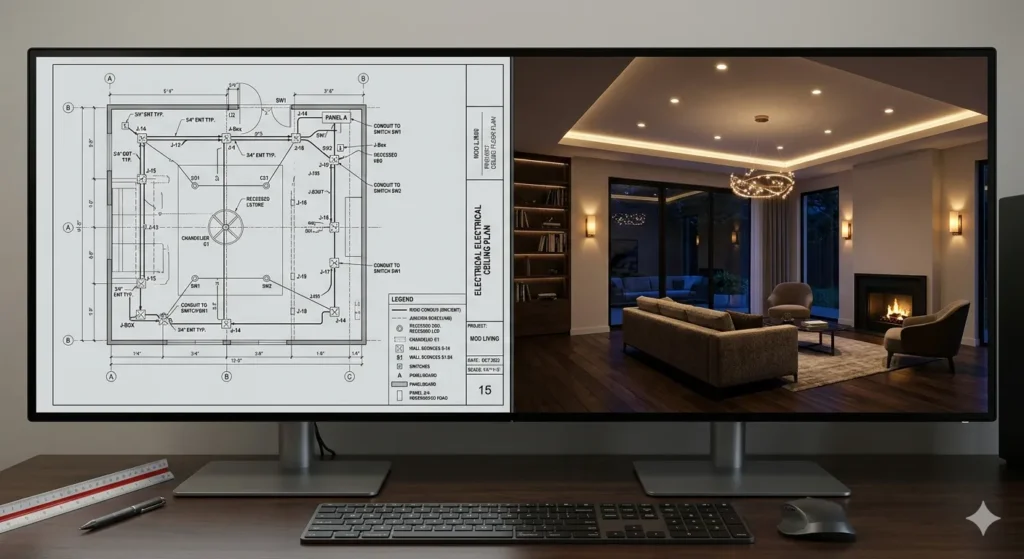
The infrastructure for proper lighting — the electrical point positions, the circuit separations that allow different zones to be controlled independently, the provision for wall-mounted and table lamps at the right locations — needs to be planned before walls are plastered. An interior designer engaged during construction, before the electrical layout is fixed, can integrate a proper lighting scheme into the building from the start. One engaged after the walls are done is working with fixed constraints that limit what design can achieve.
The Kitchen in a Ghatanji Home
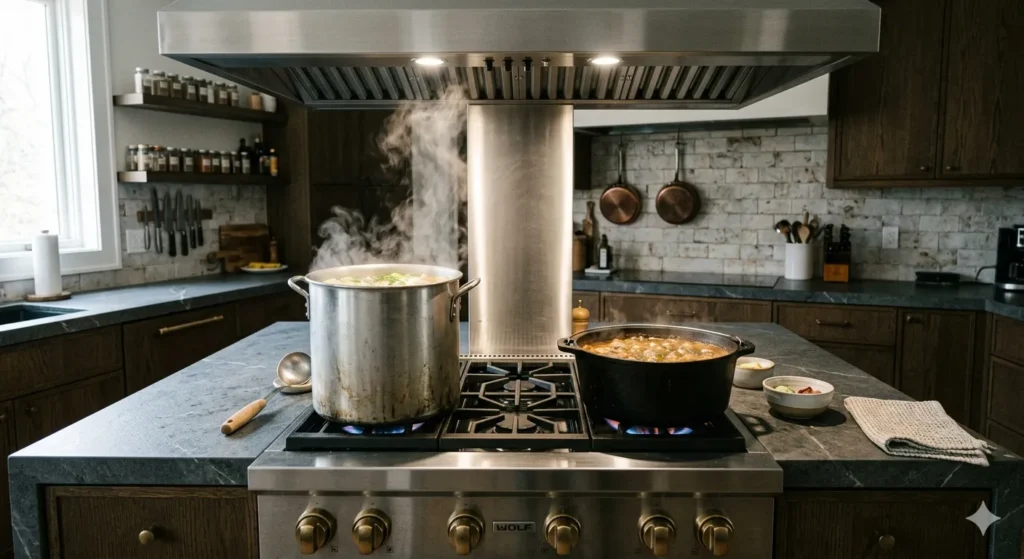
The kitchen deserves specific attention in any discussion of interior design in Ghatanji because it is where the gap between generic modular solutions and actually designed spaces is most visible. The typical modular kitchen offering available in this market is designed for a nuclear family cooking one meal at a time with contemporary urban cooking habits. Many Ghatanji households don’t look like this. Extended families, large cooking vessels for festivals and family occasions, multiple people working in the kitchen simultaneously, a pantry requirement that far exceeds what a small upper cabinet can provide — these are the realities of domestic cooking life in much of Vidarbha, and a kitchen designed for them looks different from the catalogue.
A well-designed kitchen for a Ghatanji extended family starts with understanding how cooking actually happens in this household. How many people cook simultaneously on a normal day? What size vessels are in regular use? How much dry goods storage is needed? Is there a tandoor or wood-fire cooking element that requires specific ventilation? These questions — not a catalogue selection — produce a kitchen that works for this family.
Finding Interior Designers in Ghatanji
The pool of qualified interior designers based in Ghatanji is small, and for projects with demanding design requirements, looking to Yavatmal or Nagpur may be necessary. The most reliable evaluation approach remains visiting completed projects in person — not photographs, but actual inhabited spaces. Ask to see interiors the designer has completed and spend time in them. Notice whether the design decisions hold up in daily-life conditions, not just in controlled photographic moments.
Ask the designer to describe a specific design problem they solved on a recent project. The quality of that answer tells you more about their design intelligence than any portfolio presentation.
What Interior Design Costs in Ghatanji
Interior design fees typically run eight to twelve percent of the total fitout cost. For a home with a mid-range interior fitout of ₹10 to ₹16 lakhs, the design fee is ₹80,000 to ₹2 lakhs. This is a small proportion of what the interior costs to build and furnish, and it is what determines whether that investment produces a coherent, designed environment or an assembled collection of products.
FAQs
Q1. When should I engage an interior designer for a new home in Ghatanji?
Before plastering if at all possible. Lighting circuit layout, electrical point positions, ceiling design, and floor preparation requirements all need to be decided during construction. Engaging a designer after these decisions are fixed significantly limits the design options available.
Q2. How do I distinguish a genuine interior designer from a furniture or tile supplier in Ghatanji?
Ask them to describe their design process before they show you any products. A designer begins with space and family analysis. A supplier begins with their catalogue. This difference reveals itself immediately in the first conversation.
Q3. Can I use regional materials and local craft in a well-designed Ghatanji interior?
Absolutely, and in many cases this produces better results than imported or generic national materials. Locally sourced stone, regional craft traditions, and materials with proven performance in Vidarbha’s climate combine design quality with cultural rootedness that generic specifications cannot replicate.
Built Strong. Designed Smart.
In Ghatanji, designing a home goes beyond construction; it’s about crafting a space that performs wonderfully under extreme heat and heavy monsoons, while making you feel at ease for the long haul.
QC Interiors brings together a perfect mix of smart planner, sturdy structure and organized modern design with solid local know-how. Every measure is taken to ensure your home stands strong, looks polished and serves your family for many happy years.
Why settle? Build with clarity, build great, build well.
QC Interiors
Serving: Ghatanji, Yavatmal
Qualification: Interior Design | Architectual Planing | Turnkey Renovation
📞 +91 7798153303
Book your appointment now, and experience your house in realistic 3D walkthrough—before construction.
