
Finding the Right & the Best Interior Designer in Manish Nagar Nagpur — And What to Actually Expect From the Process.
Ten years ago, Manish Nagar wasn’t the first name that came up when Nagpur families talked about where they wanted to live. That’s changed. Quietly, without the kind of marketing noise that newer developments generate, Manish Nagar has become one of those neighbourhoods that people who know Nagpur well tend to end up choosing. The roads improved. Good schools came. Hospitals, decent restaurants, reliable markets — the whole texture of daily life filled in, and the families who moved here early made a decision that looks smarter every year.
Property appreciation in the area has been running at around 6 to 7 percent annually. That number matters because it tells you something about who’s buying here and why. These aren’t speculative purchases. These are families who plan to stay — who want a home that reflects the seriousness of the decision they made when they chose this neighbourhood over a cheaper option further out or a more glamorous address they couldn’t quite afford.
Which brings us to interior design. Because when a family has thought carefully about where they live, they tend to think carefully about how they live too. The interior of a Manish Nagar home isn’t an afterthought for most of the families I’ve encountered here. It’s the next chapter of the same decision.
Best Interior Designer in Manish Nagar Nagpur
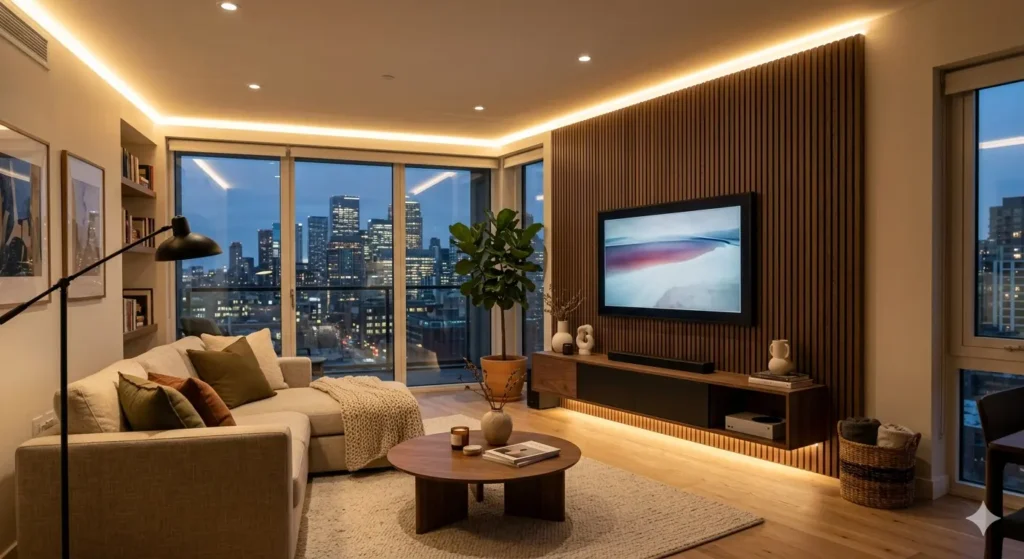
What the Homes Here Are Actually Like
Walk through a few residential complexes in Manish Nagar and you notice fairly quickly that there isn’t a single type of home. You have 2BHK and 3BHK apartments in mid-rise buildings — typically in the 950 to 1,400 square foot range — alongside older independent houses on plots that were carved out when land was cheaper and developers were less focused on maximising FSI. There are newer row houses too, and a handful of duplex units that have come up as the locality’s popularity has pushed more developer activity into the area.
Each type has its own design personality, and the mistakes made in each type tend to be different.
In the apartments, the most common problem I see is compression — the feeling that the interior has been filled rather than designed. Furniture that’s slightly too large. Storage that doesn’t work, so things pile up on surfaces. Lighting that either floods the room uniformly or leaves corners dark. The result is a home that functions but doesn’t feel generous, even when the floor plan is actually reasonable.
In the older independent houses, the problem is usually the opposite: space that the family doesn’t quite know how to inhabit. Large rooms with ceiling heights of 11 feet or more, where the furniture looks adrift and the lighting is doing nothing to create warmth or definition. These homes have tremendous potential — real bones — and they often get less design attention than they deserve because the family has lived with them so long they’ve stopped seeing what’s possible.
The duplexes and row houses sit somewhere between the two. Enough floor area to breathe, a staircase that can be either a design statement or a purely functional element, and upper floors that are often significantly underdesigned compared to the ground floor.
How the Light Behaves Here, and Why It Matters
Anyone who designs interiors in Nagpur without thinking hard about light is making a significant mistake. Manish Nagar’s residential layouts generally give most buildings reasonable access to natural light — there’s enough open space around most structures that lower floors aren’t permanently overshadowed — but from late March through June, the sun here is not something you design around casually.
East-facing rooms get hit hard in the morning. West-facing rooms are difficult to occupy in the late afternoon without proper window treatments. Rooms that face south receive consistent, relatively warm light through the day, which is actually the most forgiving orientation to work with in Nagpur.
What this means practically: colour choices need to be made in the actual room, in its actual light, not from a paint chip under showroom lighting. Window treatments need to be thought through as part of the interior design rather than chosen separately as a soft furnishings afterthought. And material finishes — flooring, furniture surfaces, ceiling treatments — should be chosen to absorb some of the summer light’s intensity rather than reflecting it around the room amplified.
A warm white that looks beautiful on a north-facing wall at 10 AM can look completely washed out on a south-facing wall at noon. Getting this right requires looking at each room specifically rather than applying a standard palette across the whole home.
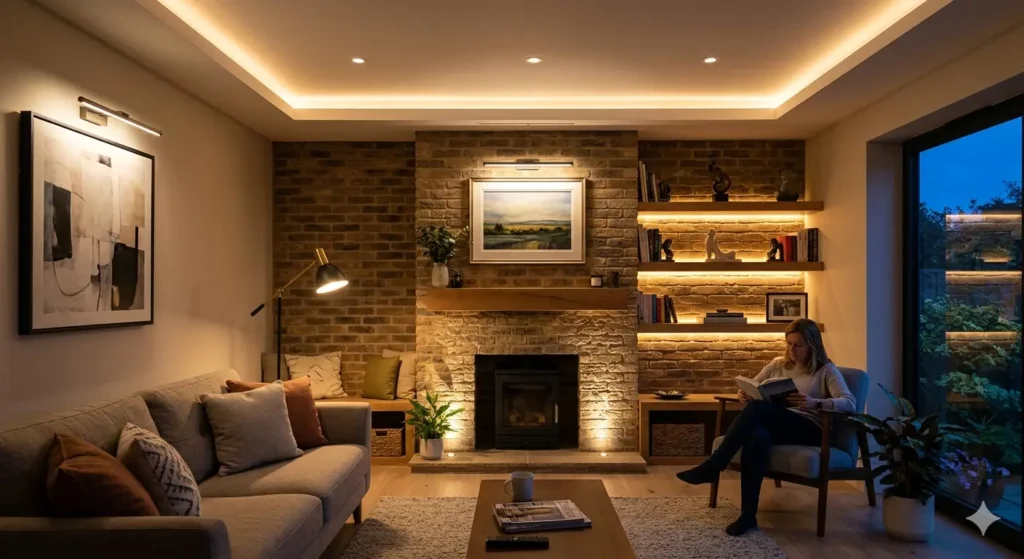
The Living and Dining Area: Where Most of the Design Budget Goes, and Should
The combined living and dining space in a Manish Nagar apartment is typically somewhere between 280 and 450 square feet. In the better-planned complexes, this space has a logical relationship between the two zones — the dining area positioned near the kitchen passthrough, the living area with enough depth to seat a proper sofa group without the television being six feet from the front row.
The false ceiling is usually the first conversation in these rooms, and it’s worth having properly. At standard apartment ceiling heights in Manish Nagar — most buildings here sit between 10 and 10.5 feet — a gypsum ceiling with perimeter cove LED and a few well-positioned downlights does several things at once. It integrates the air conditioning diffusers and the electrical wiring in a way that looks clean rather than retrofitted. It creates the layered lighting quality that separates a considered interior from a basic one. And the cove light’s warm glow in the evening changes the room’s emotional temperature entirely — it’s the difference between a room that feels lit and a room that feels inhabited.
The TV wall tends to absorb a disproportionate amount of design attention in Nagpur living rooms, and I think that’s actually appropriate — it’s the wall you look at most, and it’s the wall that visitors see immediately when they walk in. A full-height treatment in fluted wood veneer, or a combination of stone-effect cladding in the central panel with recessed niches on either side, reads as genuinely architectural at Manish Nagar ceiling heights. It stops the wall from being just a surface with a television on it and starts being a thing in itself.
The furniture arrangement question that gets asked less often than it should: where does conversation happen in this family’s daily life? Not where does the furniture look good in a photograph — where do people actually sit and talk? Sometimes the answer is the living room sofa group. Sometimes it’s the dining table. Sometimes it’s the kitchen counter. The design should support what the family actually does, not create a beautiful room that nobody relaxes in.
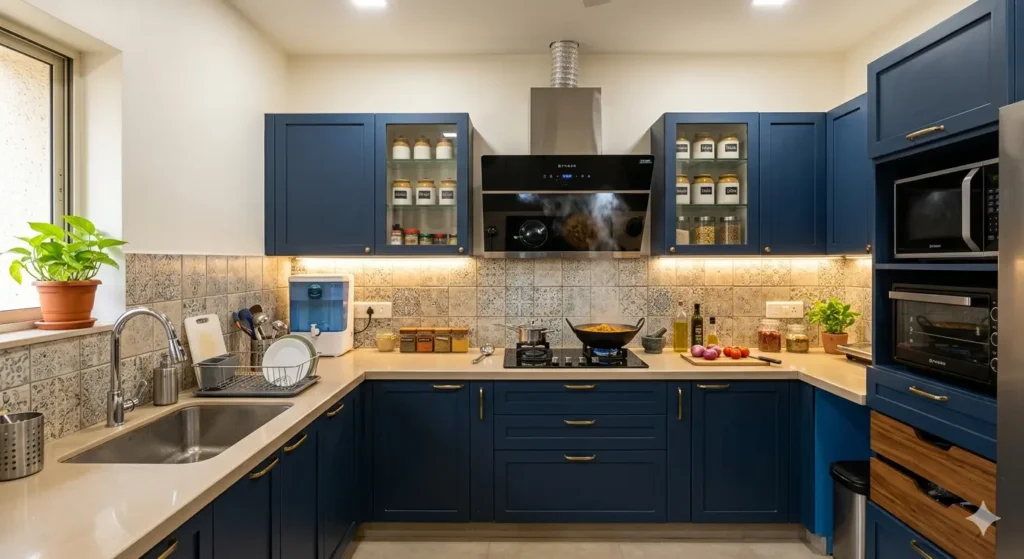
Kitchens: The Room That Needs More Honesty in the Brief
Modular kitchen companies in Nagpur — and there are many — have gotten very good at producing kitchens that photograph well. Clean lines, handleless shutters, quartz countertops, under-cabinet lighting catching the grain of the laminate. They look excellent in the brochure.
What they sometimes get wrong is the cooking. Indian cooking at the scale of a Nagpur family — the simultaneous burners, the oil, the spice grinding, the vessels that are substantially larger than what a European kitchen is designed around — puts demands on a kitchen that a catalogue-designed modular unit isn’t always prepared for.
The chimney is the most obvious example. Undersized chimneys are the single most common mistake in Nagpur modular kitchens, and the consequences are immediate and daily: smoke that doesn’t clear, oil residue that accumulates on every surface, a kitchen that smells of last night’s cooking when you walk in the next morning. The chimney specification should be driven by the actual cooking that happens in the kitchen, not by what fits the visual composition of the elevation.
Counter depth matters too. The standard 600mm counter depth that European modular systems are built around is genuinely tight for large Indian cooking vessels. Where the layout allows, 650 or even 700mm depth makes a real difference.
Storage planning should start from an honest inventory of what the kitchen actually contains — and in most Indian household kitchens, this is significantly more than the standard modular planning assumption accounts for. Spice storage alone, in a Nagpur kitchen where the masala collection might run to forty-odd varieties, needs dedicated provision that the standard modular unit’s spice pull-out doesn’t adequately address.
Mid-range modular kitchen for a Manish Nagar apartment, installed: ₹2.2 to ₹4 lakhs. Premium specification with stone countertops, quality hardware like Hettich or Blum, proper chimney, and designed storage: ₹4 to ₹7 lakhs.
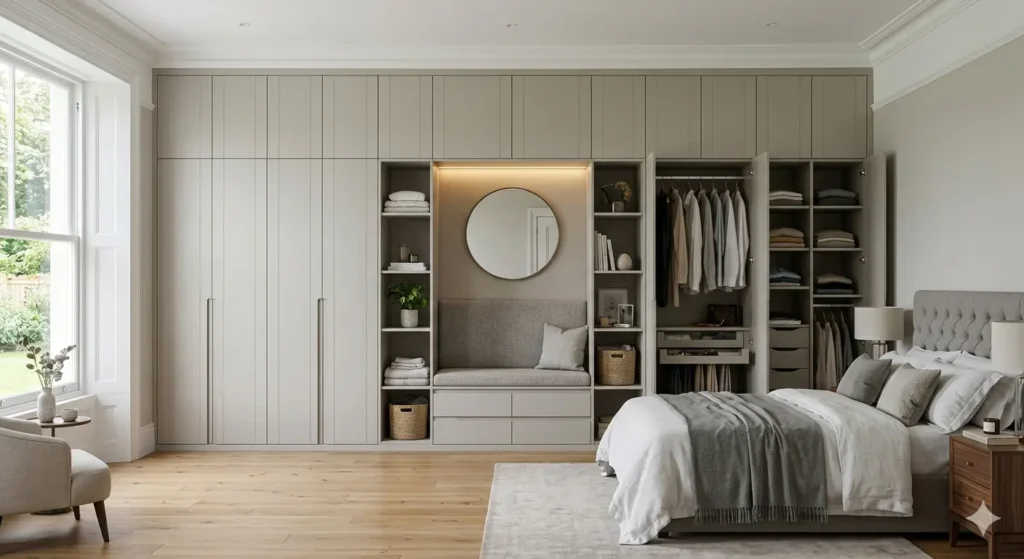
Bedrooms: Full Height, Warm Light, Somewhere to Actually Put Things
The master bedroom in a Manish Nagar apartment — typically 160 to 220 square feet — is a room where the design decisions are relatively few but where getting them right makes an enormous difference to daily life.
The wardrobe is the most important. A full-height wardrobe running wall to wall, using the full floor-to-ceiling dimension, does three things simultaneously: it solves the storage problem completely, it makes the room feel taller by drawing the eye upward, and when the shutter design and materials are chosen thoughtfully, it becomes the room’s main architectural statement. Compare this to a standard 7-foot wardrobe unit sitting in front of the wall with a dead space above it collecting dust — the difference in how the room feels is immediate and significant.
Bedhead wall treatment is the second decision. A painted accent in a warm, quiet tone — blush, warm sage, a very muted terracotta — or a textured panel treatment in fabric or veneer creates the backdrop that the sleeping area needs. This doesn’t have to be expensive. A well-chosen paint colour on the bedhead wall costs almost nothing compared to the visual difference it makes.
Lighting in the bedroom: please, not a single central ceiling light as the primary source. Cove lighting in the ceiling, bedside reading lights at the correct wall height, and a consideration of what light quality the room needs in the morning versus the evening will create a bedroom that functions properly rather than one that’s either too bright or too dim for whatever you’re trying to do.
Secondary bedrooms for children: design with five years of growth in mind rather than for exactly the age the child is now. Built-in storage and good flooring will last. The coloured walls and character furniture can change.
What a Complete Project Costs — Honest Numbers
2BHK apartment in Manish Nagar, mid-range specification, covering living and dining false ceiling and focal wall, modular kitchen, both bedrooms with full-height wardrobes, painting throughout: ₹8 to ₹14 lakhs.
3BHK at the same specification level: ₹12 to ₹20 lakhs.
3BHK at premium specification — engineered wood or stone flooring in main areas, premium kitchen, architectural lighting design, bathroom renovation: ₹22 to ₹38 lakhs.
Independent house or duplex in Manish Nagar, mid-range specification across both floors: ₹18 to ₹32 lakhs depending on size.
Choosing a Designer: What to Actually Look For
The Nagpur interior design market has grown considerably, and Manish Nagar has enough completed projects circulating on word-of-mouth now that families coming to the process aren’t starting from zero. Ask around the building or the neighbourhood before you start calling designers. The families who’ve been through it recently will tell you more than any portfolio will.
When you’re meeting designers, look at completed work in person if you can — not just photographs. Ask specifically about the contractors they use, because the quality of execution depends as much on the contractor as on the design. Ask about the warranty on materials and workmanship. And pay attention to whether the designer is listening to you in the first meeting or presenting to you.
QC Interiors works across Nagpur’s residential neighbourhoods including Manish Nagar. Free consultation, no obligation. Come talk about your home.
