
Top G+2 Villa Designs in Gachibowli Hyderabad — Three Floors, One Vision, and the Design Intelligence to Make It All Work
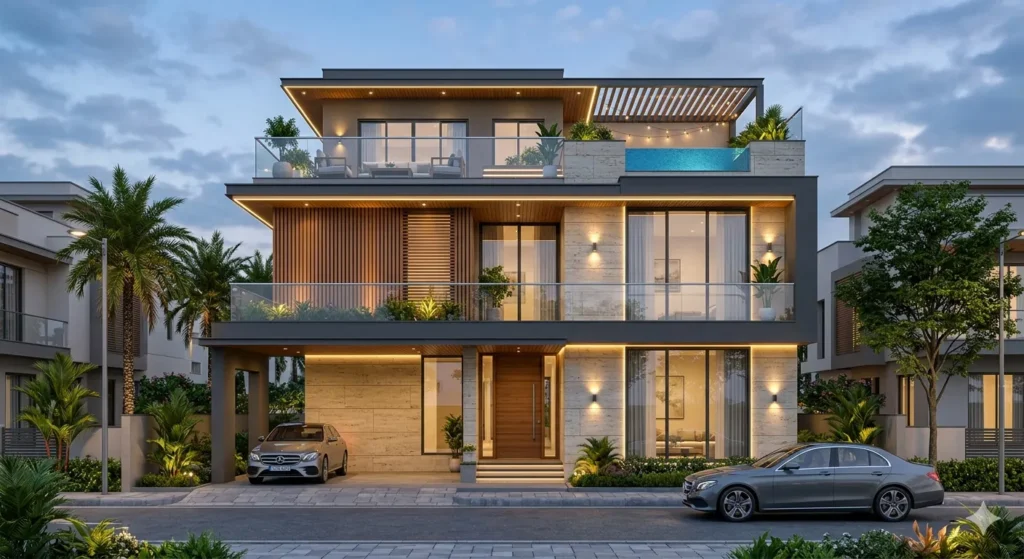
The G+2 villa — ground floor plus two upper floors — has become the definitive independent residential typology for Gachibowli’s premium home market. The plotted residential layouts in Gachibowli and the surrounding zones of Kondapur, Manikonda, Narsingi, Khajaguda, Raidurgam, Puppalaguda, and Nanakramguda are typically sized in the 200 to 400 square yard range — large enough to support a three-floor structure that provides the floor area a family wants, but not so large that a single-floor sprawl is practical or financially justifiable. The G+2 configuration gives these plots their best residential use.
But a G+2 villa is not simply a single-floor home with two extra stories attached. It’s a fundamentally different residential typology that requires specific design thinking at every level — the planning of each floor, the design of the staircase and its surrounding void, the relationship between the floors as experienced vertically, the structural system that supports three floors efficiently, and the way the building presents to the street at a three-floor scale that is categorically different from a single or two-floor home.
The top G+2 villa designs in Gachibowli understand all of this and design for it specifically. This article covers what they get right — and what the design and construction investment required to achieve it actually looks like.
Top G+2 Villa Designs in Gachibowli Hyderabad
What Defines a Top G+2 Villa Design in Gachibowli
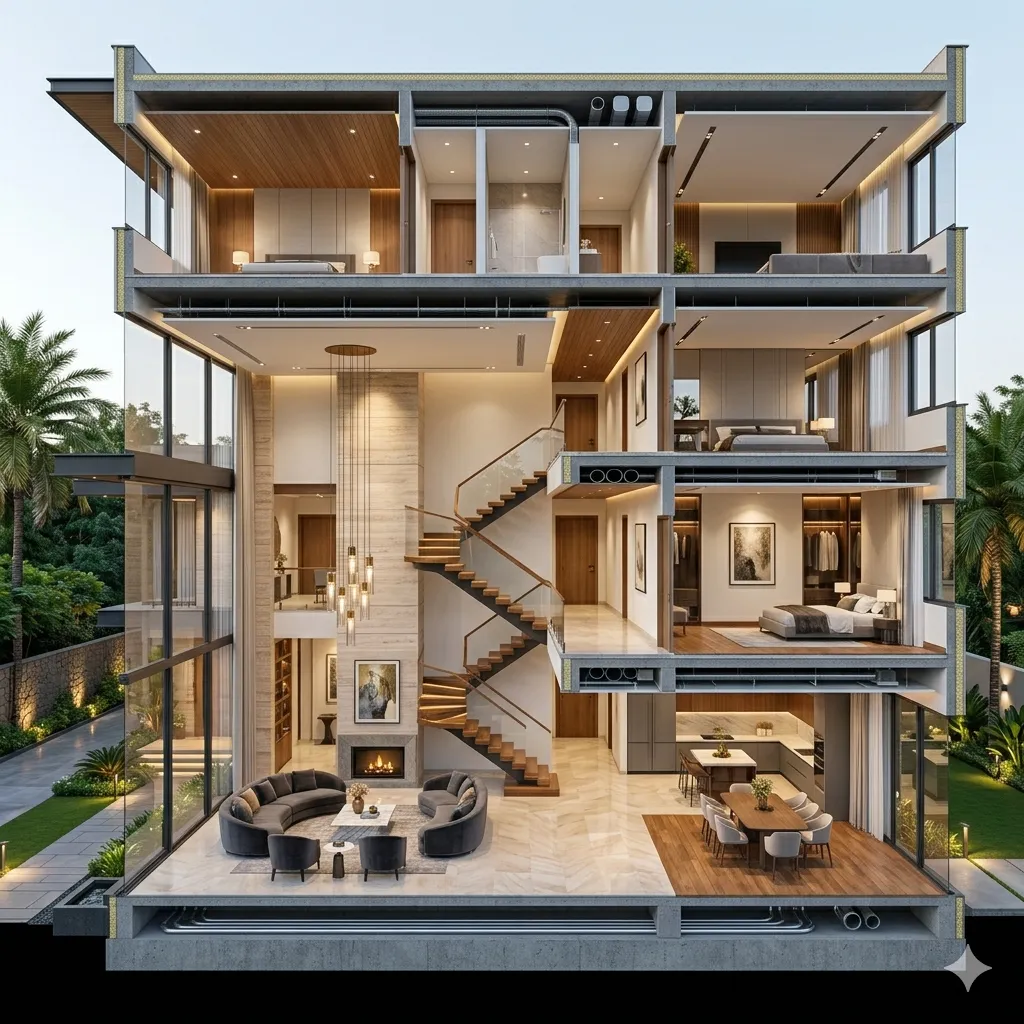
The vertical spatial experience. The defining quality of an excellent G+2 villa — the quality that separates the homes that feel genuinely impressive from those that merely have the right number of floors — is the way the three floors connect spatially. The staircase is the mechanism of this connection, and in a top G+2 design, it’s designed as a spatial experience rather than a circulation route.
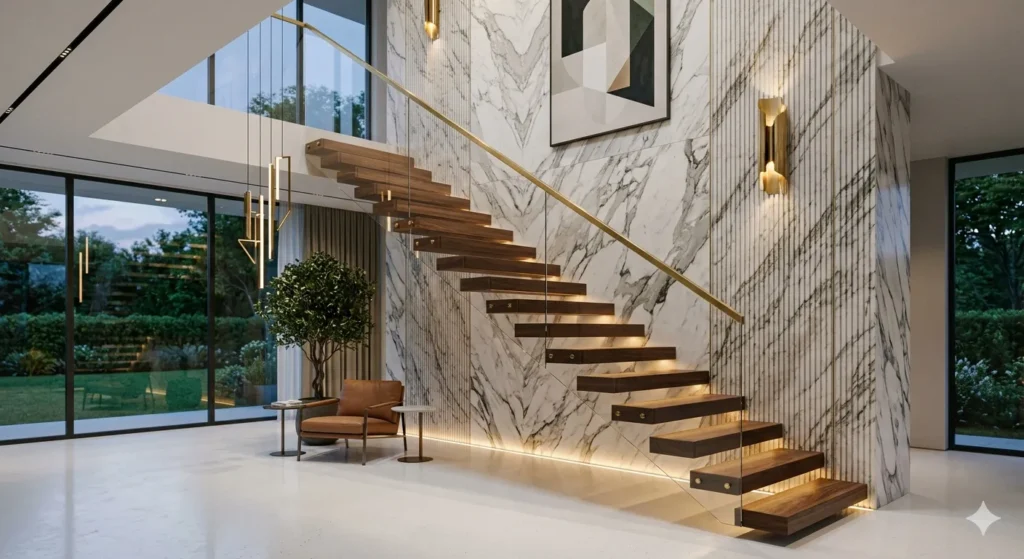
The staircase in a top Gachibowli G+2 villa rises through a void — typically double-height from ground to first floor, sometimes triple-height through all three floors — that creates the home’s most architecturally significant interior space. The entry foyer on the ground floor opens to this void, giving the visitor an immediate sense of the home’s vertical scale. The staircase itself — whether floating treads in a contemporary minimal language or a more material, substantial design in stone or timber — is the focal element that the eye returns to from every level. And the void’s wall — the wall visible from all three floor levels as you ascend — is the canvas for the home’s primary material statement.
The ground floor: social generosity. The ground floor of a top G+2 Gachibowli villa is the home’s most socially generous floor. The drawing room — typically 350 to 500 square feet in a well-planned 5,000 square foot G+2 villa — should connect visually and functionally to the outdoor terrace or garden, creating the indoor-outdoor social space that Hyderabad’s winter months make genuinely valuable. The dining area adjacent to the drawing room should be sized for the family’s actual entertainment scale — not minimum functional seating but the table that works for a dinner party of ten or twelve.
The kitchen on the ground floor of a top G+2 design has a specific brief: it must serve both the family’s daily cooking and the entertainment scale. An island or peninsular counter that allows informal gathering while cooking is in progress. Adequate counter space for preparation at scale. A pantry provision for the serious cook. And a back kitchen or utility area, accessible from the service entrance, that keeps the mess of heavy cooking preparation away from the main kitchen’s visual quality.
The first floor: the family’s private world. The first floor in a top G+2 Gachibowli villa is where the family’s private life happens — away from the social activity of the ground floor, above the road level where privacy is more easily achieved, and with access to the best views that the plot’s upper elevation provides.
The master bedroom suite occupies the most private, most view-oriented position on the first floor. Bedroom, walk-in wardrobe, master bathroom, and a private terrace or balcony are the elements of a master suite that provides the genuine quality of private retreat that the ground floor’s social function makes necessary as a counterbalance. The family sitting room on the first floor — a casual, informal space distinct from the formal drawing room below — is the element that the best first-floor plans include and that families who have it consistently value.
The second floor: the children’s domain and the rooftop opportunity. The second floor serves the children’s bedrooms and study needs through childhood and adolescence. The best second-floor plans in Gachibowli’s G+2 villas design the children’s zone with genuine independence — a small common area or study zone shared between the children’s bedrooms, giving them a floor that feels like their own domain rather than simply the continuation of the adult home.
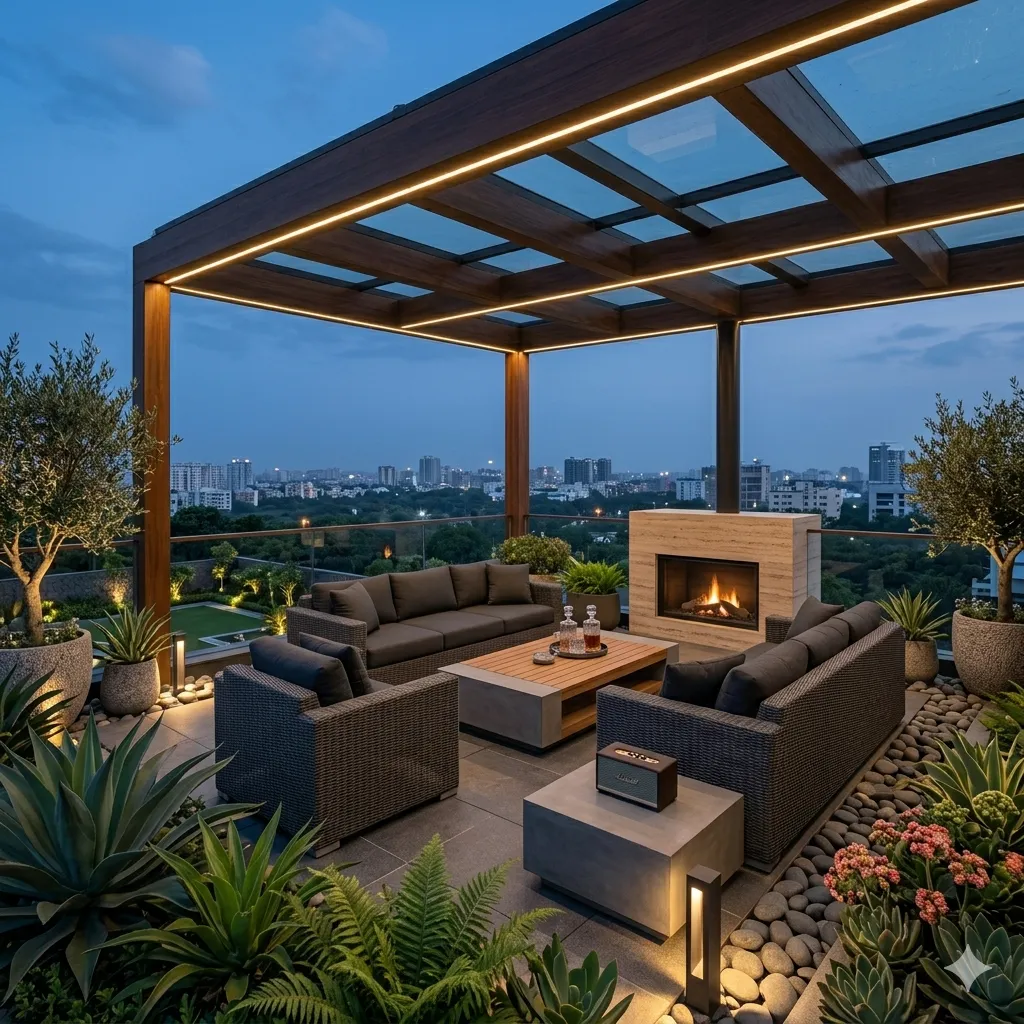
The roof terrace — the space above the second floor accessible by the staircase — is Gachibowli’s most underused residential asset and the top G+2 villa design’s most thoughtful opportunity. A properly designed roof terrace in a Gachibowli G+2 villa, with quality outdoor tile flooring, a pergola or shade structure for part of the area, outdoor furniture, a small bar or kitchenette provision, and some planting — this space is usable every evening from October through February and during the monsoon evenings when the city’s air quality and temperature make the outdoors genuinely pleasant.
G+2 Villa Design and Construction Costs in Gachibowli
Architectural design fees for a G+2 villa (floor plans for all three levels, all four elevations, sections, working drawings): ₹4 to ₹8 per sq ft. For a 5,000 sq ft G+2 villa: ₹20 to ₹40 lakhs.
Structural engineering fees for a G+2 structure: ₹2 to ₹3.5 per sq ft, reflecting the greater structural complexity of a three-floor building. For 5,000 sq ft: ₹10 to ₹17.5 lakhs.
3D exterior elevation design and rendering for a G+2 Gachibowli villa — showing the three-floor facade from the street approach, the gate and compound treatment, and the landscape: ₹40,000 to ₹2 lakhs for photorealistic exterior perspectives.
Interior design for the complete G+2 villa: ₹4 to ₹9 per sq ft. For 5,000 sq ft: ₹20 to ₹45 lakhs.
Construction cost for a G+2 premium villa in Gachibowli:
Ground floor structure and finishes at premium specification: ₹3,800 to ₹5,200 per sq ft. Upper floor construction typically runs ₹3,500 to ₹4,800 per sq ft.
For a 5,000 sq ft G+2 villa at full premium specification: construction cost ₹1.75 to ₹2.6 crore.
Interior fit-out (modular kitchens, wardrobes, false ceilings, bathrooms, painting): ₹25 to ₹55 lakhs depending on specification.
External development (compound wall, gate, driveway, landscape, car parking): ₹15 to ₹35 lakhs.
Total G+2 villa project cost in Gachibowli at premium specification (excluding land): ₹2.5 to ₹4 crore.
The Structural Considerations Specific to G+2 Villas in Gachibowli
Three-floor construction in Gachibowli introduces structural considerations that two-floor construction manages more simply.
Column and beam design for three floors: The structural frame for a G+2 home needs to be designed for the accumulated loads of three floor slabs, the roof slab, and all the contents and occupancy loads above the foundation. This requires a structural engineer’s complete design — not a contractor’s rule-of-thumb column sizing.
Staircase structural design: The staircase in a G+2 villa — particularly when it’s the open, floating-tread type that contemporary design frequently favours — requires specific structural engineering. The treads must be supported without intermediate columns that would destroy the visual lightness of the floating stair concept. This is achievable with the right structural approach (cantilevered treads from a central steel spine, or wall-cantilevered treads with concealed structural support) but requires design rather than standard detailing.
Roof terrace loading: A usable roof terrace with planted areas, outdoor furniture, and potentially a water feature imposes loads on the top slab that the structural design must account for. Typically an additional 200 to 400 kg/sq metre for planted areas. This needs to be in the structural brief from the beginning of the design.
Basement parking: Many premium Gachibowli G+2 villas include basement parking — a storey below grade for two or three cars. This adds structural complexity (retaining walls, waterproofing of below-grade structure, ramp design) and cost (approximately ₹2,500 to ₹3,500 per sq ft of basement area) but frees the ground floor from car parking and creates a significantly better pedestrian entry sequence.
FAQs: Top G+2 Villa Designs in Gachibowli Hyderabad
Q1. What is the typical built area that a 250 square yard plot in Gachibowli can support for a G+2 villa?
On a 250 square yard (approximately 2,090 sq ft) plot with GHMC FAR of 2.0 and setback requirements, the maximum permitted built area is approximately 4,180 sq ft. Across three floors plus potential basement parking, this typically produces ground floor area of approximately 900 to 1,100 sq ft, first floor of 900 to 1,100 sq ft, and second floor of 900 to 1,100 sq ft. Your architect will calculate the specific permitted areas based on the exact setback requirements applicable to your plot.
Q2. What is the cost difference between a G+1 and G+2 villa in Gachibowli?
Adding a second upper floor (G+2 versus G+1) to a Gachibowli villa adds approximately 30 to 40 percent to the structural cost (the additional slab, columns, and staircase), but only 20 to 30 percent to the total project cost because the foundation, site development, kitchen, and external works costs are largely fixed. Per additional square foot of second-floor built area, the construction cost is typically ₹3,000 to ₹4,500, making the G+2 addition cost-efficient compared to extending the ground floor (which would require a larger plot).
Q3. How do I get a 3D exterior elevation design for my Gachibowli G+2 villa before committing to construction?
Commission a 3D exterior elevation from your architect as part of the design service (included at ₹4+ per sq ft fee levels, or charged separately at ₹40,000 to ₹1.5 lakhs for standalone exterior visualisation). A photorealistic exterior render showing the three-floor facade from the street approach is the most valuable single visualisation for a G+2 villa — it allows you to verify the facade proportions, the window placement, the compound and gate design, and the overall street presence before construction begins. This is especially important for a G+2 home because the three-floor scale creates a street presence that’s difficult to visualise from floor plans and elevations alone.
Q4. What is the average total timeline from plot purchase to occupation for a G+2 villa in Gachibowli?
Plot purchase to design completion and approval: eight to fourteen months. Construction of G+2 structure: sixteen to twenty-two months. Interior fit-out: three to four months. Total from plot purchase to occupation: twenty-seven to forty months. Families who plan around thirty-six months and build in contingency for both the approval process and construction are the families who are not surprised by the timeline.
Q5. What design fee should I budget for a complete G+2 villa design service in Gachibowli?
For a complete professional design service for a 4,500 to 6,000 sq ft G+2 Gachibowli villa — architecture (₹4 to ₹8 per sq ft), structural engineering (₹2 to ₹3.5 per sq ft), interior design (₹4 to ₹9 per sq ft), 3D exterior and interior visualisation, MEP design, and landscape design — the total professional design fee budget is ₹55 to ₹1.25 crore for the complete service. This is 6 to 12 percent of the total project investment and represents the highest-return expenditure available in the project — the design that determines whether everything else comes out right.
Gachibowli & Other Locality House Design Build Services Premium G+2 Villa Design Services in Hyderabad
QC Interiors Hyderabad is a leading provider of end-to-end online architecture and interior design services in the premium segment for G+2 villas across multiple locations in Hyderabad including Gachibowli, Kondapur, Narsingi, Khajaguda, Puppalaguda, Nanakramguda, Raidurgam, Manikonda. Architect your dream home with cutting-edge floor planning and luxe 3D elevations for structural coordination, optimal utilization of space, rooftop terrace designs and flat layout, modular interiors, or turnkey villa planners — our team delivers elegant homes across multiple floors designed to fulfill your comfort and function needs while retaining easy deep value.
Contact QC Interiors today to know more about customized online consultation and contact now for G+2 villa designs for your plot,lifestyle & budget.
