
The Best Interior Designer in Pipla Nagpur: Designing Homes in a Nagpur Locality With Real Residential Momentum
Pipla doesn’t get the headline coverage that some of Nagpur’s more established or more aggressively marketed localities receive. But among the families who’ve been paying close attention to how the city’s residential landscape has been shifting — particularly in the corridors where infrastructure investment and genuine demand have been converging — Pipla has been earning quiet recognition as a locality whose time has arrived.
The combination of factors driving this is specific and worth understanding. Proximity to key employment zones. Improving road connectivity that has brought Pipla into a more practical relationship with central Nagpur. The arrival of developer-quality residential projects that have upgraded the housing stock available here. And land and property prices that, while rising, have remained accessible enough to attract families who are making serious long-term residential commitments rather than speculative purchases.
The families who have been settling in Pipla over the last several years are, by and large, families who are building a life here. They bought here with intention, they’re investing in their homes with seriousness, and they come to the interior design process with a clarity of purpose that produces some of the most satisfying projects to work on.
They know what they want their home to do for them. The designer’s job is to make it happen — better than the family imagined when they described it.
Best Interior Designer in Pipla Nagpur
The Homes in Pipla: A Realistic Picture
Pipla’s housing stock reflects its position as a locality in active development rather than one that has been fully built out for decades. There’s a meaningful proportion of newer construction — apartment complexes developed in the last five to ten years, plotted developments that have been laid out as the locality’s demand profile has grown, and a smaller number of independent houses on the older plots that predated the recent development wave.
The newer apartment complexes in Pipla represent the bulk of the interior design work in the locality. These are typically mid-rise buildings with 2BHK and 3BHK configurations, built to contemporary construction standards, with the neutral developer interiors that are a reasonable starting point for a proper fit-out but are a long way from being a finished home.
The developer handover condition in these apartments is consistent and predictable: plastered walls ready for painting, a basic kitchen platform that establishes the layout but provides no real storage or functional quality, bathroom fittings that are functional but generic, flooring in a standard vitrified tile that is inoffensive and unremarkable. The gap between this starting point and a genuinely well-designed home is the territory that interior design occupies, and in Pipla’s newer apartments this gap is significant and consequential.
The plotted independent houses and villas in Pipla represent a different and more complex design opportunity. These are homes where the family has made a larger investment and where the design ambitions tend to be correspondingly higher. The floor areas are greater — typically 1,800 to 3,500 square feet across one or two floors — and the range of design decisions is wider. Flooring across larger areas, outdoor and semi-outdoor spaces that deserve proper design rather than raw concrete, a staircase if the house is double-floor, and the full range of principal rooms at a scale that rewards genuine architectural thinking rather than just competent fit-out execution.
Understanding Light in Pipla Homes
Pipla’s developing residential areas tend to have the generous building setbacks and open space between structures that newer development layouts in expanding Nagpur localities typically provide. This translates to good natural light access in most apartments and independent houses, particularly on upper floors.
Good natural light access in Nagpur’s conditions is both an advantage and a design responsibility. The advantage is significant: homes that are well-lit by natural light feel more spacious, more alive, and more pleasant to be in for the portions of the day when the light quality is good. The design responsibility is equally significant: Nagpur’s summer sun, entering a well-oriented room without any management, creates glare, colour distortion, and heat that makes the room uncomfortable.
The window treatment solution for a well-lit Pipla apartment or villa needs to accomplish several things simultaneously. It needs to allow the room to feel connected to the outside and to benefit from natural light. It needs to control direct beam sunlight without eliminating the ambient brightness. And it needs to look intentional as part of the room’s design rather than like a practical afterthought.
Sheer linen curtains in a warm neutral tone accomplish this in most rooms: they diffuse direct sunlight into soft ambient light, they maintain visual connection to the outside, and they have a warmth and a natural material quality that suits the earthy palette that Nagpur interiors wear well.
For the interior palette: the reliable Nagpur principle. Warm whites on primary walls — specifically whites with LRV between 76 and 85, with enough yellow or cream in the undertone to read correctly under the blue-shifted summer light rather than looking cold or harsh. Accents from the earth palette introduced deliberately on single feature walls. No cool greys on primary surfaces. No pure cool whites. Colours assessed in the room’s actual light conditions at multiple times of day before any commitment is made.
Living Rooms: The Investment That Pays Social Dividends
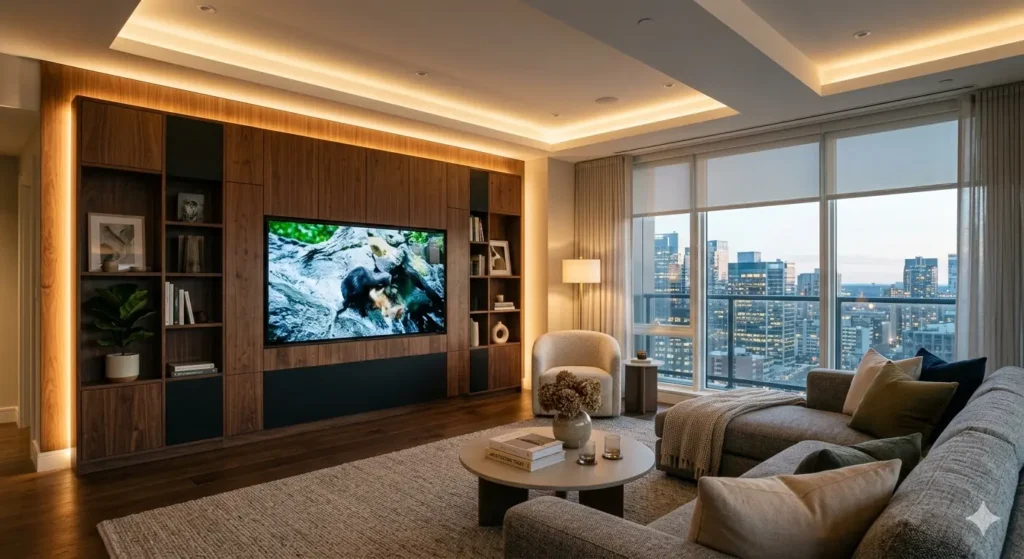
The living room in a Pipla home is the space where the family’s investment in interior design is most visible to the people who matter most to them — guests, relatives, the friends and colleagues whose impression of the home is formed within thirty seconds of walking in. Getting this room right is a priority that most Pipla families feel instinctively, and it’s one that’s worth backing up with the design thinking that makes the instinct correct.
The false ceiling is almost always the first conversation in a Pipla living room design, and it deserves to be treated as more than a standard specification. A gypsum ceiling with perimeter cove LED and positioned downlights is the right foundation — but the specific execution matters. The cove width and the depth of the cove reveal affect how much warm light fills the upper zone of the room in the evening. The downlight positions should correspond to the zones they’re illuminating — over the dining table, over the main seating group, in the circulation area between the two — rather than being distributed on a regular grid that has no relationship to how the room is used.
The TV wall in a Pipla living room should be approached as the room’s primary architectural statement. In a newly developed Pipla apartment with 10-foot ceilings, a full-height treatment — running from floor to ceiling rather than stopping at a standard 7 or 8-foot height — creates a different quality of finish than the partial-height treatment that so many Nagpur living rooms settle for. The material choice for this wall sets the tone for the rest of the room’s material language: if the room is going to use warm wood tones throughout, the TV wall in fluted veneer establishes this; if the room’s language is more architectural — stone, plaster, metal accents — the TV wall treatment should set that register instead.
Furniture selection and arrangement: the scale question deserves a full conversation before any purchases are made. Walk through any furniture market in Nagpur and you’ll find sofas, dining tables, and storage units that look proportionate on the showroom floor — which typically has higher ceilings and more space around each piece than the apartment it’s going to live in. Take measurements. Know the floor area and the ceiling height of the room before shopping, and apply those measurements honestly to every piece under consideration.
Kitchens: The Design Brief That Requires Honesty
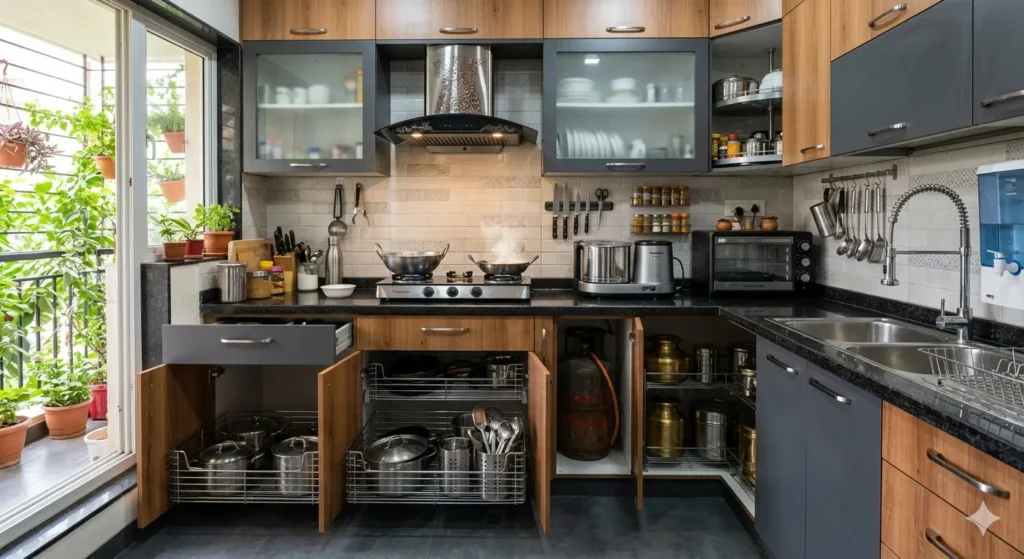
The kitchen brief in a Pipla home almost always begins with aesthetics — the family has a visual reference in mind, a style they’ve seen in a magazine or on someone else’s Instagram, a colour scheme they’re drawn to. This is useful starting information. But it’s the second part of the brief that determines whether the kitchen actually works.
The functional brief for a Pipla kitchen needs to cover the full picture of how the family cooks and uses the space. The number of people who typically cook simultaneously and what that means for the layout. The specific appliances in current use and the ones the family aspires to integrate. The storage inventory — what the kitchen contains and how it needs to be organised for efficient daily use. The countertop use patterns — where the primary preparation happens, what surfaces need to be heat-resistant, where the mixer-grinder or food processor lives in daily use rather than in storage.
A kitchen designed around honest answers to these questions is a kitchen that the family will still find genuinely functional in year seven and year ten of using it daily. A kitchen designed around an aesthetic reference without the functional brief being addressed equally rigorously is a kitchen that looks impressive at handover and develops daily friction within a year as its functional limitations become clear.
The specific attention that Pipla kitchens need from a Nagpur design perspective: chimney specification. The single most common kitchen renovation mistake across Nagpur’s residential market is the undersized or improperly positioned chimney — a fitting that was chosen for visual proportion rather than extraction capacity, or that was positioned too high above the cooking range for effective capture. In a kitchen where Indian cooking happens daily, the chimney is not a decorative element. It is a ventilation system, and it needs to be specified accordingly.
Mid-range modular kitchen for a Pipla apartment or independent house: ₹2.2 to ₹4.5 lakhs. Premium specification with stone countertop, quality hardware, and properly specified chimney: ₹4.5 to ₹8 lakhs. For a villa kitchen with island configuration: ₹8 to ₹13 lakhs.
Bedrooms: Getting the Fundamentals Completely Right
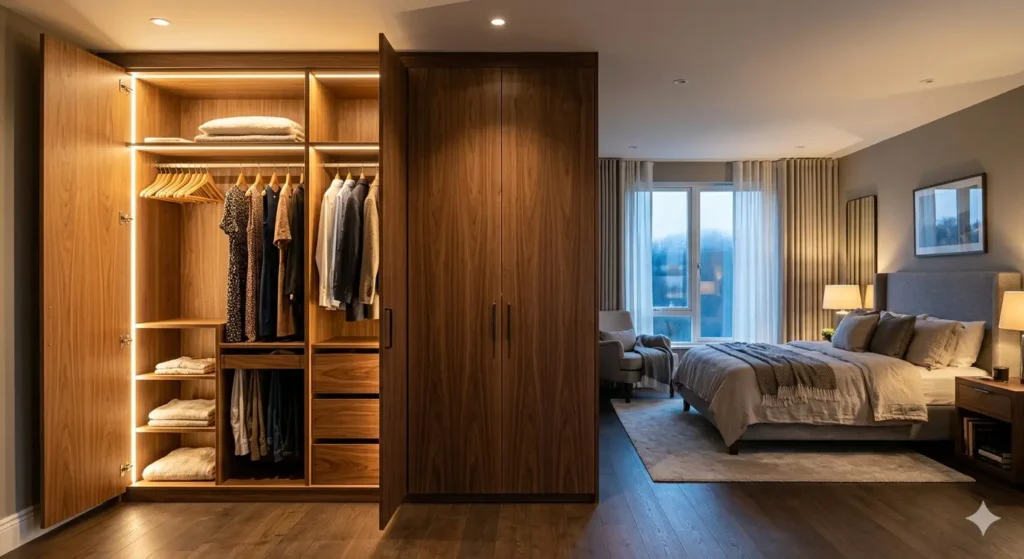
The bedroom design brief in a Pipla home comes down to three fundamentals: the wardrobe, the lighting, and the bedhead wall. Get these three elements right and the room works. Miss any one of them and the room feels incomplete in a way that’s difficult to fix without redoing the element that was compromised.
The full-height wardrobe is the standard that every Pipla bedroom deserves — not because it’s more expensive than a standard-height unit (in the context of a complete interior renovation, the cost difference is modest) but because it’s genuinely better. More storage. Better room proportion. A more finished architectural quality. These are real differences that the family experiences every day.
The internal organisation of the wardrobe should be designed specifically for this family’s clothing and storage patterns. Not a standard catalogue layout applied uniformly, but a considered organisation that puts the items used daily at the most accessible positions, creates hanging sections of the correct height for the types of garments being stored, and provides drawer and shelf provision calibrated to what’s actually going in those drawers and shelves.
Bedside lighting — wall-mounted reading lights rather than table lamps — frees the bedside surface, creates a cleaner visual line in the room, and positions the light source at the height where it actually illuminates what it’s meant to illuminate. Combined with cove ceiling lighting on a dimmer, this gives the bedroom a lighting quality in the evening that the standard central light fitting simply doesn’t produce.
The bedhead wall accent: a warm, muted colour that creates the focal depth the sleeping zone needs. Not the same colour as the primary walls — a tone deeper, a tone warmer, or a tone that introduces a subtle contrast while remaining in the same family of warmth. This single decision, which costs almost nothing in material terms compared to the rest of the bedroom fit-out, has a disproportionate effect on how the room feels.
Master bedroom complete — full-height wardrobe, ceiling with cove lighting, bedhead wall treatment, painting: ₹1.5 to ₹3 lakhs at mid to premium specification.
Outdoor Spaces in Pipla: The Opportunity That Newer Developments Create
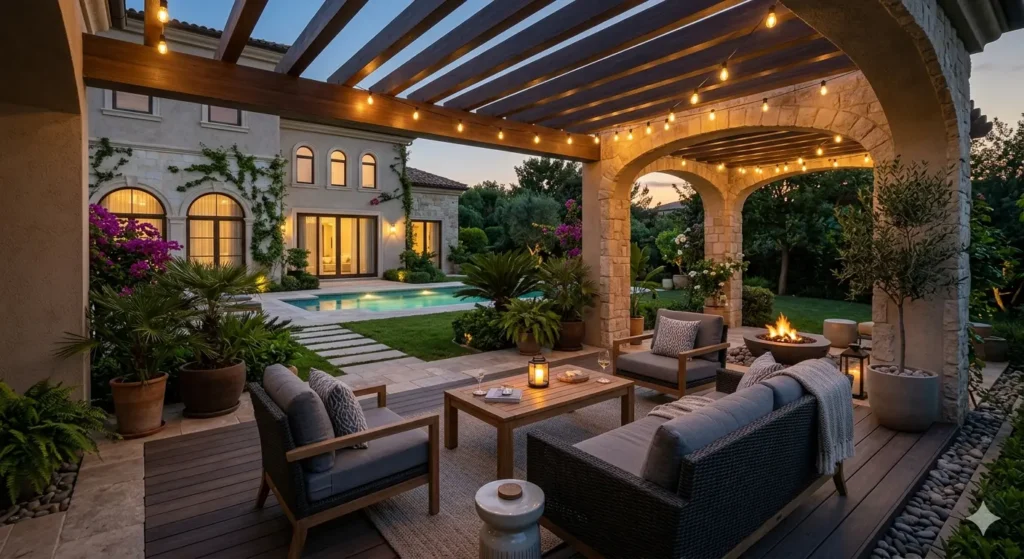
One of the design advantages that Pipla’s newer plotted developments and villa layouts offer — an advantage that many central Nagpur localities genuinely can’t provide — is outdoor space that can be designed as part of the home rather than left as a raw boundary condition.
A compound with a covered sit-out, a rear garden that receives the evening light, a roof terrace that catches the morning — these spaces, properly designed and furnished, add a quality of daily life that the floor-area calculation of the home doesn’t capture. In Nagpur’s climate, a well-designed outdoor space is usable for six to seven months of the year without air conditioning, and during the cooler months from October through February it can be the most pleasant room in the house.
The design investment required to make an outdoor space genuinely usable and comfortable is modest relative to the interior. Weather-appropriate flooring — natural stone, outdoor-rated tile, or treated wood decking. Outdoor-rated furniture in materials that handle Nagpur’s temperature cycling without deteriorating rapidly. Lighting that extends the space’s usability into the evening — warm-white outdoor fixtures on a simple circuit, positioned to create atmosphere rather than just illumination. Planting that provides shade, visual privacy, and the sensory quality that a garden brings to daily life.
If your Pipla of Hudkeshwar home has outdoor space and it’s currently a raw slab or a neglected patch of earth, it represents one of the most underleveraged opportunities in your property.
Complete Investment for a Pipla Interior
2BHK apartment in Pipla, mid-range specification, complete interior fit-out: ₹8 to ₹13.5 lakhs.
3BHK at mid-range specification: ₹12 to ₹20 lakhs.
3BHK at premium specification with flooring upgrade, architectural lighting, bathroom renovation: ₹22 to ₹36 lakhs.
Independent house or villa in Pipla, comprehensive interior at premium specification including outdoor spaces: ₹32 to ₹58 lakhs depending on size and scope. Plan your dream home smartly by understanding the 3BHK Interior Design Cost in Besa Nagpur for a perfect balance of budget and luxury.
QC Interiors works in Pipla and across Nagpur’s residential market. Book your free consultation today.
