
Best Interior Designer in Ghogli Nagpur: Designing Homes in a Nagpur Neighbourhood That’s Found Its Footing
There’s a particular kind of satisfaction that comes from choosing a neighbourhood before it becomes obvious. Ghogli sits in that position right now in Nagpur’s residential landscape — a locality that people who pay attention to how cities develop have been watching with quiet interest, because the fundamentals that make a neighbourhood genuinely good to live in have been assembling here steadily and without a lot of fanfare.
The connectivity has improved. The social infrastructure — schools, medical facilities, the daily-use markets and services that make ordinary life run without friction — has filled in. The housing stock has grown in quality as developers have recognised that the families moving here have real expectations and aren’t going to be satisfied with construction that cuts corners. And the community character that takes time to develop in any locality — the sense that this is a place where people have put down roots and intend to stay — has started to establish itself in Ghogli in a way that wasn’t quite true five years ago.
The families who’ve been building and buying homes here over the last several years tend to be people who made a deliberate decision. They looked at Nagpur’s options, they thought about what they actually needed from a neighbourhood versus what they thought they should want, and they landed here. That kind of intentionality in the housing decision tends to carry through into how families approach the interior design of their homes.
When a Ghogli family sits down with an interior designer, they’re usually not looking for someone to tell them what’s fashionable. They’re looking for someone who will listen to how their specific family lives, understand what the home needs to do for them specifically, and design something that works for the next ten to fifteen years of their actual life. That is, genuinely, the best brief an interior designer can receive.
Best Interior Designer in Ghogli Nagpur
What the Homes in Ghogli Are Like
The residential stock in Ghogli has developed in layers that reflect different eras of the neighbourhood’s growth. There are older independent houses on plots that were developed when Ghogli was still on Nagpur’s relative periphery and land was priced accordingly — these properties tend to have the generous room sizes and more flexible plot configurations that earlier residential development in expanding Indian cities typically produced. There are mid-rise apartment complexes from the last decade, built to specifications that have improved as the locality’s demand profile has upgraded. And there are newer residential developments — some apartment complexes, some plotted villa developments — that represent the current generation of construction quality in this part of Nagpur.
Each type presents a different design situation.
The older independent houses have good bones — ceiling heights that give the interior design room to work, room dimensions that accommodate properly scaled furniture without crowding, and construction that has proven its durability. What they typically need is a comprehensive renovation that brings the interior quality forward: a kitchen that functions properly for contemporary Indian household cooking, bathrooms that don’t feel like they belong to a different decade, flooring that has some character rather than the dated vitrified tile that most of these homes were finished with originally, and a coherent design language applied across the whole home rather than the patchwork of piecemeal decisions that accumulates over twenty years of occupancy.
The newer apartments are more standard in their design requirements but no less demanding in terms of what the families expect from the finished result. A contemporary apartment in Ghogli’s newer complexes comes from the developer with a kitchen platform, basic bathroom fittings, and walls that are ready for painting — a serviceable starting point that needs a designer’s hand to become a home with genuine character and quality.
The plotted villas that have come up in some of Ghogli’s newer residential layouts offer the most interesting design opportunities. Families who’ve chosen a villa development have made a deliberate choice to invest in space and quality beyond what an apartment provides — and they come to the interior design process with ambitions that match that investment.
Light, Orientation, and Why Both Matter More Than Most People Realise
Ghogli’s position in Nagpur — away from the dense inner-city fabric, with newer developments that generally have more open space between buildings — means that many of its homes receive generous natural light without the obstruction that affects lower floors in closely packed central-city complexes.
This is genuinely good news for interior design. Natural light is the single most important factor in how a home feels to live in, and homes with generous light access have a quality ceiling for interior design outcomes that constrained-light homes simply can’t reach.
But generous natural light in Nagpur comes with the obligation to manage it thoughtfully. By late March, the summer sun in Ghogli is the same sun as everywhere else in Nagpur — intense, high-contrast, directional in ways that reveal colour undertones without mercy and create uncomfortable glare in rooms without adequate window treatment provision.
The window treatment design in a Ghogli home needs to be integrated into the interior design scheme from the beginning rather than selected separately as a finishing detail. In well-lit rooms with east or west-facing windows, sheer curtains or solar roller blinds that diffuse direct sunlight without blocking it maintain the room’s brightness and connection to the outside while making the light liveable rather than harsh. In south-facing rooms that receive consistent but relatively warm light through the day, the diffusion requirement is less acute, and the window treatment can be lighter and less interventionist.
The palette for well-lit Ghogli homes follows the reliable Nagpur principle: warm whites with good LRV — around 76 to 84 — as the primary wall colour, with enough warmth in the undertone to read correctly under the summer sun’s cool, blue-shifted light. Accents from the earth palette on single feature walls. Every colour decision assessed in the actual room light at multiple times of day before final commitment.
Living and Dining Rooms: Designing for How Ghogli Families Spend Their Time
The families in Ghogli’s newer residential developments tend to use their homes in a particular way that’s worth acknowledging in the design brief: they’re often away from the home during the day — work, school, the full schedule of a two-income household with school-going children — and the home gets used most intensively in the evening and on weekends. The interior design should reflect this.
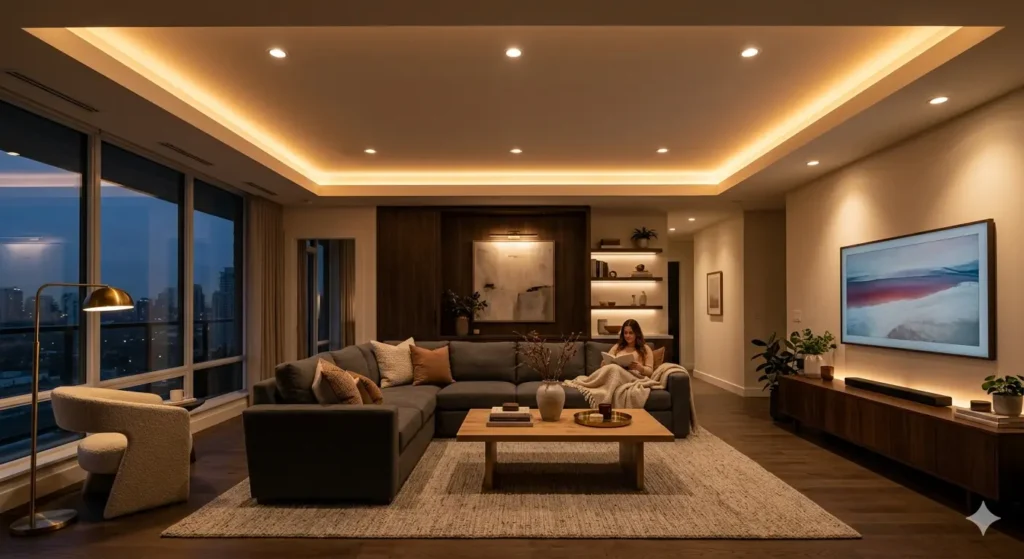
Evening use means lighting is not peripheral — it’s central. A living room whose lighting design is excellent transforms the experience of coming home at the end of a working day in a way that good furniture or a well-chosen accent wall, on their own, don’t quite achieve. The layered lighting approach — warm cove LED at perimeter, positioned downlights over specific zones, a reading light at the sofa end, a task light in the dining area — creates a room that has the right quality of light for every activity and every time of day. This requires designing the lighting from the beginning, with the ceiling design and the electrical rough-in done before any finishing work, not retrofitting a lamp here and a wall light there after the fact.
Weekend use means the living room needs to flex. Hosting family, managing children’s activities in the same space as adult conversation, accommodating the occasional larger gathering — the furniture layout and the storage design should support all of this rather than being optimised for a single, static use. A sofa group that faces both the television and the rest of the seating. A dining table that can expand. Built-in storage that absorbs the household’s objects and keeps the surfaces clear enough that the room looks presentable without requiring active management before every visitor arrival.
The false ceiling design in a Ghogli living room at standard apartment height — typically 10 to 10.5 feet in contemporary complexes — should use the volume intelligently. A gypsum ceiling with a defined perimeter cove that creates a visual border between the ceiling and the wall, integrated cove LED, and recessed downlights positioned over the specific zones they’re meant to illuminate. The air conditioning linear diffusers and any mechanical elements should be integrated into the ceiling design from the beginning — this requires coordination between the interior designer and the AC contractor before any ceiling work begins, which is a simple organisational step that is frequently skipped and always regretted.
The focal wall — almost always the TV wall in a contemporary Ghogli living room — should be designed as a full-height architectural treatment. In a room with 10-foot ceilings, a floor-to-ceiling treatment in fluted wood veneer or a combination of stone-effect cladding and recessed joinery reads as a genuine architectural element rather than a decorated surface. The difference in how the room feels — finished versus merely furnished — is significant and immediate.
The Kitchen: Where the Design Investment Shows Up in Daily Life
Ask any family in Ghogli who has undergone a complete interior renovation which element made the most tangible difference to their daily quality of life. The kitchen comes up consistently, and the reason is simple: it’s the room that gets used with the most intensity, for the most hours, by the most family members, with the least tolerance for things that don’t work properly. Design your dream home effortlessly with expert interiors for new flats in Narsala Nagpur tailored for modern living.
The kitchen design brief for a Ghogli home is almost always a renovation rather than a first fit-out — even in newly purchased apartments, the developer kitchen platform is a starting point rather than a finished kitchen. Getting the renovation right requires a level of honesty in the brief that not everyone is comfortable with initially but that produces dramatically better outcomes than the sanitised brief.
What does the family actually cook? At what scale? How many people typically work in the kitchen simultaneously? What appliances are currently in use and what appliances are aspired to? Where is the current kitchen failing — counter space, storage, chimney extraction, counter height, workflow between the preparation and cooking zones? What’s the dishwashing situation — by hand, by machine, or both? These questions aren’t asked to be intrusive. They’re asked because a kitchen that’s designed around honest answers to these questions is a genuinely different kitchen from one designed around assumptions.
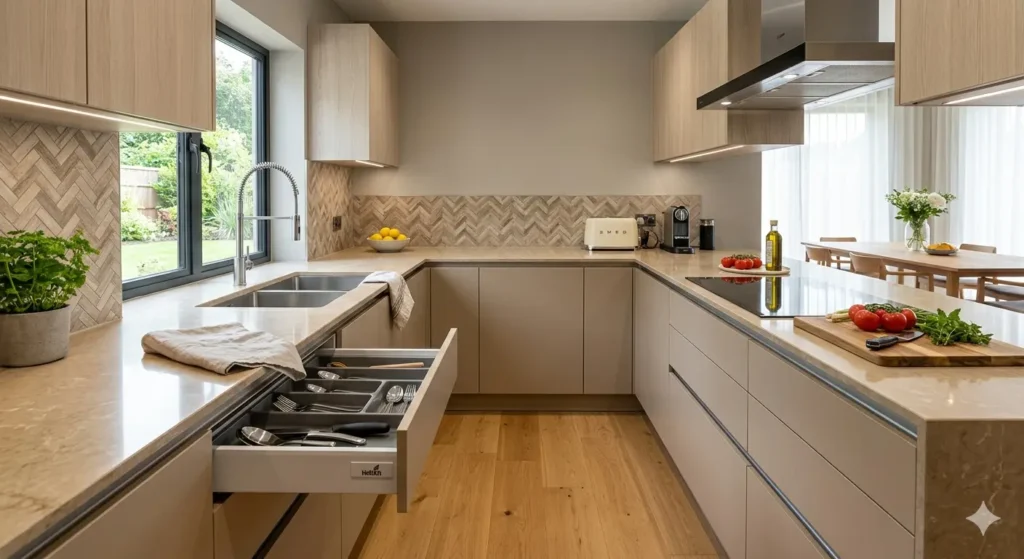
The storage audit is particularly important in Ghogli kitchens, as it is across Nagpur’s residential market. The spice inventory, the vessel collection, the grain and flour storage requirement, the hierarchy of daily-use versus occasional-use items — these need to be planned for specifically rather than assumed to fit into a standard modular storage package. A kitchen with genuinely good storage design — where everything has a specific, logical place and daily-use items are accessible without bending, reaching, or moving other things — changes the experience of cooking in a way that no countertop material or shutter finish can replicate.
For the countertop: quartz is the appropriate specification for most Ghogli kitchens. It handles the temperature cycling and the daily use of Indian cooking without requiring the maintenance that natural stone demands, is available in a range of warm neutral tones that work with Nagpur interior palettes, and holds its appearance well over years of real use. Laminate countertops are a false economy in a kitchen that’s going to see genuine daily Indian cooking — the edge swelling, the surface discolouration from heat exposure, and the general wear of laminate over five years of real use make it a specification that most families regret.
Hardware from Hettich or Blum — soft-close hinges, quality drawer runners, mechanisms that continue to work smoothly after years of daily use rather than developing the characteristic looseness and noise of cheaper alternatives — is worth the additional expenditure. It’s not glamorous, but it’s the difference between a kitchen that feels quality every time you use it and one that starts to feel tired before the surface finishes do.
Mid-range complete modular kitchen for a Ghogli home, installed: ₹2.5 to ₹5 lakhs. Premium specification with quartz countertop, quality hardware, proper chimney, and genuinely designed storage: ₹5 to ₹9 lakhs. For a villa kitchen with island configuration and integrated appliances: ₹8 to ₹14 lakhs.
Bedrooms: The Full-Height Wardrobe and Everything That Follows From It
The master bedroom in a Ghogli apartment typically runs between 150 and 220 square feet — dimensions that allow for good design if the key decisions are made correctly and that feel cramped if they’re not.
The wardrobe is the decision that matters most. Not because it’s the most visually dramatic element in the bedroom, but because it’s the element whose functional success or failure affects daily life most directly. A wardrobe that doesn’t organise the family’s clothing and accessories properly — that doesn’t have enough hanging space, that has shelves at the wrong heights, that makes finding a specific item a search operation rather than a retrieval — is a daily frustration that no amount of beautiful ceiling design compensates for.
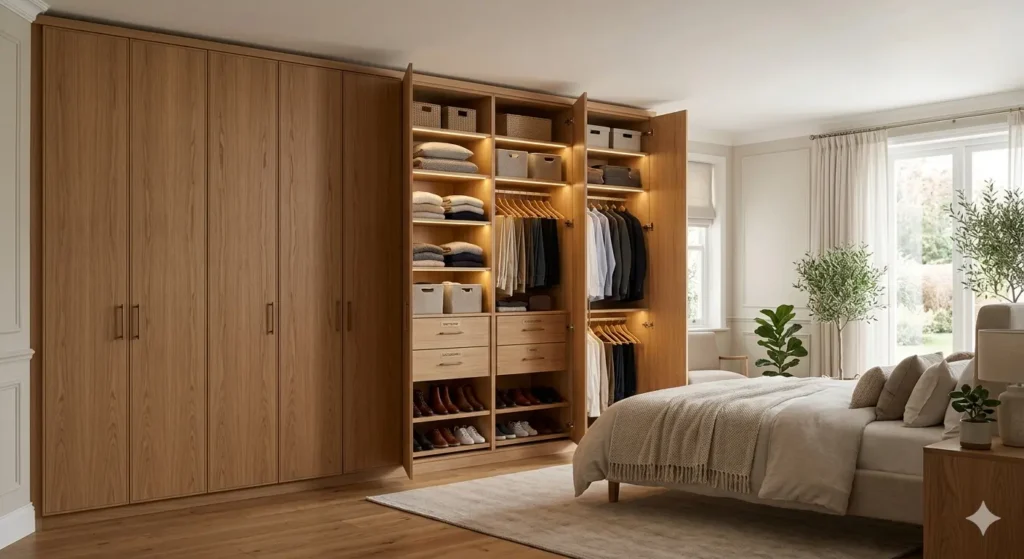
The full-height wardrobe — running wall to wall, using the full floor-to-ceiling dimension — is the specification that makes sense in almost every Nagpur bedroom regardless of the room’s overall size. It provides more storage volume than a standard-height unit in the same wall width. It makes the room feel taller. And when the shutter design is handled with care — a warm veneer finish, a profile detail that gives the flat surface some visual interest, hardware that feels quality to the touch — it becomes the room’s primary architectural statement.
The internal organisation of the wardrobe matters as much as the external design. Different hanging heights for different clothing types. Drawer provision at heights that are comfortable to use without bending or reaching. Shelf spacing calibrated to what’s actually being shelved. A dedicated section for accessories and smaller items. These decisions, made thoughtfully in the design phase, produce a wardrobe that the family uses efficiently from the first day rather than one that fills up in a pattern that doesn’t quite match how the family actually stores things.
The bedhead wall is the second most important bedroom design decision. A painted accent in a warm, restful tone — a very muted terracotta, a soft warm sage, a pale warm grey with yellow in it rather than blue — creates the focal point the sleeping zone needs without requiring significant material investment. A textured wallpaper panel or a fabric-upholstered panel behind the bed gives the same focal quality with more material richness, appropriate in a premium specification bedroom.
Lighting in the Ghogli bedroom: the standard builder provision of a single central ceiling light is a starting point, not a design. Cove lighting in the ceiling perimeter provides warm ambient illumination in the evening without the harshness of an overhead source. Wall-mounted reading lights at the correct height — approximately 900mm above the mattress level, positioned so the light falls on the page rather than in the reader’s eyes — replace the bedside lamp that takes up table surface and creates asymmetry when only one side has it. A dimmable control for the ambient layer gives the bedroom lighting the flexibility it needs for the different uses the room serves.
Children’s bedrooms in Ghogli homes: design with the next five years in mind, not just the current age of the child. The built-in storage and the flooring will last through multiple room redesigns. The wall colour, the furniture style, the decorative elements — these are the layers that change as the child grows, and they’re also the least expensive layers to update. Invest in what endures.
Bathrooms: The Space That Tells the Truth About the Rest of the Home
A bathroom that looks dated and functions poorly is the space that undermines the impression of a home more than any other single element. It can follow three rooms of genuinely impressive interior design and undo the effect of all of them. In Ghogli homes — particularly in the older properties and in apartments that haven’t been renovated since they were first occupied — the bathroom renovation is frequently the investment with the highest impact relative to its cost.
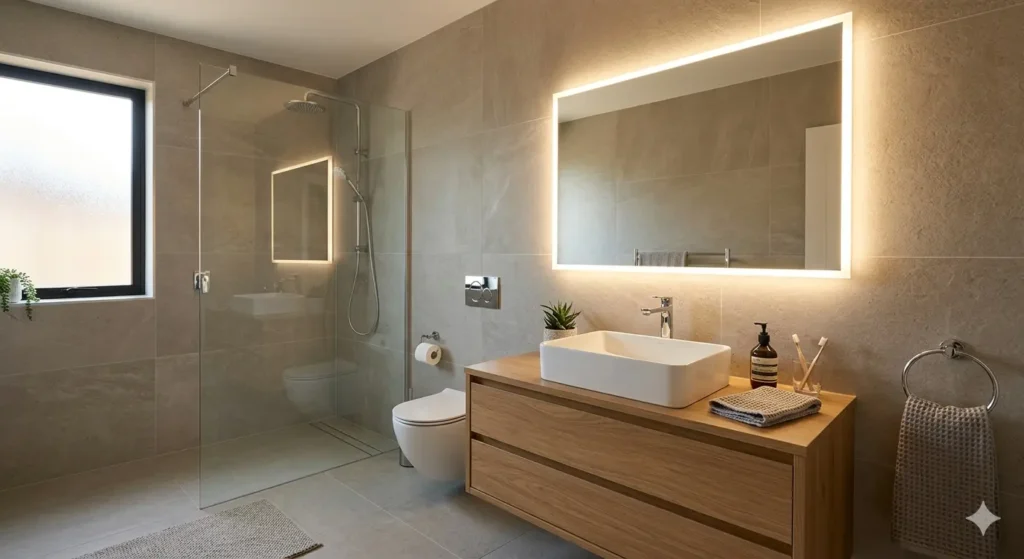
Large-format tiles in warm neutral tones — 600x1200mm minimum, laid with tight grout lines — make the bathroom feel significantly more contemporary and more generous than the small-format tiles that were standard in Nagpur bathroom construction for many years. A wall-hung WC and basin free the floor plan in a way that makes the bathroom easier to clean and visually less cluttered. A properly specified shower enclosure — frameless or semi-frameless, with a quality thermostatic fitting rather than a basic single-function fitting — creates the luxury of function that the bathroom needs.
Mirror lighting is the detail that most Ghogli bathroom renovations underinvest in. Overhead downlights alone are both functionally inadequate and aesthetically unflattering. A backlit mirror with even perimeter illumination, or wall-mounted lights flanking the mirror at face height, creates the lighting quality that makes the bathroom work properly for grooming while also creating an atmosphere that feels considered rather than merely functional.
Bathroom renovation at mid-range specification for a Ghogli home: ₹1.8 to ₹3.5 lakhs per bathroom. Premium specification with quality imported fittings, custom vanity unit, and backlit mirror: ₹3.5 to ₹6 lakhs.
The Pooja Space: Not an Afterthought
In Ghogli homes — as in virtually all traditional Nagpur family residences — the pooja space carries real significance. It’s used daily, it’s a genuine centre of family ritual life, and it deserves design attention that matches that significance.
Whether it’s a dedicated room in one of the neighbourhood’s newer villas or a carefully designed alcove in an apartment, the pooja space needs proper platform provision in marble or natural stone, warm and soft lighting from within the space rather than harsh overhead illumination, storage for ritual materials that keeps the space ordered without cluttering its visual character, and a design language that expresses the space’s significance rather than treating it as one more joinery element.
Complete Investment for a Ghogli Interior
2BHK apartment, mid-range specification, complete interior fit-out: ₹8.5 to ₹14 lakhs.
3BHK at mid-range specification: ₹13 to ₹21 lakhs.
3BHK at premium specification with flooring upgrade, architectural lighting, bathroom renovation: ₹23 to ₹38 lakhs.
Newer villa or independent house in Ghogli, comprehensive interior at premium specification: ₹35 to ₹60 lakhs depending on size and scope.
Why Choosing the Right Designer Matters in Ghogli Right Now
Ghogli is at a stage in its development where the quality of what gets built and designed here will set the standard for the neighbourhood’s next decade. Homes that are designed and executed with genuine quality will hold their value and their livability in a way that homes assembled from budget compromises simply won’t.
The designer you choose should show you completed work in Nagpur — not only portfolio photographs, but projects you can visit and experience in person. They should be able to specify materials clearly, explain the rationale for every key decision, and give you a project timeline tied to execution milestones rather than to the designer’s convenience.
QC Interiors works in Ghogli and across Nagpur’s residential market. Book a free consultation and let’s talk about your home. Transform your home with expert Interior Design for Flats in Beltarodi Nagpur tailored for modern living and smart space utilization.
