
Best Interior Design for Nagpur’s Extreme Heat.
Nagpur’s summers are not a minor inconvenience that good air conditioning can fully offset. From late March through to mid-June, temperatures regularly exceed 44 degrees Celsius — making Nagpur one of the hottest cities in India during this period and one of the few urban centres where interior design decisions have a direct, measurable effect on thermal comfort, energy consumption, and the long-term condition of every material in the home.
The families who have lived here for any length of time understand this intuitively. They know which room faces west and becomes uninhabitable by four in the afternoon in May. They know which wall gets hot enough in summer to feel warm to the touch from the inside. They know which flooring choice — made without thinking about heat — now radiates discomfort through the soles of their feet for four months a year. They also know, in many cases, that the interior design they received at possession was not designed for Nagpur’s climate at all. It was designed for a notional Indian apartment that exists somewhere with a more moderate climate, and it was applied here without adjustment.
Designing a home for Nagpur’s extreme heat is a specific discipline, and it begins with understanding the mechanisms by which heat enters, accumulates, and dissipates in a building — because the design responses follow directly from that understanding.
Best Interior Design for Nagpur’s Extreme Heat
How Heat Enters a Nagpur Home
Heat enters a building in three primary ways: solar radiation through windows and skylights, conduction through walls and roofs from the hot outdoor air, and infiltration of hot outside air through gaps and openings.
In a Nagpur apartment or bungalow, the dominant pathway is usually a combination of the first two. Solar radiation through glass is particularly aggressive because glass transmits radiation with very low resistance — a single-glazed west-facing window in a Nagpur flat on a May afternoon admits heat that a 1.5-tonne split AC will struggle to fully offset. The second pathway — conduction through walls — is most significant for flats on the top floor, which receive direct solar gain on the roof slab all day, and for rooms on the west and south elevations, where the wall surface temperature can reach 55 to 65 degrees Celsius on a peak summer day.
Understanding which rooms in your specific flat are most thermally exposed — which face what direction, which walls are exterior, whether you are on an upper floor — is the starting point for every heat-management interior design decision.
Window Treatments That Actually Work
Window management is the highest-leverage intervention for reducing heat gain in a Nagpur home, and it is the one that is most consistently mishandled in standard interior specifications.
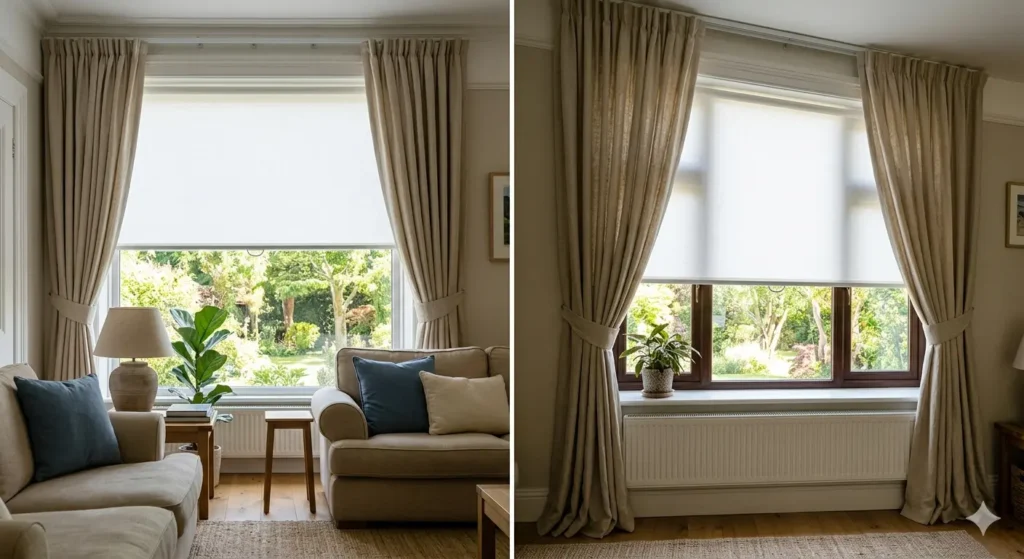
The principle is simple but counterintuitive to anyone accustomed to temperate climates: in Nagpur’s summer, the purpose of a window covering is not to filter light. It is to block heat. Solar radiation carries both visible light and infrared heat, and fabric curtains — even heavy ones — manage the light but transmit most of the heat. A room with floor-to-ceiling curtains that look impressive but are made of a light woven fabric will still be 5 to 7 degrees hotter than the same room with a proper solar-blocking roller blind underneath.
The most effective window treatment combination for Nagpur homes: a solar-reflective roller blind in white or a light neutral as the primary heat-blocking layer (a quality solar roller blind with a high reflectance rating blocks 80 to 90 percent of solar heat gain through the glass), paired with a fabric curtain in a natural linen or cotton blend that provides the soft visual quality of a well-dressed window. The blind does the thermal work; the curtain provides the aesthetic.
For west and south-facing windows in rooms that have significant occupancy in the late afternoon — family rooms, dining rooms, home offices — this combination is not optional. It is the difference between a room that remains thermally manageable with air conditioning and one that your AC cannot keep comfortable even at maximum capacity.
Cost for quality solar roller blinds in a 2BHK — all primary rooms: ₹28,000 to ₹55,000 depending on window sizes and the specification of the blind material.
Flooring for a Hot Climate: What Works and What Doesn’t
Flooring is a sensory experience in ways that become very direct in Nagpur’s climate. The floor surface temperature in a room that has been closed for several hours on a 45-degree day varies dramatically depending on the material — and the difference is felt immediately through the feet.
Vitrified tile — the standard specification in virtually every Nagpur apartment — has a thermal mass that makes it feel cool underfoot in an air-conditioned room but very warm in a room that has been closed and exposed to heat. This is not necessarily a problem if the room is air-conditioned regularly, but it means the floor takes time to cool down after the AC is switched on.
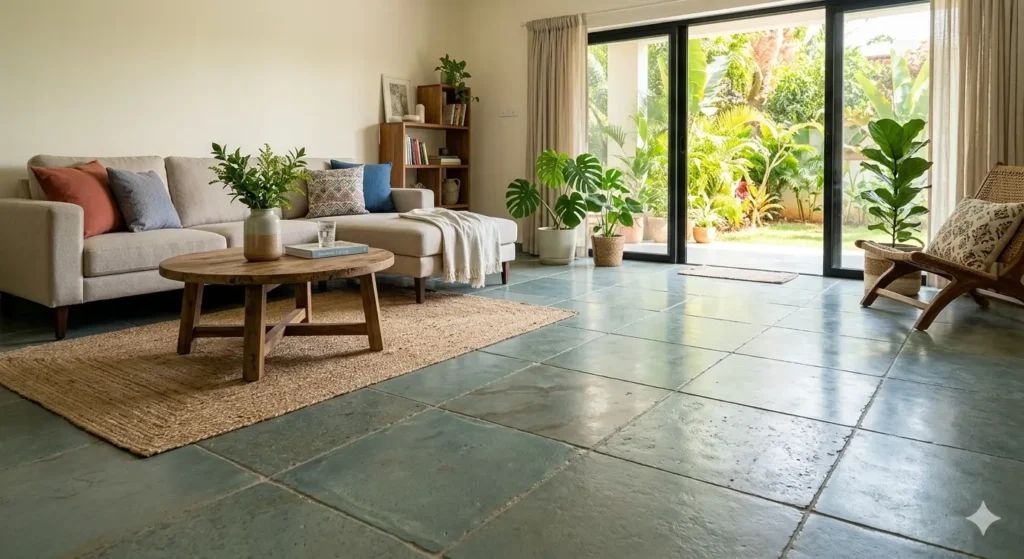
Natural stone — specifically Kota stone, which has been used in Nagpur homes for generations — has a lower thermal conductivity than vitrified tile, which means it absorbs heat more slowly and releases it more gently. A Kota stone floor in a Nagpur home stays noticeably cooler to the touch than a vitrified tile floor of the same area in the same thermal conditions. For families who walk barefoot — as most Indian households do indoors — this is a real comfort difference.
Wooden flooring and engineered wood have the lowest thermal conductivity of standard flooring options, making them the most comfortable underfoot in both summer and winter. The significant qualification: natural wood flooring in Nagpur requires careful species selection and very thorough sealing, because the humidity swing between the pre-monsoon summer (extremely dry) and the monsoon (very humid) is severe enough to cause dimensional movement in woods that are not suited to it. Engineered wood — a thin hardwood veneer over a stable plywood or HDF core — handles Nagpur’s humidity swing far better than solid wood and delivers the same thermal comfort benefit.
Avoid dark-coloured flooring in south and west-facing rooms. Dark surfaces absorb significantly more radiant heat than light surfaces, and on a peak summer day in Nagpur, a dark floor in a sun-exposed room will be meaningfully warmer than a light one.
Wall Colours That Handle Nagpur’s Light
Nagpur’s summer light is intense — not the soft, diffused northern European light for which many contemporary interior colour palettes were originally developed, but a hard, direct light that reads cool or warm tones in ways that can produce uncomfortable or visually exhausting interiors if the palette was not chosen for this specific condition.
The principle: in strong direct light, cool tones look harsher and cooler whites look stark. Warm whites — those with a slightly yellow or cream undertone — handle Nagpur’s light better than pure whites or cool whites, looking balanced in strong sun and warm and inviting in the evenings under artificial light.
Off-whites and warm creams as the primary wall colour in living areas and bedrooms are the palettes most tested and most reliable in Nagpur’s conditions. They do not glare in the harsh summer light, they do not look cold in the low morning light of a north-facing room, and they respond well to warm-white LED lighting in the evenings.
For accent walls and secondary surfaces, the colours that consistently work in Nagpur interiors: warm terracottas and Indian-earth tones (the climate’s original palette, for excellent reason), soft ochres and honey yellows, and muted sages and olive greens that have enough warmth in them to avoid looking clinical. Cool blues, cool greys, and pure whites are the palette choices that most often need revisiting after a first Nagpur summer.
Ceiling Design and Air Circulation
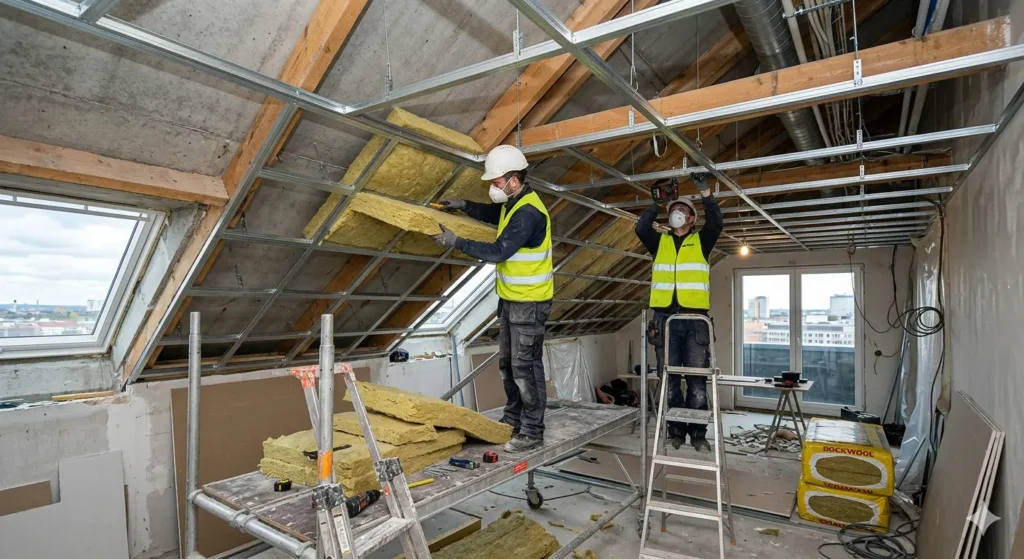
The false ceiling plays a specific role in heat management in Nagpur homes that is separate from its visual and lighting functions. A gypsum false ceiling creates a dead air space between the ceiling slab and the finished ceiling surface — and this air space acts as a modest thermal buffer, reducing the rate of heat transfer from a hot roof slab above into the living space below.
For top-floor flats in Nagpur, where the roof slab is exposed to direct sun all day, the thermal buffering effect of a false ceiling is significant enough that it reduces the AC load measurably. The ceiling slab surface temperature on a peak summer day on the top floor of a Nagpur building can reach 50 to 55 degrees. A false ceiling with a 12 to 18-inch air gap introduces a meaningful resistance into that heat transfer path.
The additional ceiling design measure for maximum heat management in top-floor Nagpur flats: mineral wool or glass wool insulation installed within the false ceiling cavity. This adds ₹40,000 to ₹80,000 to the ceiling budget for a full flat and can reduce the room temperature by 3 to 5 degrees on a peak summer day — a reduction that translates directly into lower AC runtime and electricity consumption.
Kitchen Ventilation in a Nagpur Summer
The kitchen is the most thermally demanding room in any Nagpur home during summer, and it is the room where ventilation design has the most immediate effect on comfort.
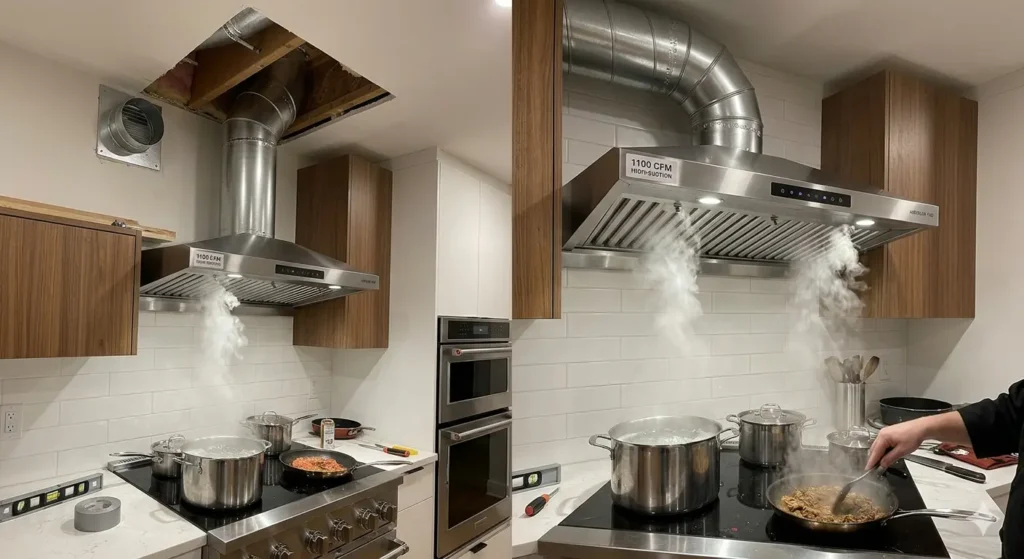
Indian cooking generates heat, steam, and airborne oil particles at rates that require serious ventilation — not a recirculating chimney with a carbon filter that cleans the air and puts it back into the kitchen, but a ducted chimney that moves the cooking exhaust completely out of the apartment. In a Nagpur kitchen running at full capacity — two or three burners, a pressure cooker, a deep-frying cycle — a recirculating chimney will leave the kitchen air at 38 to 42 degrees and at high humidity, regardless of the adjacent AC.
A properly ducted chimney rated at a minimum 900 to 1,100 CFM, combined with a cross-ventilation window that draws fresh air into the kitchen when the exhaust is running, is the correct kitchen ventilation specification for Nagpur. It is not a premium addition. It is the baseline for kitchen comfort in this climate.
The Air Conditioning Design Decision
Interior design and air conditioning specification are not separate conversations in Nagpur. The AC layout — the number of units, their positioning, the furniture arrangement that allows the air to circulate — is a design decision that should be made as part of the room’s design brief, not after the room has been designed and furnished.
The two most common AC-related design errors in Nagpur homes: positioning AC units directly above seating or sleeping areas (so the cold air blows directly on occupants, causing discomfort and respiratory issues), and placing furniture in ways that block the return air path and reduce the AC’s efficiency. Both are preventable with a design process that considers the AC layout as part of the room’s spatial plan.
For rooms above 200 square feet in Nagpur — the combined living and dining space, the master bedroom — the AC specification should be reviewed against the room’s thermal load, which includes the direction it faces, whether it is on an upper floor, and how many people occupy it. The standard 1.5-tonne split AC is undersized for a west-facing living room above the fourth floor in a Nagpur building during the summer peak.
A Home Designed for This Climate
A Nagpur home designed specifically for the city’s extreme heat — with the right window treatments, appropriate flooring, climate-responsive colour palette, properly insulated false ceilings on upper floors, correct kitchen ventilation, and an air conditioning layout that is part of the room’s design — is a home that is meaningfully more comfortable for eight months of the year than one that was designed without these considerations.
The investment required is not disproportionate. Most of these decisions are choices rather than additional costs — between a solar roller blind and a fabric curtain, between light flooring and dark flooring, between a ducted chimney and a recirculating one. The premium, where it exists, is modest relative to the thermal comfort benefit delivered for the life of the home.
Book Your Climate-Conscious Interior Design Consultation
QC Interiors designs specifically for Nagpur’s climate. Every project we undertake considers material selection, window treatment, ceiling design, ventilation, and AC layout in the context of the specific flat’s orientation, floor level, and thermal exposure. If you are renovating a Nagpur home, the climate conversation should happen at the beginning of the design process, not after the decisions are already made. Book your free consultation today.
