
Home Interior Design on Besa-Pipla Road Nagpur: Designing for One of the City’s Most Active Corridors.
There is a particular energy to Besa-Pipla Road that you notice the moment you drive along it on a weekday morning. Tower cranes on three different plots. A new society completing its final phase while families are already living on the floors below. The general sense of a neighbourhood that is mid-construction — not finished, not stalled, but actively, visibly becoming something. The families who have bought homes along this corridor and in the societies that branch off it are living in that becoming, and their interiors are the most immediate way to create the home they moved here to have.
The Besa-Pipla Road corridor has absorbed significant residential development over the past eight to ten years. Driven by its connection to MIHAN in the south and the established areas of Besa and Manewada to the north, it has attracted a mix of buyers: apartment residents in societies from multiple builders at multiple price points, independent home owners in plotted layouts, and families who bought here because the connectivity was good and the values were sensible.
QC Interiors has been working with families along this corridor since the first wave of project deliveries, and we understand the specific design context, the common starting conditions, and the approach that delivers the best results in these homes.
Interior Design on Besa-Pipla Road Nagpur
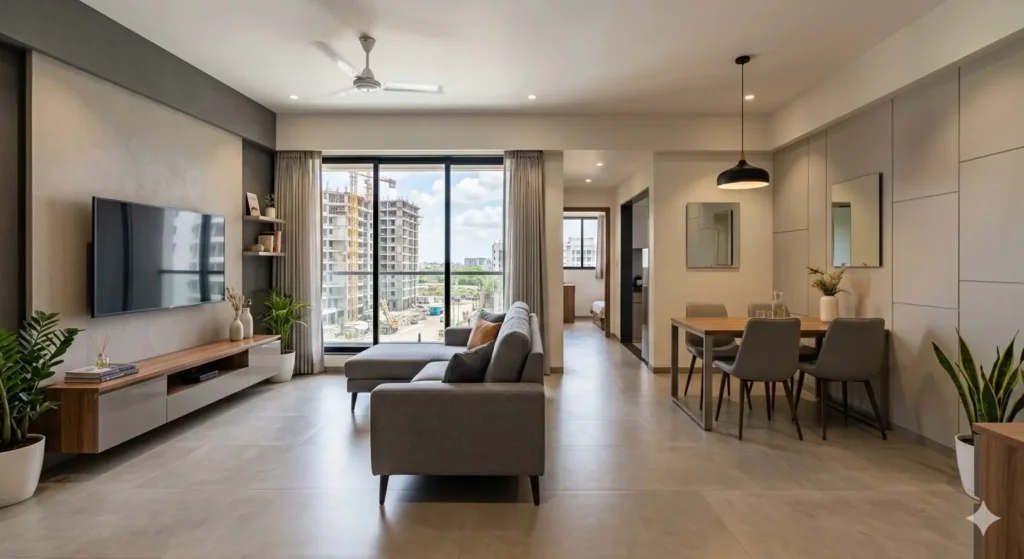
Understanding the Homes Along This Corridor
Most residential units on and off the Besa-Pipla Road are 2BHK and 3BHK apartments ranging from 750 to 1,150 square feet of carpet area. The construction quality varies by builder and era, but is generally competent — not the quickly-built units of Nagpur’s earlier development boom, but not premium construction either.
Builder finishes across most Besa-Pipla societies follow the standard template: vitrified tile in cream or beige tones, plain painted walls, a kitchen space with slab and connections, and bathrooms with basic fittings. One characteristic of this corridor worth noting for design purposes: some units face ongoing construction rather than settled views, and the ambient light in certain orientations is affected by scaffolding and incomplete buildings nearby. This is a transitional reality — the corridor will look different in three years than it does today — but it is worth accounting for now when planning window treatments, light-coloured walls that may gather more dust during nearby construction, and outdoor spaces that are not yet useful.
The Design-First Approach for Besa-Pipla Homes
Every QC Interiors project on this corridor begins with a thorough site visit: mapping the flat’s sun orientation at different times of day, assessing the construction quality of the specific unit, identifying the actual services (electrical circuits, plumbing positions, ventilation), and understanding the family’s specific brief. This is followed by a complete 3D design that shows the finished home before any work begins.
Families along this corridor are typically in the middle phase of their financial lives — established enough to invest properly in a home design, experienced enough to want to understand exactly what they are committing to before they commit. The 3D process gives them this clarity. They start work not with a verbal agreement about a general direction, but with a detailed visual plan that removes ambiguity from every decision and gives every contractor a clear instruction set to work from.
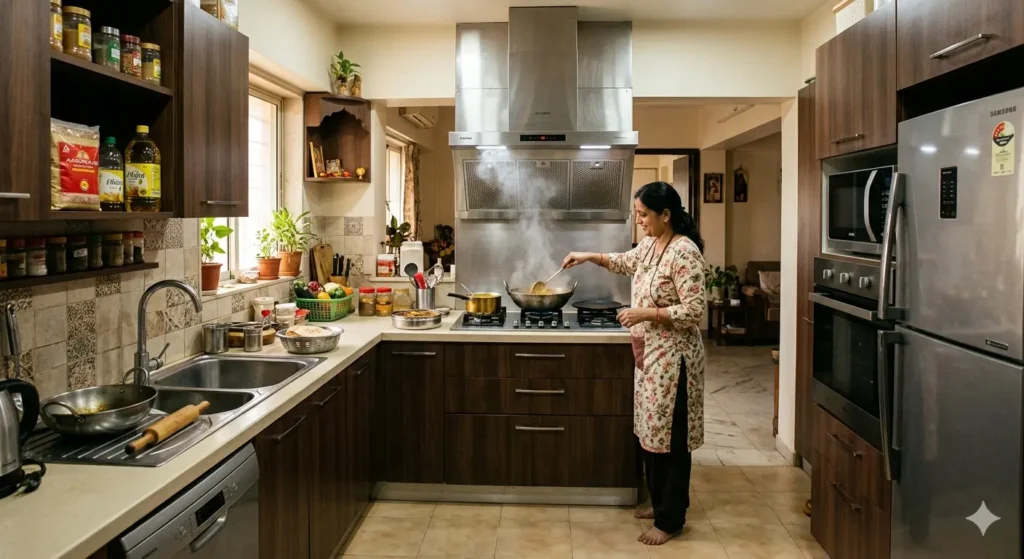
Kitchen Design for Besa-Pipla Homes
The kitchens in flats along this corridor are typically 80 to 115 square feet in an L-shaped or U-shaped configuration. The U-shaped kitchen is the most functional for Indian cooking — three walls of cabinetry create an efficient work triangle between the cooking zone, the preparation surface, and the washing area, with everything within a comfortable reach.
For a 3BHK kitchen on this corridor, a complete modular kitchen at mid-range specification runs ₹2.8 to ₹5 lakhs. This covers a full layout with laminate shutters in a contemporary colour, a granite countertop, a proper chimney, electrical points for all major appliances, and internal organisation accessories. A premium kitchen with membrane or acrylic shutters and quartz countertop: ₹5 to ₹8 lakhs.
One consistent finding from kitchens along this corridor: the chimney provision in the builder design is almost always undersized for real Indian cooking. Indian cooking generates fumes and moisture at a volume that European cooking benchmarks do not account for. A chimney with 900 to 1,200 CFM capacity, properly ducted to the outside rather than recirculated through a carbon filter, makes an immediate and lasting difference to the air quality and comfort of the entire flat. This is not a luxury — it is a basic functional requirement that the builder’s provision usually does not meet.
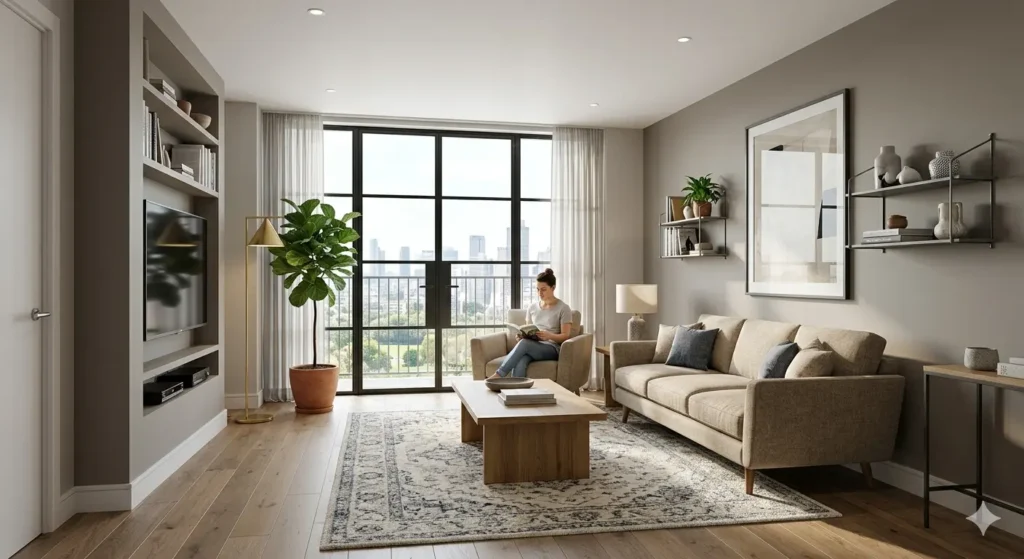
Living and Dining Areas: Creating the Social Core
Drawing rooms along the Besa-Pipla corridor face a common design challenge: variable natural light depending on orientation, builder-plain walls with no character, and the furniture accumulation problem — pieces bought over time from different eras and different sources that have never quite come together into a coherent living space.
The sequence that works most reliably for transforming a Besa-Pipla drawing room: start with the false ceiling, which establishes the room’s architectural character and creates the lighting infrastructure. Then the TV wall — designing it as a complete surface rather than a flat plane with a television attached to it. Then wall paint, chosen in relation to the ceiling and the flooring rather than in isolation. Finally, furniture scaled to the room and positioned according to a clear spatial plan.
This sequence — ceiling, focal wall, colour, furniture — consistently produces rooms that look designed rather than assembled. The false ceiling and cove lighting alone, costing ₹75,000 to ₹1.1 lakhs for the drawing and dining area combined, deliver a transformation that changes how the room feels at the most important moments — the evening hours when the family is home and the home’s character is most directly experienced.
Bedrooms: Rest, Privacy, and the Right Storage
Master bedrooms in Besa-Pipla apartments typically measure 140 to 185 square feet — enough for a king bed and wardrobes if designed properly, but tight if furniture is placed without a clear spatial plan. The single most effective bedroom intervention in this area is a full-height, full-width wardrobe that uses every available inch of the designated storage wall — matched on the inside to the specific clothing and personal storage patterns of the two people who use it.
Complement this with a proper wall colour (chosen for the room’s orientation — cooler tones for south-facing rooms, warmer tones for north-facing ones), recessed downlights over the reading zone, and a ceiling fan positioned correctly to move air over the sleeping area, and a well-designed bedroom in a Besa-Pipla flat delivers genuine comfort every night.
Wardrobe cost per bedroom: ₹35,000 to ₹70,000 depending on size and specification.
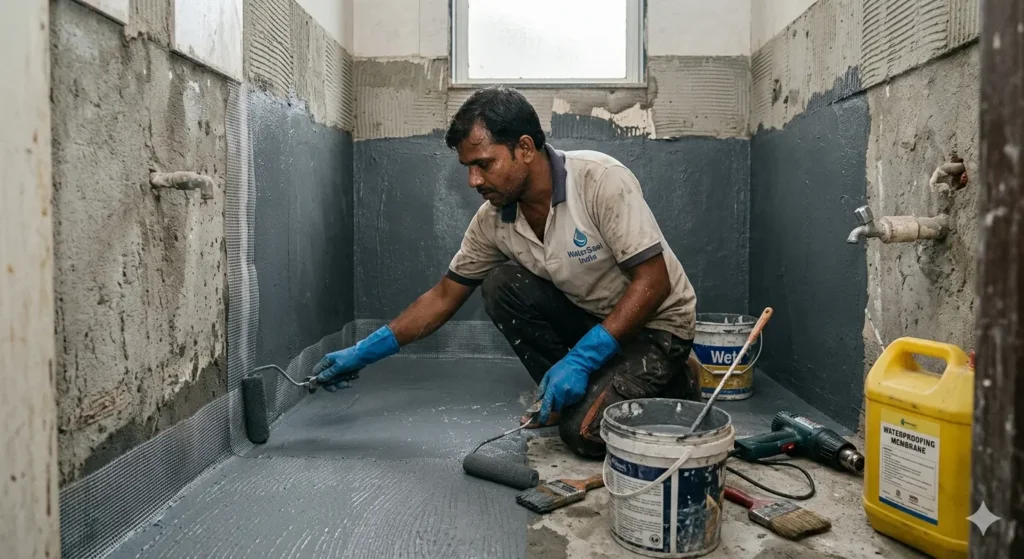
Bathrooms on This Corridor: Act Early
Flats along the Besa-Pipla corridor span a range of construction vintages from 2012 to the present. Units built between 2012 and 2018 are now entering or well into the window where builder waterproofing begins to age and show signs of wear. The indicators are consistent: dark patches at the base of bathroom walls, tiles that produce a hollow sound when tapped, paint blistering on the wall of an adjacent bedroom in the monsoon.
For families in these older societies, bathroom waterproofing treatment should be near the top of the renovation priority list — not below the drawing room ceiling or the new wardrobe design, but either alongside or before them. A complete bathroom renovation with proper waterproofing on all wet surfaces, new tiles, replacement fittings, and a vanity: ₹1.3 to ₹2.2 lakhs per bathroom.
Complete Interior Costs for Besa-Pipla Homes
A complete interior package for a 2BHK on this corridor: ₹7 to ₹11 lakhs. For a 3BHK: ₹10 to ₹16 lakhs. A focused renovation covering kitchen, wardrobes, and drawing room ceiling: ₹5 to ₹8 lakhs. All QC Interiors estimates are itemised in detail and presented formally before any work begins — no mid-project surprises, no vague scopes that expand unexpectedly.
Get Started With a Free Site Visit
QC Interiors offers free site visits for homes along the Besa-Pipla Road corridor. Book your visit today and begin the conversation about what your home can become.
