
Home Renovation Loan Guide for Nagpur Homeowners: Finance Your Dream Interior Without the Stress.
You have the home. You have the vision — a kitchen that finally works, wardrobes that solve the storage problem, a living room you are proud to walk into every day. You have spent enough time in the existing space to know, with conviction, that it is time to change it. The only thing standing between the home you have now and the home you want is the budget.
For many families in Nagpur — working professionals, salaried couples, joint families who have built their lives in this city — a home renovation loan is not a last resort. It is a practical, widely available, and financially sensible tool that makes the renovation possible now rather than after years of saving. The renovation does not have to wait for the full amount to accumulate in a savings account. The bank can be a partner in the project.
This guide is our honest, practical overview of everything Nagpur homeowners need to know about renovation financing: what loans are available, what they cost, how to apply, what documents are needed, and how to think about the decision sensibly. We are not a bank and this is not financial advice in the formal sense — but as a company that has helped hundreds of Nagpur families plan and execute renovations, we understand the financing landscape and we want families to approach it clearly.
Home Renovation Loan Guide for Nagpur
What Is a Home Renovation Loan and How Is It Different From a Home Loan?
A home renovation loan — also called a home improvement loan — is a loan product specifically designed for renovating, upgrading, or repairing an existing home. It is distinct from a home loan (which is for purchasing or constructing property) in several important ways.
First, it is faster to process. A home loan requires full property valuation, title verification, and extensive documentation because the loan amount is typically much larger and the bank takes the property as primary security. A renovation loan — particularly an unsecured personal loan used for renovation — can be processed and disbursed in five to seven working days from application, sometimes faster for pre-approved customers.
Second, it requires less documentation. For a salaried applicant with a good credit history, a renovation loan requires significantly fewer documents than a home loan.
Third, the amounts are smaller and the tenures are shorter — which means the total interest paid over the life of the loan is more manageable.
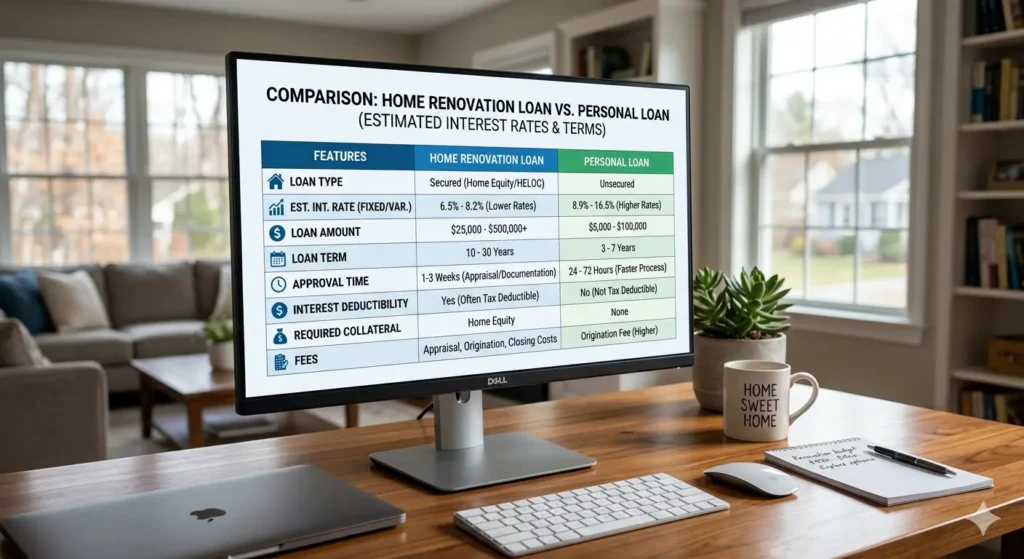
In India, renovation loans come in two primary forms: secured renovation loans (where the home is offered as collateral) and unsecured personal loans used for renovation purposes. Secured loans attract lower interest rates but involve more documentation and processing time. Unsecured loans are faster and simpler but at higher interest rates. The right choice depends on the loan amount needed, the applicant’s credit profile, and how quickly the funds are needed.

Which Banks and NBFCs Offer Renovation Loans in Nagpur?
Renovation loans are widely available in Nagpur through most major banks and non-banking financial companies (NBFCs). SBI offers a dedicated home renovation loan as part of its SBI Home Loan product suite, available at competitive interest rates for existing SBI home loan customers and fresh applicants alike. HDFC Bank offers both secured home improvement loans and personal loans that can be used for renovation. ICICI Bank, Axis Bank, Kotak Mahindra Bank, and Bank of Baroda all offer renovation-specific loan products.
Among NBFCs, Bajaj Finserv and Home Credit offer personal loan products that are commonly used for home renovation, with faster processing and flexible repayment options. Housing finance companies like HDFC Ltd, LIC Housing Finance, and PNB Housing Finance offer home improvement loans specifically for property owners.
Nagpur also has a strong network of cooperative banks — Maharashtra Rajya Sahakari Bank, Vidarbha Merchants Urban Co-op Bank, and others — that offer renovation loans to their members, often with competitive rates and a more personalised processing experience for smaller loan amounts.
Comparison is important. Interest rates, processing fees, prepayment penalties, and tenure options vary significantly across lenders. A difference of one percentage point in interest rate on a ₹10 lakh loan over seven years amounts to approximately ₹45,000 in total interest — a meaningful difference worth the effort of comparison.
How Much Can You Borrow and What Are the Interest Rates?
Renovation loan amounts in India currently range from ₹50,000 to ₹40 lakhs, with the actual sanctioned amount depending on the applicant’s income, credit score (CIBIL score), the property’s value, the lender’s internal policies, and the documented cost of the renovation.
For most renovation projects in Nagpur — a complete 2BHK renovation (₹8 to ₹12 lakhs), a 3BHK overhaul (₹12 to ₹18 lakhs), or a modular kitchen and wardrobe installation (₹5 to ₹8 lakhs) — the required loan amount is well within the sanctioned limits of most lenders for applicants with a reasonable income and a decent credit history.
Interest rates for renovation loans in India (as of 2025-26) range from approximately 8.5 to 9.5 percent per annum for secured renovation loans backed by property, to 12 to 16 percent for unsecured personal loans used for renovation. The exact rate depends on the lender, the loan amount, the tenure, and the applicant’s credit profile. Applicants with CIBIL scores above 750 typically qualify for the better rate bands.
To illustrate the EMI implications: for a ₹10 lakh loan at 10 percent interest over seven years, the monthly EMI is approximately ₹16,600. Over five years at the same rate, the EMI rises to approximately ₹21,200. Over ten years, it drops to approximately ₹13,200. The right tenure is a balance between affordable monthly EMI and manageable total interest paid — shorter tenures save more in interest but require higher monthly commitment.
Documents Required for a Renovation Loan in Nagpur
The documentation for a renovation loan is more straightforward than many families expect, particularly for salaried applicants.
For salaried applicants, the standard document set includes: identity proof (Aadhaar card and PAN card), address proof (utility bill, Aadhaar, or passport), recent passport-size photographs, the last three months of salary slips, the last three months of bank statements showing salary credit, Form 16 for the last two financial years or the most recent ITR, and property documents (property registration, society share certificate, or property tax receipt).
For self-employed applicants — business owners, professionals, traders — the requirement adds: the last two to three years of ITR with computation, CA-certified profit and loss account and balance sheet, and sometimes GST returns for the last year.
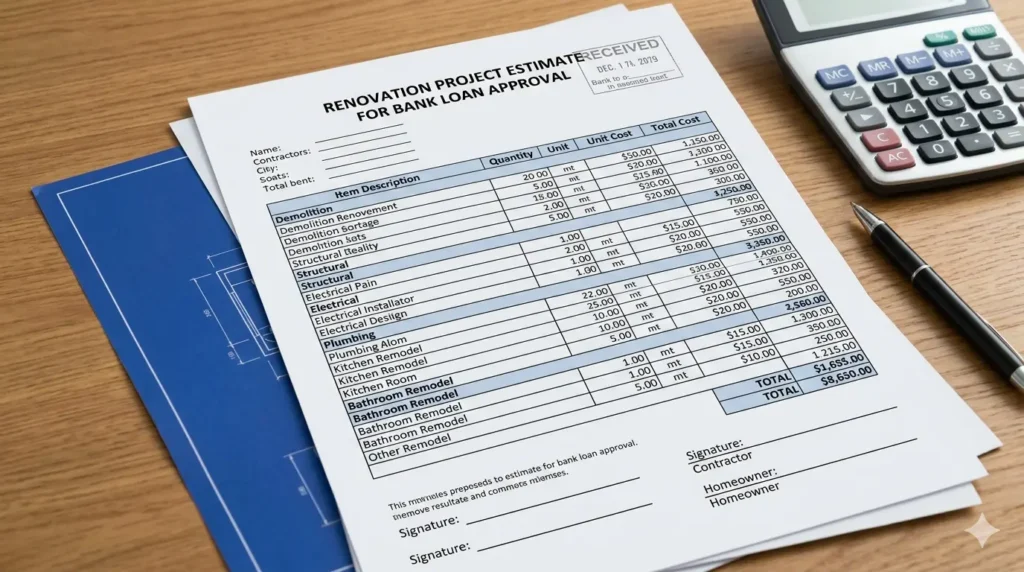
In addition to the standard documents, renovation loan applications are strengthened significantly by a detailed, professional renovation estimate from the contractor or interior designer. This estimate demonstrates to the lender the specific purpose of the loan amount, justifies the amount requested, and shows that the borrower has thought seriously about the project. An estimate from QC Interiors — itemised by category, professionally formatted, covering all aspects of the renovation — satisfies the lender’s requirement completely and also serves as your project planning document.
Should You Take a Loan or Pay From Savings? The Honest Analysis
This is a personal financial decision, but there are several angles worth considering before reaching a conclusion.
The cost of borrowing versus the opportunity cost of using savings. If the renovation loan rate is 10 to 11 percent and your savings are in fixed deposits earning 6 to 7 percent, the net borrowing cost — adjusting for the return you lose by using savings — is 3 to 5 percent. If your savings are in equity mutual funds averaging 12 to 15 percent, the case for keeping your savings invested and borrowing for the renovation becomes stronger. If your savings are in low-yield instruments, using them directly may be cheaper than borrowing.
Liquidity. Using savings for a renovation depletes the liquid reserves that most families should maintain for emergencies. For a family whose entire savings are in one fixed deposit, using that for the renovation leaves no emergency cushion. A loan that can be repaid from monthly income over several years preserves the liquidity of the savings, even at the cost of interest.
The cost of deferral. Deferring a renovation is not free. A kitchen that is genuinely difficult to use every day — inadequate storage, insufficient electrical points, poor ventilation — has a real daily cost in time, frustration, and energy. A bathroom with compromised waterproofing does not stay stable — it gets progressively worse with each monsoon, and the cost of repair grows with each year of deferral. The renovation that happens now captures the benefit immediately; the renovation deferred loses those benefits for every year of waiting.
Many families in Nagpur find that a renovation loan — particularly for amounts between ₹5 and ₹15 lakhs — is the approach that keeps the project moving, maintains the family’s liquid savings, and makes the monthly cost of the renovation predictable and manageable through EMI.
GST on Renovation Work: Planning for the Full Cost

Interior design and construction services in India attract GST at 18 percent. This is a significant and frequently underestimated component of renovation cost planning.
On a renovation project with a base cost of ₹10 lakhs, the GST component is ₹1.8 lakhs — bringing the total to ₹11.8 lakhs. On a ₹15 lakh project, the GST adds ₹2.7 lakhs to the total.
When planning a renovation loan amount, the GST must be included in the calculation. If the renovation estimate (excluding GST) is ₹10 lakhs, the loan should be for at least ₹12 lakhs to cover both the renovation cost and the tax component, or the family should plan to pay the GST from savings.
Reputable renovation firms including QC Interiors issue GST-compliant invoices for all work, which means the renovation spend is properly documented and the GST paid is part of the official transaction record. This is important both for financial transparency and for any future property valuation or sale, where documented renovation investment can support the property’s assessed value.
How a Detailed Design Estimate Strengthens Your Loan Application
Banks and NBFCs that process renovation loans require documentation of the planned renovation — typically in the form of an estimate or quotation from the contractor or designer. This serves two purposes: it demonstrates the legitimate renovation purpose of the loan, and it justifies the specific amount requested.
An estimate that simply says “Renovation work — ₹10 lakhs” does not satisfy either purpose adequately. An estimate that breaks down the renovation into categories — modular kitchen (₹3.2 lakhs), wardrobes in three bedrooms (₹2.4 lakhs), false ceiling and lighting (₹1.2 lakhs), bathroom renovation (₹1.8 lakhs), painting (₹80,000) — with specific material grades and quantities specified, gives the loan officer both the justification for the amount and the confidence that the borrower has a serious, planned project.
QC Interiors provides fully itemised professionally formatted estimates for every project we work on. These estimates are designed to satisfy the requirements of bank loan applications — they have been used successfully by dozens of Nagpur families to support renovation loan applications with SBI, HDFC, ICICI, and other lenders.
Start With a Free Renovation Estimate From QC Interiors
The first step to a renovation loan is a reliable, detailed cost estimate. QC Interiors offers free site visits and detailed renovation estimates across Nagpur — for projects of any size, from single-room upgrades to full home overhauls.
Come to us with your renovation wish list and your budget ceiling — or even without a clear budget, and we will help you understand what your project realistically costs. We will give you an honest, itemised breakdown of every component of the renovation that you can take directly to your bank as the documentation for your loan application.
Your home is worth investing in. The renovation you have been thinking about for years does not have to wait any longer.
