
Vastu Compliant Interior Design in Nagpur: Harmony, Function, and Spaces That Feel Right.
Talk to ten Nagpur families about interior design and within the first few minutes of conversation, Vastu will come up. It is not a niche concern or an elderly generation’s preference — it cuts across ages, professions, and income levels. Young software engineers and retired government officers, joint families and nuclear ones, people in flats on Wardha Road and people in bungalows on Seminary Hills — Vastu is part of how Nagpur families think about their homes.
For most families, Vastu is not superstition. It is a set of principles about how a home should be oriented, organised, and inhabited — principles that carry both practical wisdom about living with nature’s forces and deeper significance about the relationship between a family and its home. When a Nagpur family says they want a Vastu-compliant kitchen or a Vastu-aligned master bedroom, they mean something specific and serious. They are not asking for a token gesture.
The good news — and this is something we tell every family at the start of every project — is that Vastu-compliant design and genuinely beautiful, functional interior design are not in opposition. In our experience of over a decade working with Nagpur families, the core principles of Vastu align remarkably well with the principles of good design: proper orientation and relationship with natural light, thoughtful room placement that considers function and dignity, ventilation and airflow, and a sense of order and calm that makes a home feel right to live in.
This article is a complete guide to Vastu-compliant interior design in Nagpur — the key principles, how they translate into specific design decisions, and how QC Interiors incorporates them into a design process that honours both the Vastu brief and the aesthetic and functional needs of the family.
Vastu Compliant Interior Design in Nagpur
How QC Interiors Approaches Vastu in the Design Process
Many design firms approach Vastu as an afterthought or a constraint — something to accommodate around the “real” design after the primary decisions have been made. This approach creates conflicts and compromises that satisfy neither the Vastu brief nor the functional one.
At QC Interiors, Vastu considerations are built into the 3D design process from the beginning. When a family tells us at the first meeting that Vastu compliance is important to them — and in Nagpur, this is most families — we incorporate the Vastu framework into the initial design brief alongside the functional and aesthetic requirements.
Our process starts with mapping the cardinal directions on the floor plan of the specific home. Every flat and every bungalow sits differently on the site, and the actual orientation of the rooms — which direction does the main entrance face, where is the northeast corner, which wall has the southeast exposure — is determined precisely before any design decisions are made.
We then have a specific conversation with the family about which Vastu principles are firm non-negotiables for them and which allow some flexibility. Every family’s relationship with Vastu is different. Some have had a Vastu consultant previously and have a specific brief to follow. Others have general principles they hold and want the design to respect. Still others are flexible about most things but have particular convictions about the Pooja room or the master bedroom. Understanding this allows us to design a home that genuinely reflects the family’s beliefs rather than applying a generic Vastu template.
The Main Entrance and Foyer: Where the Home Begins
In Vastu Shastra, the main entrance is one of the most significant elements of the home. A north or east-facing entrance is considered auspicious — the north is associated with prosperity and the east with new beginnings and positive energy. The entrance should allow free movement: a door that swings open easily, a foyer that is clear and welcoming, and no obstruction directly in front of the main door when it opens.
Beyond the directional considerations, Vastu principles for the entrance align well with good design practice. The entrance should be well-lit — both naturally and artificially — to create a welcoming first impression. It should be free of clutter — shoes, bags, umbrellas — which means providing adequate, well-designed storage in the foyer so that these items have a designated place rather than accumulating on the floor. And it should offer a clear, open feeling when you enter — not a wall immediately in front of you or a tight corner that makes entry feel constrained.
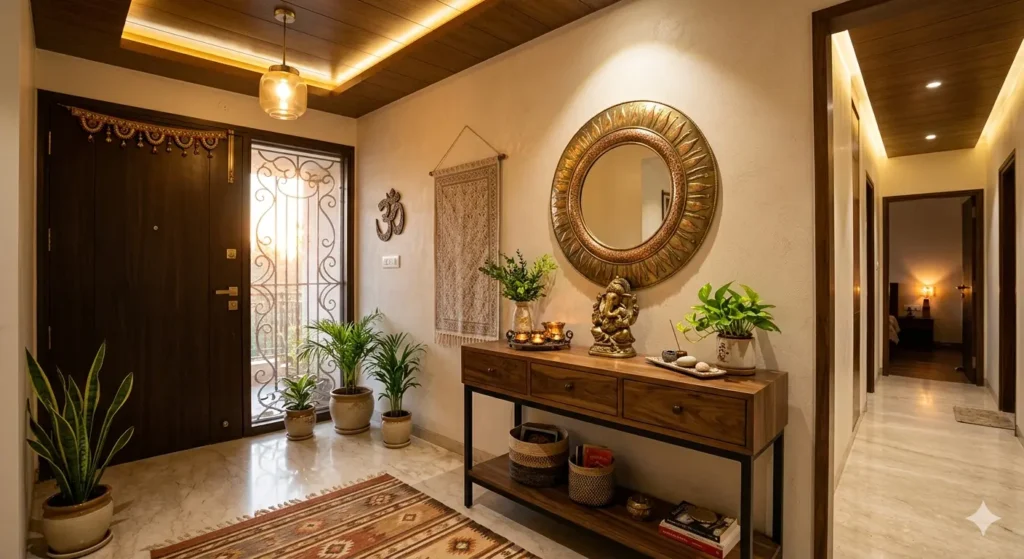
We design Nagpur foyers with a console table or a storage unit for shoes and outerwear, a mirror (which visually expands the space and serves the practical function of a last-look before leaving the house), good ambient lighting, and where space allows, a small plant or a piece of art that makes the entrance feel intentional. A well-designed foyer communicates something about the quality of everything beyond it — it sets the tone for the whole home.
The Kitchen: Southeast Placement and the Importance of the Cook’s Position
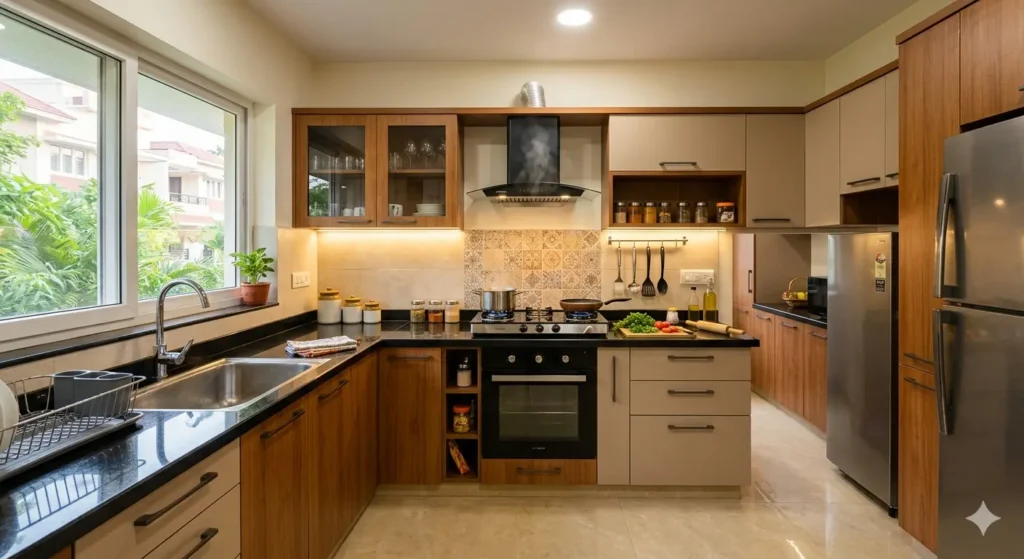
Vastu places the kitchen in the southeast corner of the home, associated with the fire element and with the energy of nourishment. The cooking platform should ideally face east, so that the cook faces the rising sun — an orientation that brings both auspicious energy and the practical benefit of good morning light on the working surface.
In contemporary flat construction, the kitchen is not always in the southeast corner — the building layout determines where the kitchen space is, and families often have no choice about its location. In these cases, the Vastu brief focuses on the elements that can be controlled within the existing kitchen space: the orientation of the cooking platform, the position of the sink (which should ideally be on the northeast side of the kitchen, associated with water), and the placement of the fire element (the stove or hob) in the southeast quadrant of the kitchen room.
From a practical design perspective, these Vastu orientations align well with good kitchen ergonomics in Nagpur. An eastward-facing cooking position means the cook has morning light on the work surface — the time when most Indian cooking happens. The sink in the northeast position, if the kitchen layout allows, typically works well with the overall plumbing layout and the flow of food preparation from raw to washed to cooked.
For joint family kitchens in Nagpur — where two or more women may be cooking simultaneously — we design the layout so that multiple people can work in the kitchen without crossing each other’s paths and without any cook having their back to the entrance. This is both Vastu-aligned (the cook should not face a wall) and practically sensible in a busy household kitchen.
Bedrooms: Placement, Orientation, and the Direction of Sleep
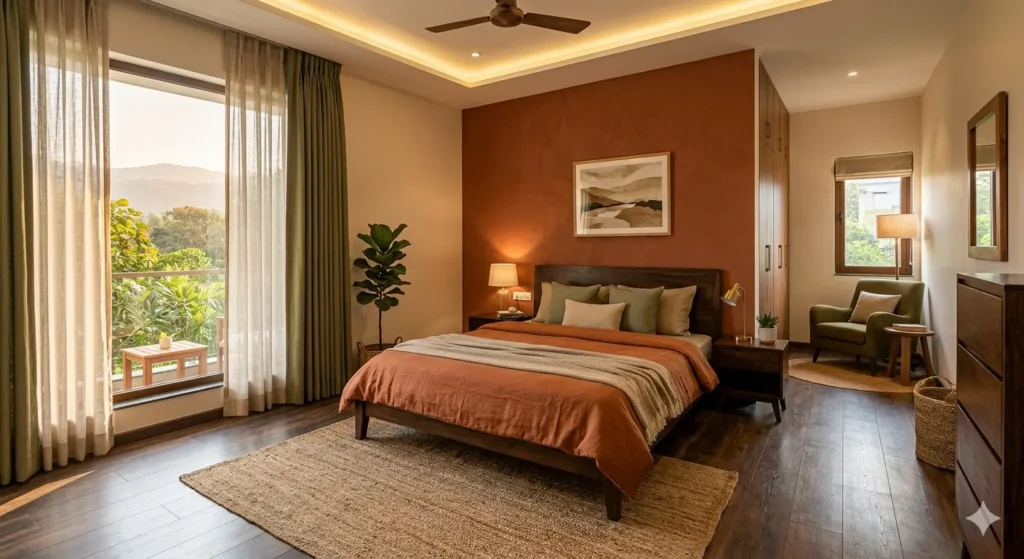
Vastu places the master bedroom in the southwest quadrant of the home — associated with stability, grounding, and the consolidation of energy. The head of the bed should ideally point south when sleeping, which is considered the most restorative sleep direction according to Vastu principles. East is an acceptable alternative; west is tolerated; north is generally discouraged.
The southwest master bedroom placement also has a practical logic in Nagpur’s climate. A southwest bedroom receives less direct morning sun than an east-facing one (which can be too bright for comfortable sleep) and the afternoon sun hits the west wall rather than the south wall (which has a somewhat more moderate solar load than the west wall in summer).
For children’s bedrooms, Vastu suggests the northwest or north — associated with movement, learning, and the energy appropriate for young minds. For families with children preparing for competitive examinations (a significant category in Nagpur’s family culture), the north and northwest rooms also tend to be among the quieter rooms in the flat, away from the main entrance and the living areas where household activity is highest.
For elderly family members, the southwest or south rooms are often recommended — associated with stability and rest, which are particularly appropriate for older occupants who may need more sleep or quieter conditions.
We incorporate these bedroom placements into the 3D design in a way that can be visualised clearly, allowing families to understand exactly how the furniture will sit in each room and whether the orientation requirements are being met.
The Pooja Room: A Space That Deserves Its Own Design
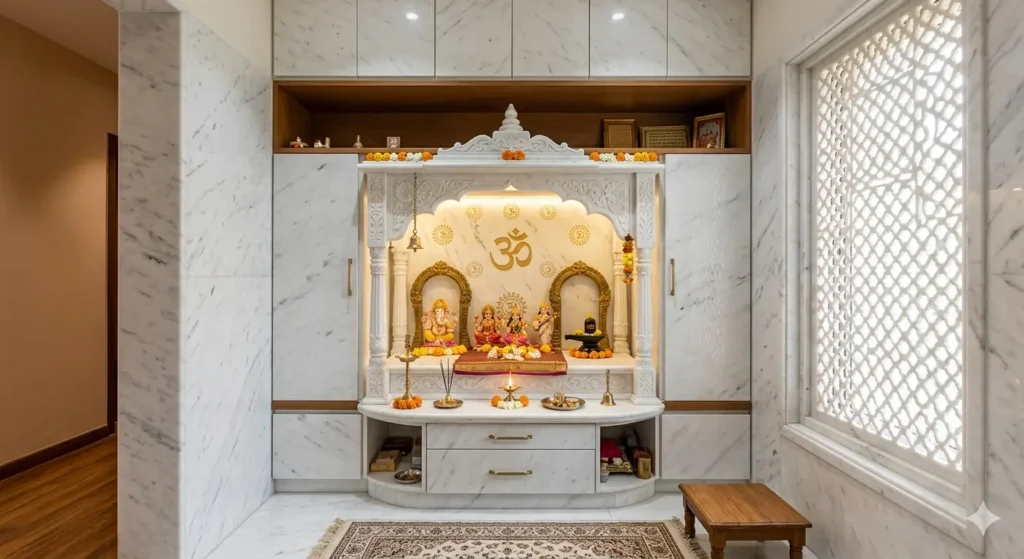
The Pooja room is among the most personally significant spaces in any Nagpur home, and it is among the most consistently requested design elements — even in families where other design preferences vary widely. The northeast is Vastu’s designated zone for the Pooja room — associated with clarity, spiritual energy, and the divine.
Designing a Pooja room is one of the most satisfying projects within any Nagpur home renovation. The space should feel removed from the everyday activity of the household — quieter, more considered, more sacred. Materials should be natural and dignified: marble, natural stone, or teak wood for the mandir structure itself, clean white or cream finishes on the walls, and warm focused lighting on the idols or murtis.
Storage for puja items — agarbatti, diyas, kumkum, flowers, puja thalis — should be organised and adequate. The chaos of scattered puja items in a small cabinet is at odds with the dignity that the space deserves. We design Pooja rooms with dedicated, organised storage so that everything has its place and the space can be kept clean and arranged with minimal daily effort.
Even in smaller flats where a dedicated Pooja room is not possible, we design Pooja corners within the northeast area of the living room or a bedroom — a dedicated alcove or a wall-mounted mandir with proper lighting and storage — that gives the puja practice a specific, intentional home within the flat.
The Living Room and Colour Choices in Vastu-Aligned Design
Vastu associates different directions with specific colours — yellow and orange for east-facing rooms, green for north, white and cream for the northeast (particularly the Pooja area), earthy tones like brown and yellow ochre for the southwest master bedroom, and blues and greys for the northwest.
These colour associations map helpfully onto good interior design for Nagpur homes. Warm yellow tones in an east-facing dining room that receives morning sun — the warmth of the colour complements the warmth of the light. Crisp white or cream in the Pooja room or the northeast corner — these clean colours create the sense of purity and clarity that is appropriate for a sacred space and also happen to be thermally intelligent in Nagpur’s climate. Earthy, grounded tones in the southwest master bedroom — tones that are warm and restful rather than stimulating.
We use Vastu colour principles as a framework rather than a rigid prescription. Within each directional colour range, there is a world of variation — from barely-there tints to more saturated tones — and our job is to find the shades within each range that satisfy both the Vastu brief and the family’s personal aesthetic preference. A family who loves dark dramatic colours in their master bedroom and a family who prefers soft pastels may both be able to find a southwest-appropriate colour that satisfies both of them.
Vastu and Good Design: Two Approaches, One Goal
After a decade of designing homes for Nagpur families who bring Vastu as a serious and sincere brief, our experience is clear: Vastu-compliant homes are often very beautiful homes. The principles of orientation, light, order, and natural material use that Vastu promotes are also the principles of good interior design. When the two briefs are integrated from the beginning — as they are in every QC Interiors project — the result is a home that feels right in every sense: right for the family’s beliefs, right for the climate, right for the way the family lives.
Come to QC Interiors for a free Vastu-aware design consultation. We will show you how a home can genuinely honour your principles and still be the most beautiful space you have ever lived in.
