
Bungalow Interiors in Civil Lines Nagpur: How to Design a Home That Truly Matches Its Address: There is a particular pride that comes with owning a bungalow in Civil Lines. Maybe you have been working towards it for years. Maybe it came down through the family and you are now the one responsible for giving it a new life. Either way, standing in the middle of those large, generous rooms with high ceilings and bare walls, the question that hits you is: where do I even begin?
Civil Lines is not just a locality in Nagpur. It is an address with a history. Wide tree-lined roads, older architecture with real bones, and a certain quietness that the newer parts of the city cannot replicate. When you live here, the standard is already set by the neighbourhood itself. Your interiors need to rise to meet it.
Bungalow Interiors in Civil Lines Nagpur
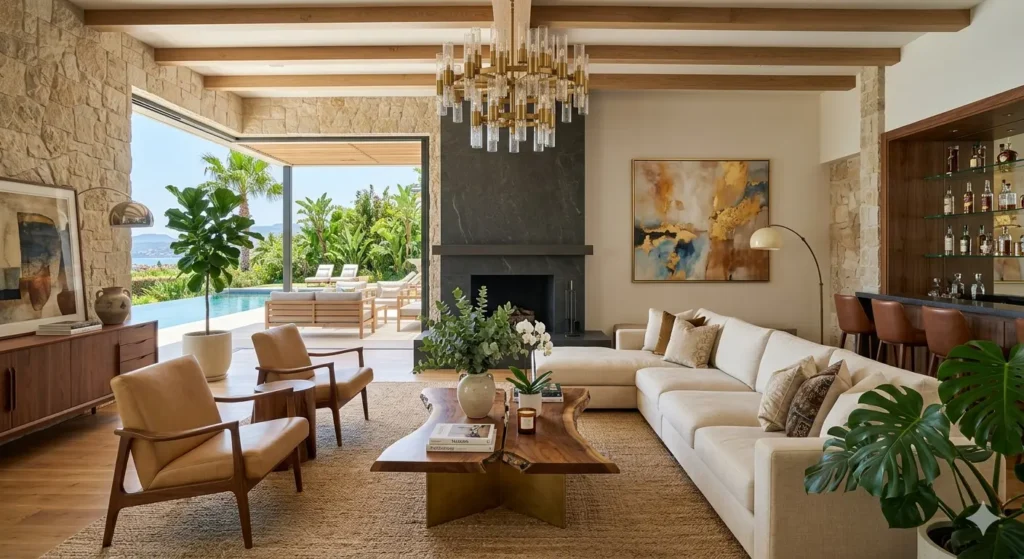
Why Bungalow Design Is Completely Different From Flat Design
This is something a lot of people learn the hard way. They move into a bungalow after years in a flat, bring along their existing furniture, hire a contractor who has mostly done flat work, and six months later, the home feels like a showroom with mismatched pieces — impressive in individual parts, but not cohesive as a whole.
Bungalows in Civil Lines typically have ceiling heights ranging from 11 to 14 feet, room proportions that are genuinely grand, verandahs, and often a foyer or entrance hall that functions as its own space. None of this is the same as a 3BHK flat. The furniture scale, the lighting design, the wall treatments, the way you zone a large living room — everything needs to be reconsidered from the ground up.
A sofa that was the right size for your previous living room may look like toy furniture in an 800 square foot drawing room. A pendant light that looked impressive in the showroom may simply disappear into a 13-foot ceiling. These are not small oversights — they are decisions that will affect how your home looks and feels for the next decade.
This is why, at QC Interiors, every bungalow project starts not with material selection, not with contractor mobilisation, but with a detailed 3D visualisation of the actual space. You see your specific rooms — your actual ceiling heights, your real window positions, your natural light — transformed into a fully designed, liveable environment before a single tile is laid or a wall is painted.
The 3D Design Process: Why It Saves You Money and Prevents Regret
We have been designing homes in Nagpur for over a decade, and the families who have the smoothest renovation experiences are the ones who spent time getting the design right before the work began. A 3D walkthrough is not a luxury reserved for large projects. It is the most practical investment you can make before starting any significant work.
Here is what typically happens without it: you select materials based on samples in a showroom that look very different from how they will appear in your actual space. You agree to a false ceiling design that looks fine on paper but feels oppressive once it is up. You choose a wall colour that was beautiful on a small swatch but overwhelms the room at full scale. These are the decisions that lead to expensive, avoidable rework.
With a full 3D design session, your family can walk through the finished version of your Civil Lines bungalow virtually. You can see exactly how the living room will look with that particular wood panel on the TV wall. You can see how the master bedroom will feel with the wardrobe placed on that wall versus the opposite one. You can agree on every detail together — before anything is demolished, before any money is spent on materials. The peace of mind this creates is genuinely hard to put a price on.
Working With High Ceilings: The Art of Not Wasting Vertical Space
High ceilings are one of the most desirable features in any home, but they come with their own design responsibilities. A common mistake is treating a tall room exactly like a regular one — putting in standard-height furniture and leaving the upper half of the wall completely bare. The result is a room that feels cold and institutional rather than grand and welcoming.
In Civil Lines bungalows, the approach to height needs to be intentional. This means a few things in practice. First, lighting must be layered. A single ceiling fixture in a 12-foot room will leave the lower half of the space in relative darkness and the upper half uncomfortably bright. We design with at least three lighting levels: ambient ceiling light, wall-mounted sconces at mid-height, and floor or table lamps that create warmth at the human level. This layered approach makes a large room feel intimate without shrinking it.
Second, tall walls benefit from vertical design elements that draw the eye upward intentionally. Wainscoting — a simple panel detail on the lower portion of the wall — gives texture and visual interest without being overly decorative. Tall bookshelves or display niches built into the wall make productive use of the height. A well-proportioned painting or a carefully chosen piece of art placed at the right height on a large wall can anchor the whole composition.
Third, the furniture itself must be scaled correctly. A seven-seat sectional sofa, a large dining table for eight, a generous armchair rather than a small accent chair — these are the proportions that work in a Civil Lines bungalow. Not because you want to fill the space for the sake of it, but because correct proportion is what makes a large room feel balanced and lived-in rather than sparse.
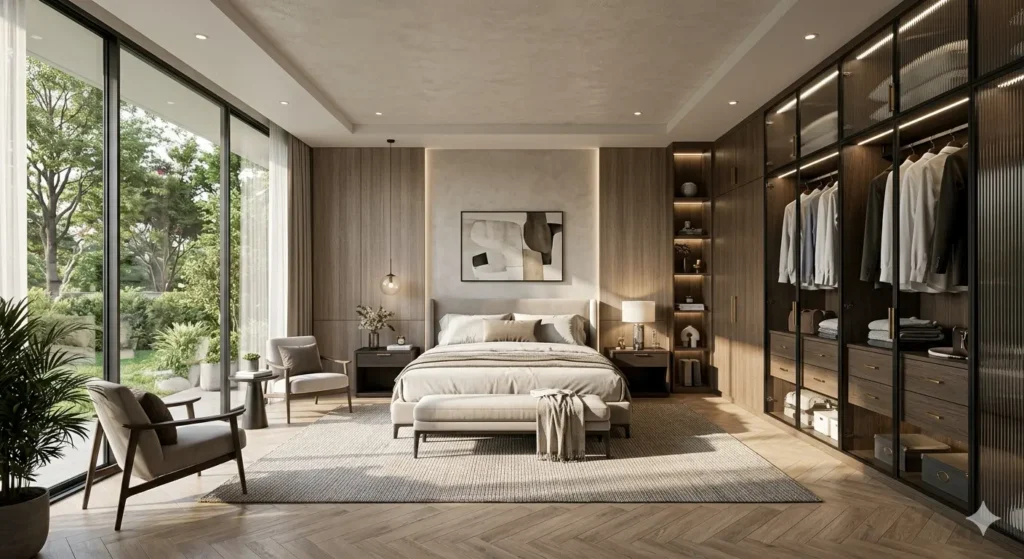
The Classic-Contemporary Balance: Finding Civil Lines’ Design Tone
One of the most common questions we hear from Civil Lines homeowners is this: should the home look traditional because of the architecture, or can we do something more contemporary?
The honest answer is that the most beautiful homes we have worked on in this part of Nagpur do neither exclusively. They find a tone that respects the character of the architecture while incorporating the comfort and clean lines that contemporary design offers. Think of it as a conversation between two eras rather than a choice between them.
In practice, this might look like: arched doorways (which Civil Lines bungalows often already have) paired with furniture in clean geometric forms rather than ornate carved pieces. Natural stone flooring — Kota stone or a premium vitrified in a large format — that has both heritage resonance and modern practicality. A dining room with deep, rich wall colour that feels old-world in its confidence, but with a contemporary chandelier and a table with simple lines. Wood panelling in the study that could belong to 1940 or 2024, because it is executed with quality materials and honest joinery.
The goal is timeless, not trendy. A Civil Lines bungalow designed for the current trend cycle will start to look dated within five years. A Civil Lines bungalow designed with careful attention to proportion, material quality, and the character of the architecture will only get better.
The Living Room: Designing for Real Hosting
In a Civil Lines bungalow, the living room is not just a room where the family watches television in the evenings. It is the room where you receive guests — relatives from out of town, business colleagues, old friends who come by for Sunday lunches, neighbours who drop in for Diwali. The space needs to perform on multiple levels simultaneously: impressive without being stiff, comfortable without looking casual, interesting without being cluttered.
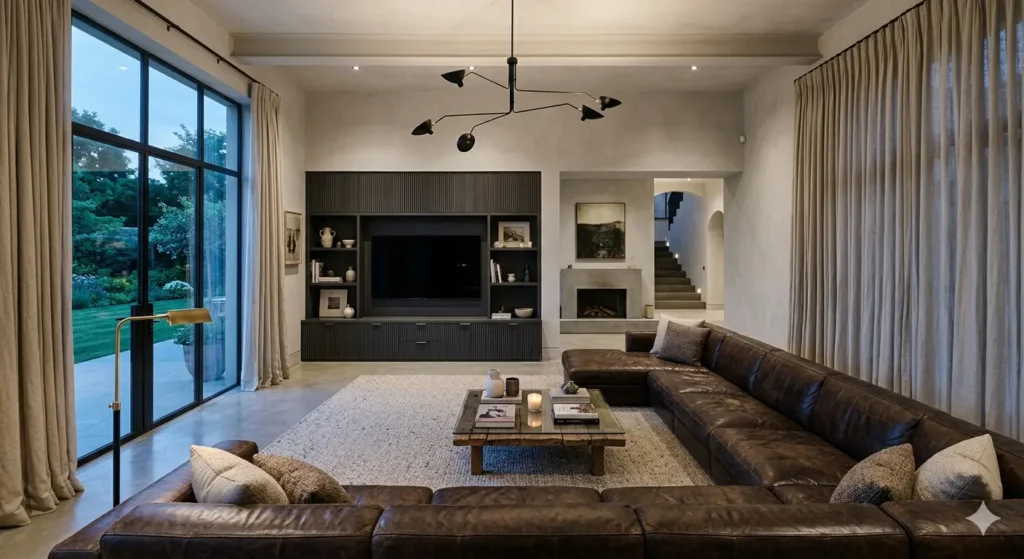
We typically recommend for Civil Lines drawing rooms a large seating arrangement — an L-shaped or U-shaped configuration in fabric or leather that can seat eight to ten people without squeezing. The arrangement is centred not around the television (which can be a design distraction in a formal drawing room) but around a substantial coffee table or a pair of them. The TV wall gets its own careful design: a recessed panel with integrated storage, perhaps fluted wood or a combination of stone and wood, with the TV as one element rather than the dominant one.
Window treatments in Civil Lines living rooms are an opportunity. The windows are often large and original to the building. Heavy linen or cotton drapes in a natural tone — off-white, warm beige, deep olive — that pool slightly on the floor are both beautiful and appropriate to the scale. They also help manage the western sun that comes into many of these rooms in the afternoon.
On a Sunday evening when that golden light comes in low through the bungalow windows, falling across a well-chosen rug and the warm tones of the walls, with a ceiling fan moving the air gently — that is the moment a well-designed Civil Lines living room earns every rupee spent on it.
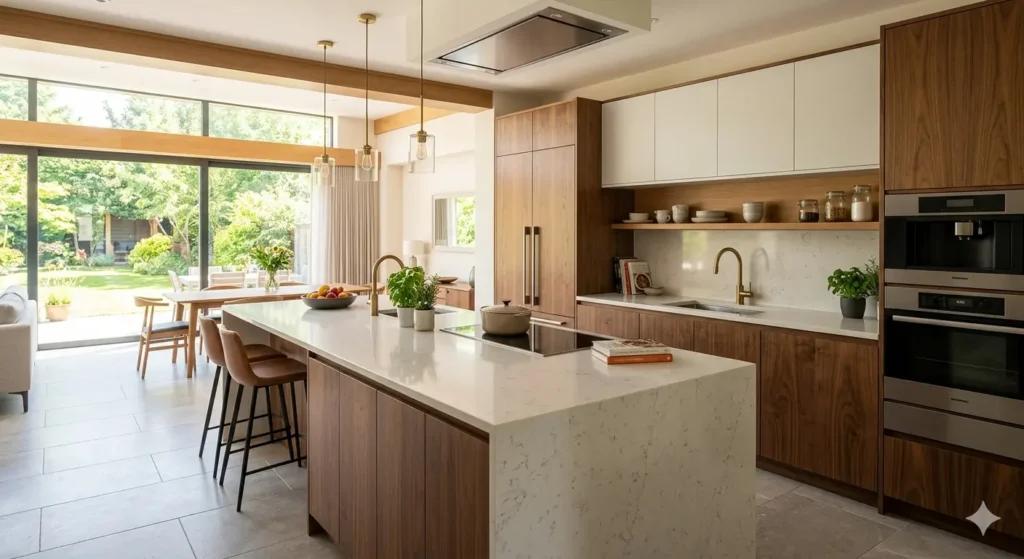
Kitchens in Bungalows: Space to Cook, Gather, and Celebrate
Bungalow kitchens in Civil Lines are often the largest kitchens in the building — rooms that were designed in an era when cooking was a significant household occupation and the kitchen was its own ecosystem. Many of them have space for an island, a separate utility area, and a pantry. This is extraordinary by modern flat standards, and it is an opportunity that should be designed with equal care to the living spaces.
A modular kitchen in a Civil Lines bungalow should be designed for the actual cooking habits of the family. A joint family that cooks for twelve on Sunday afternoons needs more cooking surface, more burners, and more prep space than a working couple. A family that entertains formally needs a kitchen that flows well — easy to use during a party without the cooking mess visible to guests.
From a material perspective, bungalow kitchens benefit from countertops that are both beautiful and durable. Granite, engineered quartz, or natural marble (with appropriate sealing and maintenance) are all appropriate for this scale of space and this character of home. Cabinet shutters in a warm solid wood veneer or a high-quality lacquer finish rather than standard laminate. Good hardware throughout — soft-close drawers, full-extension pull-outs, a proper chimney integrated into the ceiling design.
For full modular kitchen projects in Civil Lines, the investment range is typically ₹3.5 lakhs for mid-range finishes up to ₹7 lakhs and above for premium configurations with custom joinery, stone fronts, and professional-grade appliances. This is a significant spend, but in a kitchen of this size and character, it is the right investment.
The Sharma Family’s Bungalow: A Civil Lines Story
Let us tell you about one of our recent Civil Lines projects, because real stories are more useful than abstract promises.
The family — a retired couple who had lived for years in a smaller flat in Sadar — had finally moved into their own bungalow after decades of waiting. They came to QC Interiors with a clear brief: “We want it to look like it belongs here. Not too modern, not too old-fashioned. Just right.”
We spent two sessions doing a 3D walkthrough with them, adjusting details until the design felt exactly like their version of “just right.” The final design had a double-height entrance foyer with a statement pendant light — a large, custom piece that could hold its own in the vertical space. The drawing room had deep teal walls in the seating area, a natural stone floor in large format, and full-height bookshelves flanking the fireplace. The dining room was panelled in warm wood, with a chandelier sized to fill the ceiling space rather than dangle awkwardly from it. The master bedroom used every inch of an awkward recess for a walk-in wardrobe that the couple had been dreaming about for years.
When their daughter visited from Pune for the first time after the renovation was complete, she stood in the entrance and said, “This is the most beautiful home in the family.” That is the reaction we work for every time.
What Does a Full Bungalow Interior Actually Cost in Nagpur?
This question deserves a straight answer, so here it is.
For a 4BHK or 5BHK bungalow in Civil Lines — a complete interior package covering the drawing room, dining room, kitchen, all bedrooms with wardrobes, false ceilings, lighting, bathrooms, and a Pooja room — the realistic investment range is ₹18 lakhs to ₹35 lakhs, depending on material grades, the extent of structural changes, and the complexity of the design.
The difference between a ₹20 lakh project and a ₹30 lakh project is not arbitrary. At ₹20 lakhs, you get quality materials, solid execution, and a genuinely beautiful home. At ₹30 lakhs, you get custom joinery throughout, premium natural stone in the bathrooms, a more detailed and designed false ceiling with layered lighting, hardware that will last thirty years, and a level of finish detail that you notice every time you walk through the house.
We present these trade-offs clearly and honestly at the start of every project, so families can make informed decisions about where they want to invest and where they can choose a more budget-conscious option. Spending more on the kitchen and master bedroom and less on the guest bedroom is a legitimate choice. Choosing premium flooring throughout and a simpler false ceiling design is another. Our job is to help you understand what each decision means for the final result.
QC Interiors has completed over 500 residential projects across Nagpur, Hyderabad, Amravati, and Yavatmal over more than a decade. We know what lasts, what looks good after five years rather than just on day one, and what genuinely makes daily life better in the specific climate and lifestyle context of Nagpur.
Your Civil Lines Bungalow Deserves the Right Start
If you own a bungalow in Civil Lines — whether it is newly acquired, inherited, or long overdue for a transformation — the right first step is a free site visit with the QC Interiors team. We will walk through every room with you, understand how your family actually uses the space, talk about your brief (aesthetic and practical), and give you an honest picture of what is possible within your budget.
Civil Lines is a special address in this city. The trees, the roads, the particular quality of light in the evening — they are all there. The interiors of your bungalow should be worthy of where it stands. Come and have that first conversation with us.
