
Top Home Architects in Wardha — What Families in This Historic City Need Before They Build
Wardha occupies a position in Maharashtra’s geography and history that no other city quite replicates. The city where Mahatma Gandhi established Sevagram Ashram, the city that Vinoba Bhave made his base, the city that carries a weight of national significance alongside its everyday character as a mid-sized Vidarbha district headquarters — Wardha is not a place that treats itself casually, and its residents tend not to treat the things that matter to them casually either.
Homes matter here. The families of Wardha — the agricultural trading families whose wealth moves on cotton and soybean cycles, the professional families connected to the government and institutional life of a district headquarters, the families who’ve been building and rebuilding their residential footprint across generations — build with a seriousness and a permanence that reflects the city’s own character. A home in Wardha is not a transitional address. It’s where the family plants itself, where the next generation grows up, where the accumulated evidence of a life well-lived gradually fills every room.
That seriousness about building is exactly why the architect decision matters so much here. The difference between a home that has been genuinely designed — by someone who thought hard about how your family lives, about how Wardha’s specific climate shapes the indoor experience, about how the building sits on its plot relative to the morning sun and the afternoon heat — and a home that was built from a contractor template without that thinking, is a difference that lives in every room for thirty years. Most Wardha families who have experienced both understand this without needing it explained.
Top Home Architects in Wardha
Wardha’s Climate and What It Demands of Residential Design
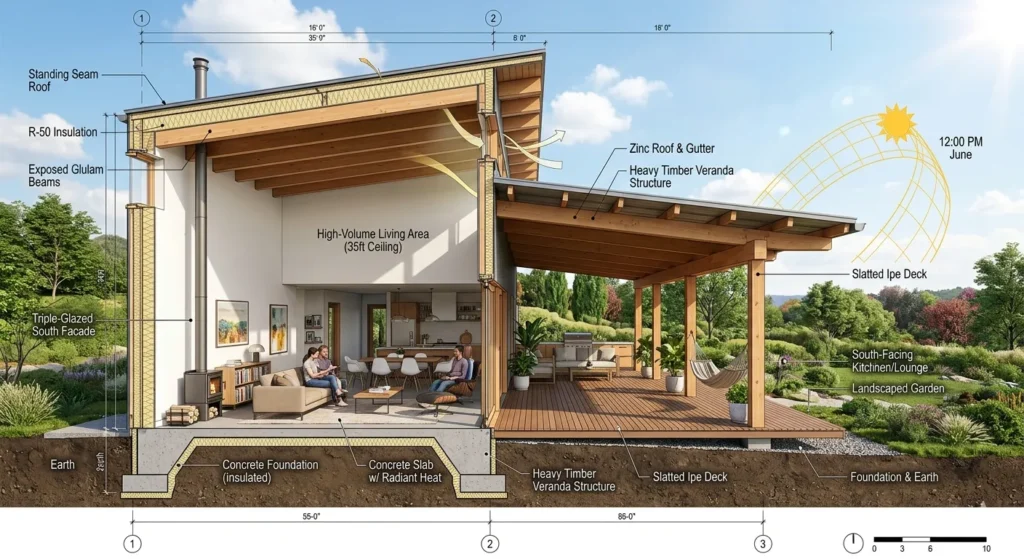
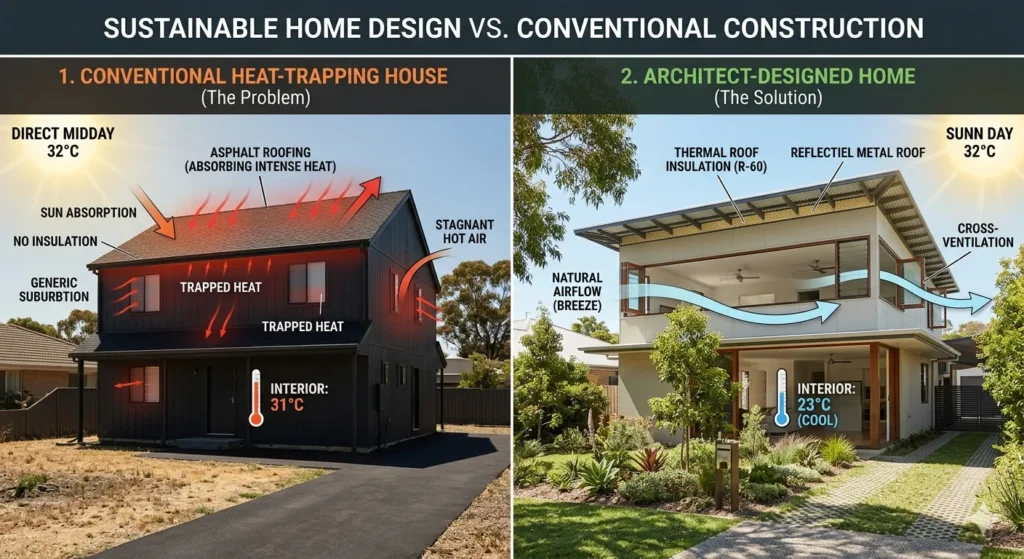
Wardha’s climate is Vidarbha’s climate at its most characteristic — and that means demanding. The summers here are genuinely severe. April and May bring temperatures that routinely reach 44 to 46 degrees, with peak periods that push beyond this. The sun at this latitude and at this time of year comes from a high angle for most of the day, with intense direct radiation that creates surface temperatures on roofs and west-facing walls that are significantly above the ambient air temperature.
The monsoon season, from June through September, brings rainfall that is meaningful and that buildings need to handle reliably. Wardha sits in a part of Vidarbha where the monsoon is not a gentle affair — the rainfall comes in episodes of real intensity, and buildings that aren’t designed with proper drainage, adequate roof pitch, and genuine waterproofing attention develop the problems that are expensive and disruptive to fix after the fact.
The winter, by contrast, is one of Wardha’s genuine pleasures. December and January evenings are cool enough to make outdoor life comfortable, and the mornings have a quality of clear light that the summer months don’t offer. A home designed to make the most of this winter outdoor life — with a veranda or covered outdoor space that faces south or east, properly oriented to catch the winter light — adds a daily quality to the family’s life for four to five months of every year.
A residential architect who designs for these specific conditions — roof pitch for monsoon drainage and summer thermal management, room orientation for light quality and afternoon shade, veranda provision for outdoor use and interior sun protection — is designing a home that serves its family better every single day than one designed from a generic template. This is what site-specific architectural thinking produces, and it’s what families in Wardha should be looking for.
The Veranda: Wardha’s Most Important Architectural Element
Any serious conversation about residential architecture in Wardha has to include the veranda. Not as a stylistic gesture toward tradition, but as a functional element whose value in this climate is immediate and practical.
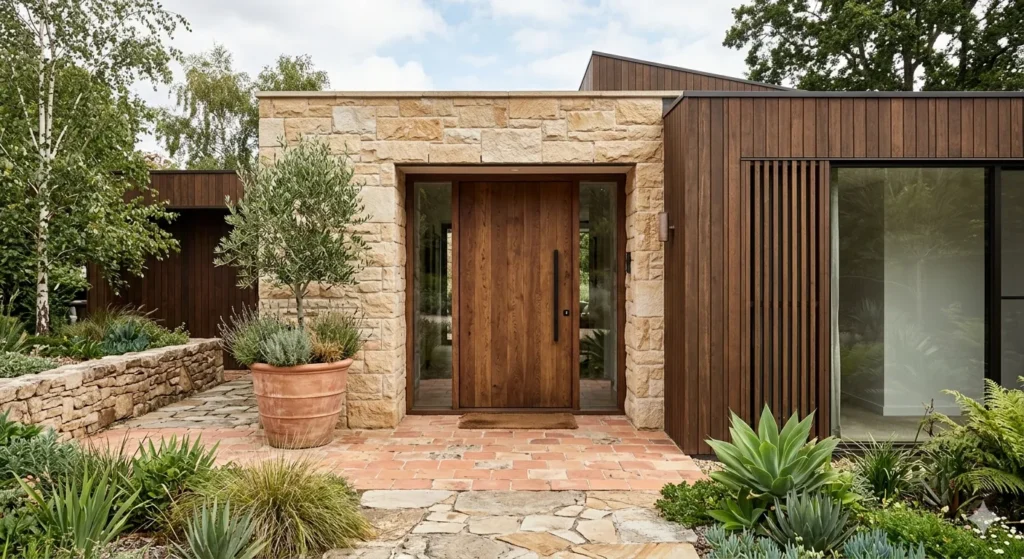
A properly designed covered veranda along the south or east face of a Wardha home does multiple things at once. It shades the windows and walls behind it from the direct afternoon sun — reducing the heat load on the interior in a physically meaningful way, not just by a percentage point but by creating a genuine shadow zone that protects the main rooms from the 2 PM to 6 PM sun that makes west and south-facing rooms difficult to occupy in April and May. It creates the semi-outdoor living space that Wardha’s October-through-February climate makes genuinely valuable — the space where the evening happens, where guests sit informally, where the morning begins. And it gives the home a quality of arrival and character that direct-door-from-boundary-wall construction doesn’t have.
Wardha’s older residential architecture — the homes in the established neighbourhoods near the old city, near Sevagram Road, in the areas that developed when Wardha was a more quietly significant town — understood this. The covered veranda was standard. The home presented itself to the road with a shaded, welcoming face. Contemporary construction in Wardha’s newer layouts sometimes discards this logic in favour of maximum FSI utilisation, and the homes that do this are the ones whose families run the AC on April afternoons and wish the building had been designed differently.
An architect who includes a proper veranda in a Wardha home design as a non-negotiable element — correctly oriented, properly dimensioned, connected to the main social rooms in a way that makes it part of daily life rather than a decorative appendage — is designing for where the building actually is.
How to Find and Evaluate Architects in Wardha
Wardha’s architectural practice ecosystem reflects the city’s scale — smaller than Nagpur’s, larger than the smaller Vidarbha towns’, with a range that includes established local practices, newer designers, and the draftsmen-and-contractors who handle a significant portion of the town’s residential construction without formal architectural qualification.
The Council of Architecture registration check is the first step. Every architect signing drawings for Wardha’s municipal body plan approval must be COA-registered. Ask for the registration number. Verify it on the COA website. This takes five minutes and confirms the minimum professional standard.
Visiting completed residential work is the more revealing evaluation step. Ask for homes the architect has designed in Wardha or nearby Vidarbha towns that you can visit — not photographs, actual buildings. Walk through them. The questions to ask yourself as you do: Do the main rooms feel well-lit and pleasant at different times of day? Does the kitchen layout make sense for real Indian household cooking? Does the entry sequence feel considered? Does the upper floor — if there is one — feel comfortable or was the heat question never addressed? These experiential assessments tell you far more about design quality than any portfolio conversation.
Ask specifically about their knowledge of Wardha Municipal Council’s plan approval process — the documentation requirements, the processing timeline, the zone-specific compliance requirements. An architect who navigates this fluently is an architect who saves you months.
Wardha’s Residential Areas: Context for the Design Brief
Wardha’s residential development spans several distinct areas, each with its own character. The older established neighbourhoods — the areas around Wardha’s historic centre, near Datta Mandir, along Sevagram Road — have housing stock that reflects more generous older construction with larger plots and higher ceiling heights. Families renovating or rebuilding in these areas are working with a context that has real architectural character.
The newer developing areas — the layouts on Nagpur Road, toward Pulgaon, the plotted developments on the city’s periphery — have a contemporary residential character with newer construction quality but less established community infrastructure. The design priorities here lean toward getting the building itself right: proper orientation, good roof design, adequate natural light provision.
The areas near Sevagram and the ashram-related institutional campus add a specific contextual dimension to residential design in that zone — a heritage and cultural significance that the best residential architecture here acknowledges in its material language and its attitude toward the landscape.
Construction Costs and Architectural Fees in Wardha
Construction costs in Wardha in 2025-26 range from approximately ₹1,800 to ₹2,600 per square foot depending on specification level. A basic to mid-range specification — standard vitrified flooring, painted walls, standard bathroom fittings — sits toward the lower end. A good specification with natural stone flooring in main areas, quality kitchen and bathroom, premium external finish — approaches and in some cases exceeds the upper end.
Architectural fees in Wardha typically run 5 to 9 percent of construction cost. For a 2,400 square foot home at ₹2,200 per square foot — a ₹52.8 lakh construction cost — the architectural fee is approximately ₹2.6 to ₹4.75 lakhs. This is among the most consequential investments in the project and among the smallest as a percentage. The quality of the design thinking it buys determines how well the home serves the family for the next thirty years.
FAQs: Top Home Architects in Wardha
Q1. Is plan approval from Wardha Municipal Council mandatory for residential construction? Yes. All construction within Wardha Municipal Council limits requires plan sanction before construction begins, with drawings signed by a COA-registered architect. Construction without approved plans creates legal complications for property registration, occupancy certification, and future sale. Wardha’s municipal body has been increasingly strict about this in recent years.
Q2. What is Wardha’s specific climate challenge that a good architect should address explicitly? The combination of extreme summer heat — which demands proper roof design, room orientation, and shading provision — and intense monsoon rainfall — which demands proper roof pitch, drainage design, and waterproofing — are the two climate challenges that Wardha residential design must address. An architect who doesn’t address both explicitly in the design brief is missing the most important site-specific design requirements.
Q3. Are there local architectural practices in Wardha, or do families typically engage from Nagpur? Both options exist. Wardha has local architectural practitioners who know the local approval process, local contractors, and local site conditions well. Some families with larger or more design-ambitious projects engage Nagpur-based architects who bring broader design exposure. The right choice depends on the project’s scope and the family’s design aspirations rather than on a generic preference for either source.
Q4. How does Wardha’s historical and institutional character affect residential architecture here? The presence of Sevagram Ashram, the Gandhian heritage, and the institutional character of a district headquarters creates a cultural context that the best Wardha residential architecture acknowledges — in a preference for natural materials, in a certain restraint and honesty in the design language, in the relationship between the home and the landscape. This is not a mandatory aesthetic — families build in a range of styles — but it is a context that the most locally resonant architecture engages with.
Q5. What is the single most valuable thing an architect does for a Wardha home that a contractor cannot? They think about the family’s specific life and Wardha’s specific conditions before drawing anything, and they translate both into the spatial organisation and material logic of the building. A contractor builds efficiently from established patterns. An architect questions the patterns, asks whether they serve this family in this place, and designs accordingly. For a home that the family will occupy for thirty years, this difference in starting position produces dramatically different outcomes.
Strong Foundations. Smart Living.
Building a duplex in Wardha is more than construction—it’s about creating a home that withstands harsh summers and heavy rains while staying comfortable year-round.
QC Interiors combines smart planning, durable construction, and modern design to deliver homes that last and impress.
Build with confidence. Build with QC Interiors.
Serving: Wardha
📞 +91 7798153303
