
Top Bungalow Architects in Ner Parsopant
There is a specific kind of house you notice in the older residential areas of Ner Parsopant — the kind that was built thirty or forty years ago by a farming family that had done well enough to build generously. Thick lime-plastered walls. A covered veranda running the full width of the south face. Rooms that are large not because space was extravagant but because the people building them understood that a room should be sized for the life that happens inside it. Ceiling heights that breathe. Windows that are positioned where the prevailing summer wind actually comes from.
Nobody called the person who designed these homes an architect. Often there wasn’t a single person who designed them at all — they grew from a family’s accumulated knowledge of what a house in this climate needs to be. But the intelligence embedded in them is architectural in every meaningful sense. It is the intelligence of people who understood their place.
The challenge for bungalow construction in Ner Parsopant today is that this accumulated intelligence has been largely displaced by the catalogue aesthetic that arrived with improved road connectivity, satellite television, and the internet. The reference images have changed. Families are building toward the contemporary Indian middle-class residential ideal they’ve seen in renovation videos and real estate brochures — flat roofs, decorative jaali work, Italian tiles, German-brand fittings — without always understanding that the intelligence of the old buildings was doing important thermal and spatial work that the new aesthetic doesn’t automatically replicate.
A top bungalow architect in Ner Parsopant is someone who bridges these two things. Who can design a bungalow that looks contemporary — genuinely contemporary, not a pastiche of the old vernacular — while preserving the climate intelligence that made the older buildings work. That combination is harder to find than it should be, and the families in Ner Parsopant who find it build better than the ones who don’t.
Top Bungalow Architects in Ner Parsopant
The Veranda as a Design Priority
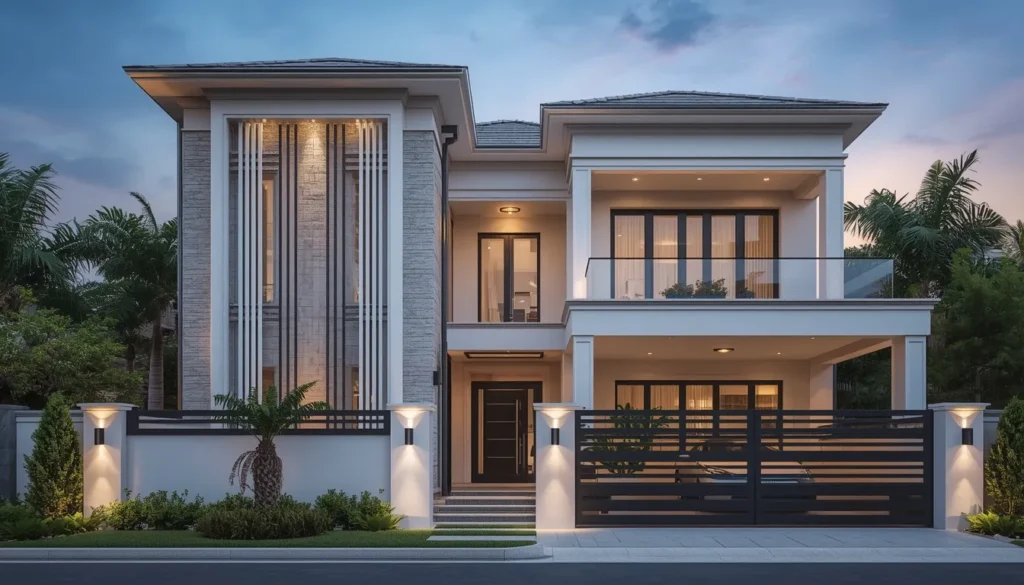
The veranda in a Ner Parsopant bungalow deserves to be discussed at length because it is the single design element that is most consistently compromised in contemporary bungalow construction in this town. Most new bungalows have something called a veranda — a strip of covered space along the front of the house, typically 1 to 1.5 metres deep, that provides shade to the front wall. This is not a veranda in any functional sense. You can’t put furniture in it. You can’t sit in it without your legs extending beyond the shade. It doesn’t do what a veranda is supposed to do.
A functional veranda in Ner Parsopant needs a minimum usable depth of 2.5 metres — ideally 3 metres — measured from the wall to the outer edge of the roof. At 3 metres, you can place a set of chairs and a small table and sit in genuine shade through the afternoon. You can receive a guest informally without bringing them into the drawing room. You can watch the evening settle over the compound with a proper sense of enclosure and shade. You can do none of these things in a 1.2-metre utility strip.
The orientation of the veranda matters as much as its depth. A veranda on the south or east face does real thermal work — it intercepts direct summer sun before it reaches the wall and glass behind it, reducing the heat that would otherwise radiate into the room through the afternoon. A veranda on the north face provides pleasant shade but does less thermal work because the north face doesn’t receive significant direct sun in summer. An architect who understands Ner Parsopant’s sun geometry designs the veranda to do both jobs — thermal protection and social space — by placing it on the correct face of the building.
Spatial Hierarchy in a Well-Designed Bungalow
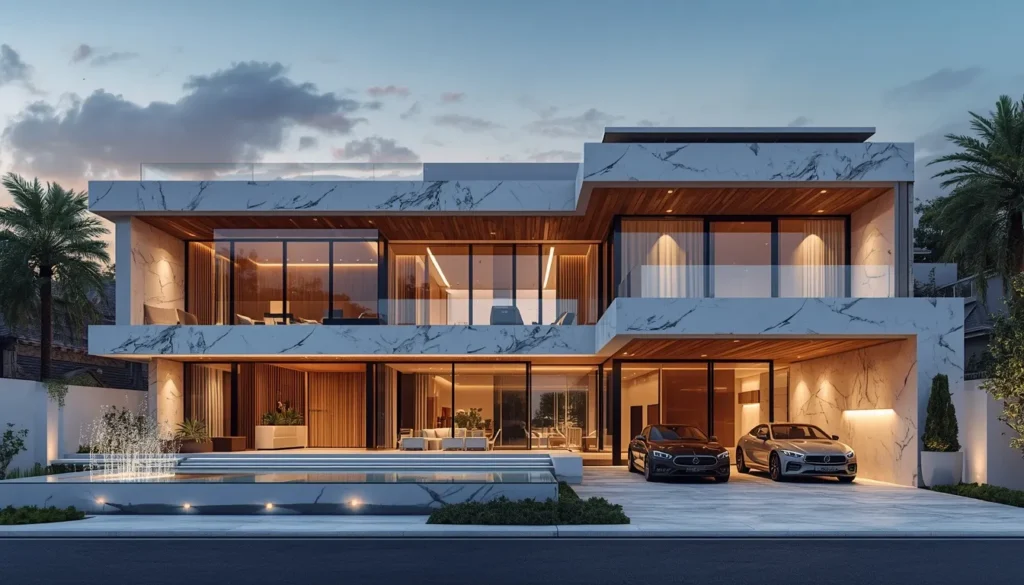
One of the things that distinguishes the work of a top bungalow architect from a contractor-produced plan is the presence of spatial hierarchy — the deliberate difference in size, ceiling height, and quality of light between the home’s most important rooms and its service rooms.
In a well-designed Ner Parsopant bungalow, you know when you’ve entered the drawing room. Not because there’s a sign on the door, but because the room is slightly larger than the others, slightly better lit, slightly more connected to the outdoor space. The transition from the entrance lobby to the drawing room is a spatial event — a change in ceiling height perhaps, or a step up or down, or simply the view through the room to the veranda beyond. The drawing room earns its primacy through the design, not just through being labelled on the plan.
In a contractor-produced plan, all rooms are roughly equal in status regardless of their name. The drawing room is the room at the front. The master bedroom is the room at the back. They may be the same size. They may have the same ceiling height, the same quality of light, the same relationship to the outdoor space. The design does nothing to reflect the actual hierarchy of how the family uses these spaces.
This is purely a design quality distinction. It doesn’t cost more in construction. It requires the architect to make deliberate decisions about what each room is in the life of the household and to reflect those decisions in the design.
What a Top Bungalow Architect Brings That Others Don’t
The brief conversation is the most important thing. A top bungalow architect in Ner Parsopant will spend more time developing the brief than producing initial design options, because the brief is the document that makes the design specific to this family rather than generic. The questions go beyond the room list — which direction do you want the front of the house to face, do you have elderly family members who will eventually need ground-floor access, how many people cook simultaneously on a festival day, do the children study independently or do they need supervision from the kitchen, does the family want a separate servant’s room or is that not relevant to their household.
The design that emerges from this conversation is different from the design that emerges from a room list. It accounts for the family’s actual life rather than an assumed life. The kitchen is bigger than the plan suggested because the family hosts large joint family gatherings six times a year. The study is positioned next to the kitchen rather than tucked upstairs because the mother needs to supervise homework while cooking. The master bedroom has a proper dressing area because the couple’s morning routine involves a level of privacy that the smaller secondary bedrooms don’t need.
These are design decisions that improve daily life. They come from listening.
Fees and Construction Costs for Bungalow Architecture in Ner Parsopant
Professional architectural fees for bungalow projects in Ner Parsopant:
Basic package — sanction drawings, site plan, basic elevations: ₹3 to ₹5 per sq ft. For a 2,500 sq ft bungalow: ₹75,000 to ₹1.25 lakhs.
With 3D exterior elevation — two to four views of the finished bungalow including compound, gate, and approach: ₹5 to ₹7 per sq ft. For a 2,500 sq ft bungalow: ₹1.25 to ₹1.75 lakhs.
Comprehensive service — full working drawings, structural coordination, site supervision: ₹7 to ₹10 per sq ft. For a 2,500 sq ft bungalow: ₹1.75 to ₹2.5 lakhs.
Construction cost for a good-specification bungalow in Ner Parsopant runs ₹1,900 to ₹2,600 per sq ft. For a 2,500 sq ft bungalow at mid-specification, construction cost ₹47.5 to ₹65 lakhs. Add architectural and structural fees, interior design if engaged, and site development for the compound and approach, and the full project typically runs ₹55 to ₹80 lakhs excluding land for a well-finished bungalow.
Standalone 3D exterior elevation (if you already have sanction drawings and want a visualisation): ₹20,000 to ₹65,000 depending on complexity and number of views.
Frequently Asked Questions
Q1. My parents built the bungalow I grew up in without an architect and it turned out fine. Why do I need one?
The bungalow your parents built benefited from accumulated vernacular intelligence even without a formal architect — the local building community understood what Ner Parsopant’s climate required and built accordingly. Contemporary construction using imported reference images and catalogue materials doesn’t automatically carry that intelligence. An architect applies design thinking to your specific project and site, which the vernacular tradition used to provide collectively. You need one because the collective knowledge isn’t reliably guiding construction anymore.
Q2. How do I know if an architect’s proposed floor plan is actually good?
Walk through it in your mind, seriously — wake up in the morning and follow the path you’d take from bed to bathroom to kitchen. Bring visitors in through the main entrance and follow them to the drawing room. Have a friend or family member arrive and ring the bell while you’re cooking — how do you receive them while the cooking is happening? If these mental journeys work naturally, the plan is probably good. If they involve awkward detours or exposing private spaces to guests, they aren’t.
Q3. Should I engage an architect before or after I know my construction budget?
Before, or at least simultaneously. One of the most useful things an architect does in the early stages is help calibrate what’s achievable at the family’s budget — whether a single-floor bungalow is more appropriate than a G+1, whether premium finishes should be concentrated in the main social rooms and standard specification used elsewhere, how to prioritise the construction budget across the building’s elements. These are design decisions that shape the budget, not decisions that follow from it.
Q4. What is the process for getting an old bungalow approved for renovation rather than fresh construction in Ner Parsopant?
This depends on whether the existing structure has valid sanction drawings on record with the local municipal authority. If it does, modifications that fall within the sanctioned building envelope may be permissible without full resubmission. Significant structural modifications, additions, or changes to the external envelope typically require fresh plan submission. An architect familiar with the Ner Parsopant municipal approval process will assess the existing documentation and advise on the appropriate route.
Q5. What finish materials work best for a bungalow exterior in Ner Parsopant’s climate?
Quality elastomeric exterior paint over cement-sand plaster is the most durable and cost-effective exterior finish in this climate — it accommodates the thermal movement of the building fabric without cracking, it is breathable enough to allow the masonry to dry after monsoon wetting, and it’s straightforward to touch up and repaint when needed. Natural stone cladding on the plinth and entrance frame adds durability and character at the points of maximum physical exposure. Avoid tile cladding on large wall areas — grout joints open over time in Vidarbha’s thermal cycling and become water ingress points.
Why Choose QC Interiors for Bungalow Design in Ner Parsopant:
Firm: QC Interiors Yavatmal
Expertise: Climate-Responsive Bungalow Design, Space Planning, Municipal Drawing Support
Service Areas: Ner Parsopant & Nearby Residential Areas
Plan a home that works beautifully through Vidarbha’s summers, monsoons, and everyday family life with expert architectural guidance.
