
Residential Interior Designers in Darwha — What the Best Designers Here Deliver and How to Find and Work With Them
A residential interior designer’s job, stated simply, is to make the inside of a home better than it would have been without their involvement. Not just more beautiful — better in every dimension that matters for daily life. More functional for the specific family. More comfortable in Darwha’s specific climate. More coherent as a designed environment where every element relates to every other element rather than being assembled from independent decisions. Better lit. Better organised. Better at being what a home needs to be.
This sounds straightforward. The delivery of it is not. In Darwha’s residential market, the gap between what is offered as interior design services and what genuine interior design actually involves is wide, and narrowing that gap is the challenge that families commissioning their interiors face. Understanding what to look for — and how to recognise it when you find it — is the starting point.
Residential Interior Designers in Darwha
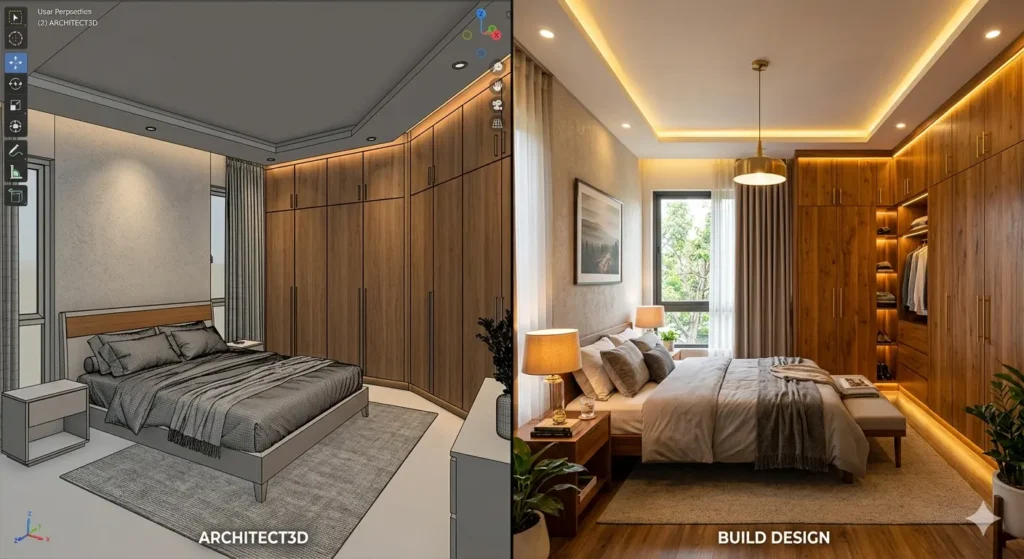
What Residential Interior Design Actually Looks Like in Practice
When a genuine residential interior designer begins a project in Darwha, the first conversations are not about tiles or furniture styles. They are about the family and the house. Who lives here? How many people, what ages, what is the structure of the household — nuclear, extended, multi-generational? How are the different spaces in the house used through a typical day? Which rooms are used by which family members and at what times? What activities are central to this household’s daily life, and do those activities have the spatial support they need?
From these conversations comes the design brief — a specific understanding of what the interior needs to do for this specific family. The design that follows responds to this brief. Every decision — the choice of flooring material in the kitchen, the placement of the primary seating in the living room, the storage provision in the master bedroom, the lighting level in the puja room — can be justified by reference to the brief. This is what makes a designed interior different from a decorated one.
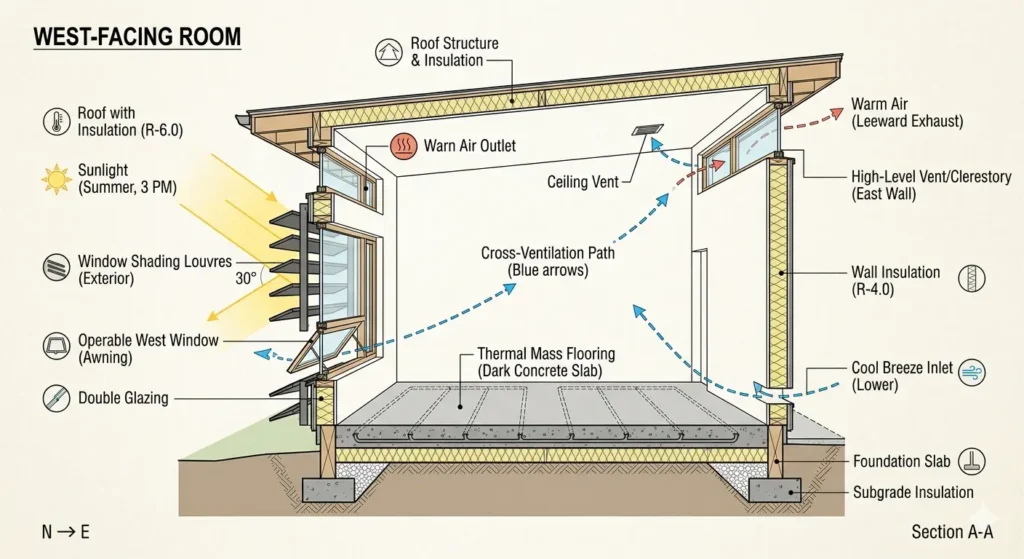
The spatial analysis runs alongside the family analysis. What is the quality of natural light in each room? The north-facing bedrooms in a Darwha home receive softer, more consistent light than the east-facing ones, which get strong morning sun, and this has implications for wall colour, artificial lighting intensity, and the choice of window treatment. The west-facing rooms accumulate the most heat in the afternoon and need specific design attention — window shading, thermal mass in the floor material, ventilation provisions — that rooms on other faces don’t require in the same way.
The Kitchen as a Design Priority
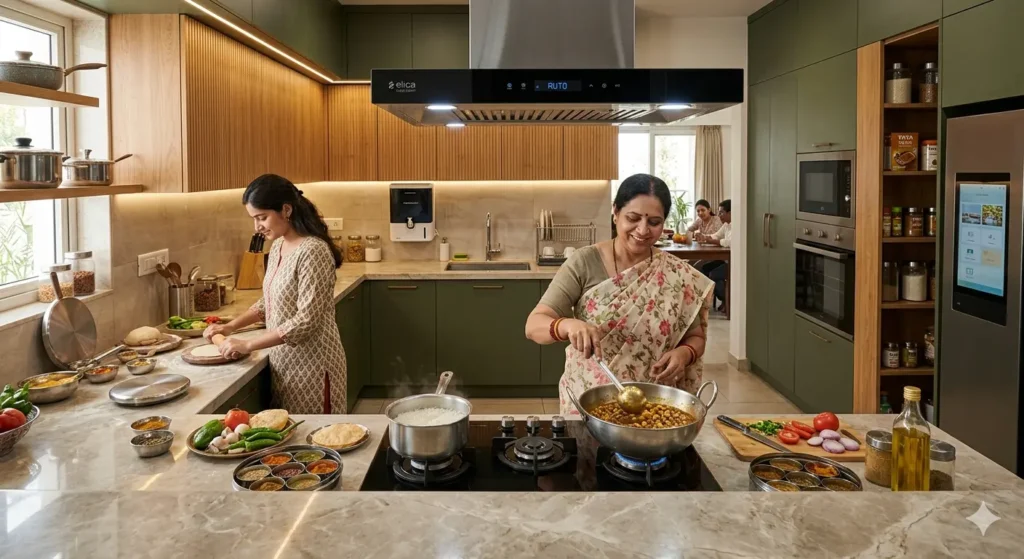
The kitchen in a Darwha home deserves special emphasis in any discussion of residential interior design because it is simultaneously one of the most heavily used spaces in the house and one of the most consistently under-designed. The standard approach in this market is to specify a modular kitchen unit from a Yavatmal or Nagpur supplier, choose a worktop and shutter colour, and install it. The result is functional. It is not designed for the way a Darwha extended family kitchen actually works.
A kitchen designed for a large Vidarbha household accounts for multiple people cooking simultaneously — the vessel sizes used for festive cooking, the storage required for the large quantities of provisions typically kept in a Darwha household, the ventilation needs of a kitchen in use for extended periods in a climate where summer temperatures are already high, and the relationship between the kitchen and the areas where family members congregate while cooking is happening.
A well-designed kitchen in this context has storage that is generous and logical — that puts the most frequently used items at the most accessible heights and the less-used items above and below. It has task lighting at every work surface, not just general overhead illumination. It has adequate ventilation — not just an exhaust fan above the stove, but thought given to where the cooking air flows and how it is removed from the space. It has a layout that allows two people to work at different stations without constantly getting in each other’s way.
The Puja Space
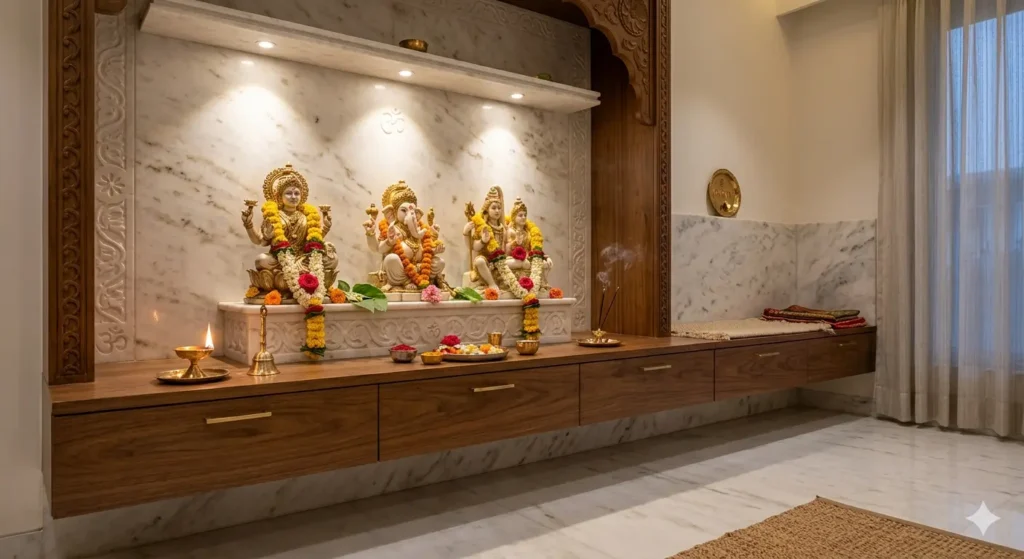
The puja space in a Darwha home is one of the most culturally significant interior design considerations in any residential project in this region, and one of the most frequently either over-designed with visual decoration that misses its spiritual character or under-designed as an afterthought squeezed into a corner. Neither outcome does justice to what this space means in a Darwha household.
A well-designed puja space — whether it is a dedicated room or a purpose-designed alcove within a larger space — has specific qualities. It has adequate lighting, including dedicated illumination for the deities and their surroundings, separate from the general room lighting. It has storage for the items used in daily puja — vessels, flowers, incense, lamps — organised so that the daily ritual is easy and the space remains orderly. It has a flooring material appropriate to the space, and a ceiling that acknowledges the significance of what happens below it. It faces the right direction, which in Hindu domestic architecture is typically east or north, and this placement needs to be considered when the floor plan is being designed rather than assigned to whatever space remains after everything else is placed.
The Value of Local Knowledge in Darwha
An interior designer with genuine local knowledge of Darwha brings specific value that a designer applying a national or metro-derived vocabulary cannot. They know how the light behaves in this climate across the seasons. They know which local material suppliers provide consistent quality and which do not. They know the craftsmen and contractors in the region who can execute specific elements of a design well, and the ones who cannot. They know how Vidarbha’s monsoon cycle affects different finishes and materials over time.
This local knowledge is not the only thing that matters in a designer’s credentials — genuine design ability is more fundamental — but it is a meaningful additional quality in the Darwha context. A designer who has designed homes in this specific environment for several years will make better material decisions, set more realistic expectations about execution, and manage the relationship between design intent and built outcome more effectively than one who is encountering these conditions for the first time.
What Residential Interior Design Costs in Darwha
Interior design fees in Darwha for a complete residential engagement — covering all primary rooms, including material specification, lighting design, joinery design, furniture selection, and construction supervision — typically run eight to twelve percent of the total fitout budget. For a home with a comprehensive interior fitout cost of ₹12 to ₹18 lakhs, the designer’s fee would be ₹1 to ₹2.2 lakhs. Projects with premium specification or custom elements will have higher total fitout costs and correspondingly larger fees.
The fitout budget — the cost of materials, joinery, furniture, and installation — is the larger number, and the design fee is a fraction of it. What the design fee delivers is coherence, appropriateness, and the quality that distinguishes a home that has been designed from one that has been furnished. Over the years of daily life in the finished space, this quality is felt continuously.
FAQs
Q1. What is the most common mistake families make when approaching residential interior design in Darwha?
Starting with the furniture purchase. Families who begin by buying furniture — often during a visit to Nagpur and often before the construction is complete — then find themselves with pieces that may not fit the rooms, may not work with the flooring material that is later chosen, and may not create the spatial arrangement that the room requires. The design should precede the procurement, not follow it.
Q2. Can good interior design be achieved on a modest budget in Darwha?
Yes. Good design is a function of intelligence and coherence, not of the unit cost of materials. A home with consistent, well-chosen mid-range materials — kota stone floors, simply designed joinery, a well-considered lighting scheme — can feel genuinely well-designed. A home with expensive materials chosen without design logic can feel expensive without feeling designed. Budget affects specification. It does not determine design quality.
Q3. How do I know when a designer’s proposal is genuinely responding to my brief and not just showing me their preferred style?
Ask them to explain, for each major design decision in their proposal, what in your brief led to that decision. A designer who can trace each choice back to something you told them — about your family, about how you live, about what matters to you — is a designer who has listened and responded. One who cannot is a designer who has applied their preferred vocabulary to your project and dressed it in your brief.
Designing a duplex residence in Darwha is not merely a process of building; it involves forming an environment that endures extreme summers and torrential monsoons. We take smart design, durability and elegance and marry it with deep local expertise to protect your investment for decades at QC Interiors.
Skip the compromise—develop perfectly precise and quality your family should have.
QC Interiors
Serving: Darwha, Yavatmal
Specialisation: Comprehensive Home Interior Design | Architectural Planning | Turnkey Renovations
📞 (+91) 7798153303
Book your consultation now and walk through with our 3D walkthrough of your home before a hammer is lifted!
