
Modern Duplex House Designs in Pusad — What They Can Be, and What They Actually Need to Work
The duplex house has become the residential aspiration of a specific generation of Pusad families. Not the older generation, whose residential ideal was the single-floor bungalow with a generous plot — the home that spread outward across the land rather than upward into the sky. And not the youngest generation, who are still in the stage of life where an apartment or a modest independent home is the practical starting point. The duplex dream belongs to the generation in the middle — families in their thirties and forties who have accumulated enough to build seriously, who want more than a standard single-floor home, and who have a clear mental image of the kind of home they want their family to grow up in.
This image is almost always shaped by things they’ve seen — on social media, during visits to relatives in Nagpur or Pune or Hyderabad, in the design accounts they follow on Instagram. It involves a striking staircase, a double-height entry, a master bedroom on the upper floor with its own balcony, a kitchen that looks genuinely contemporary rather than like a standard contractor job. These are real design aspirations, and the good news is that they’re entirely achievable in a Pusad context — if the design process is done properly.
The less good news is that a duplex designed without proper architectural thinking — the kind of duplex that emerges from a contractor offering to “do the drawings” — often achieves the visual elements of the aspiration while missing the underlying design logic that makes a duplex genuinely good to live in. It has stairs and two floors, but the staircase is positioned awkwardly. It has a master bedroom above, but the upper floor is hot in summer because the roof design doesn’t address Vidarbha’s thermal load. It looks like a duplex from the outside, but it doesn’t feel like a thoughtfully designed home on the inside.
This article is about what modern duplex house design in Pusad actually involves — the principles that make a duplex work, the specific considerations that Pusad’s climate and context impose, and the design elements that make the difference between a duplex that fulfils the aspiration and one that merely attempts it.
Modern Duplex House Designs in Pusad
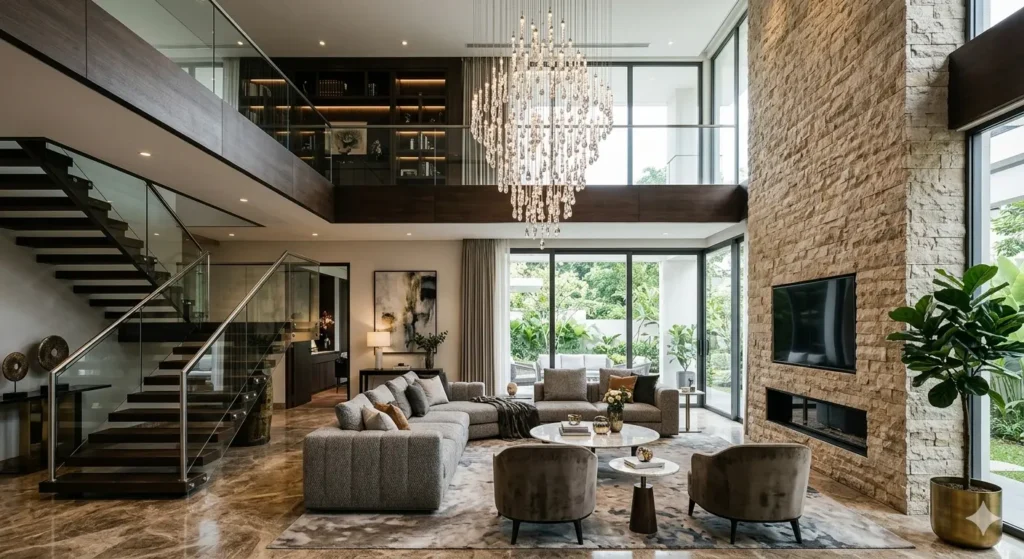
Understanding the Duplex Typology in Pusad’s Context
A duplex in Pusad is almost always an independent house on a privately owned plot — not a duplex apartment within a larger building, which is the more common form in Nagpur and larger cities. The typical Pusad duplex sits on a plot of 150 to 300 square metres, occupies both floors of the structure, and provides the family with a total built area of 2,000 to 4,000 square feet spread across the ground and upper floors.
This typology has specific design implications. The ground floor typically carries the public and service functions of the home: the drawing room, the dining area, the kitchen, a guest bedroom or prayer room, and the entry foyer. The upper floor carries the private functions: the master bedroom suite, the children’s bedrooms, and — in well-designed duplexes — the bathrooms that serve each bedroom properly rather than being shared across the floor.
The staircase is the element that connects these two worlds physically and visually, and it is the element that most distinguishes a designed duplex from an undesigned one. More on this shortly.
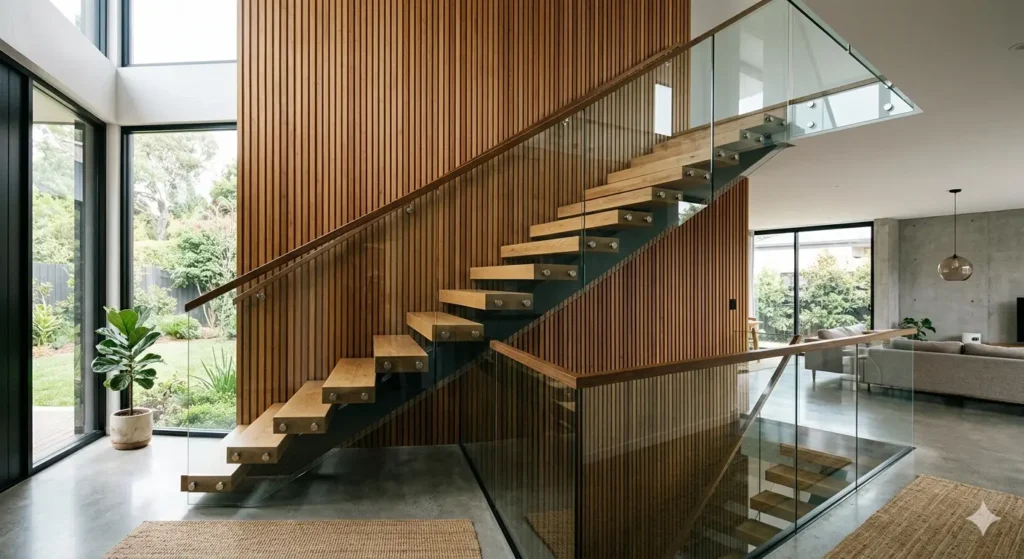
The Staircase: The Duplex’s Defining Architectural Moment
In Pusad duplex homes, the staircase is where the design investment has the highest visible return. It is the element that every visitor sees immediately upon entering, the element that the family passes through dozens of times daily, and the element that most directly communicates whether the home has been designed or merely constructed.
The design vocabulary for a contemporary Pusad duplex staircase has evolved considerably from the old concrete-and-tile staircase that was standard for decades. The options that current Pusad families are building toward are primarily two.
The first is the open-riser staircase with a glass or cable balustrade — treads without risers, creating visual transparency through the staircase structure. In a double-height entry space, this kind of staircase creates a lightness and openness that makes the home feel significantly more spacious than the floor plan dimensions alone suggest. Combined with a feature wall that uses the full height of the double-height space — natural stone cladding, fluted teak veneer, or a textured plaster — this staircase design creates the dramatic entry that is the signature of a well-designed Pusad duplex.
The second is the fully clad staircase with a solid wall treated as a material statement — the wall alongside the stairs clad in natural stone, in wood veneer, or in a large-format decorative tile — and a balustrade in forged iron or powder-coated steel that complements the wall treatment. This version has more weight and materiality than the open-riser design, and it suits homes where the design language is richer and more traditional rather than clean and contemporary.
The structural engineer needs to be involved in the staircase design from the beginning — not after the rest of the structure is built. The staircase’s structural requirements, its position relative to the slab opening, and the loads it transfers to the supporting structure all need to be considered in the initial structural design rather than retrofitted into it.
The Double-Height Space: Pusad Duplexes’ Biggest Opportunity
Many Pusad duplexes incorporate a double-height space above the entry foyer or above part of the drawing room — a void in the upper floor slab that creates a ceiling height of 18 to 22 feet in that zone. This feature is the single most architecturally significant element of a duplex, and it is the element most commonly either ignored or underdesigned in Pusad construction.
The double-height space needs to be treated as the home’s architectural centrepiece. The feature wall visible from both the ground floor and the upper landing — typically the wall that the staircase runs alongside — is the canvas for the home’s primary material statement. Natural stone cladding that runs the full height, in a warm local stone or in a premium imported variety. Vertical wood slats that create a rhythm across the height of the wall. A textured plaster finish in a warm, deep tone that gains atmosphere in the evening light.
The pendant light or chandelier hung in the double-height void is not a decorative afterthought — it is a critical design element that anchors the vertical dimension of the space and gives visitors something architecturally significant to look at the moment they enter. A sculptural light fitting chosen for its visual quality as much as its output — in the ₹40,000 to ₹1.5 lakh range depending on the selection — makes the double-height space complete.
Climate-Specific Design for a Pusad Duplex
Pusad’s climate imposes specific requirements on a duplex house design that a designer working primarily in a different region might not fully appreciate.
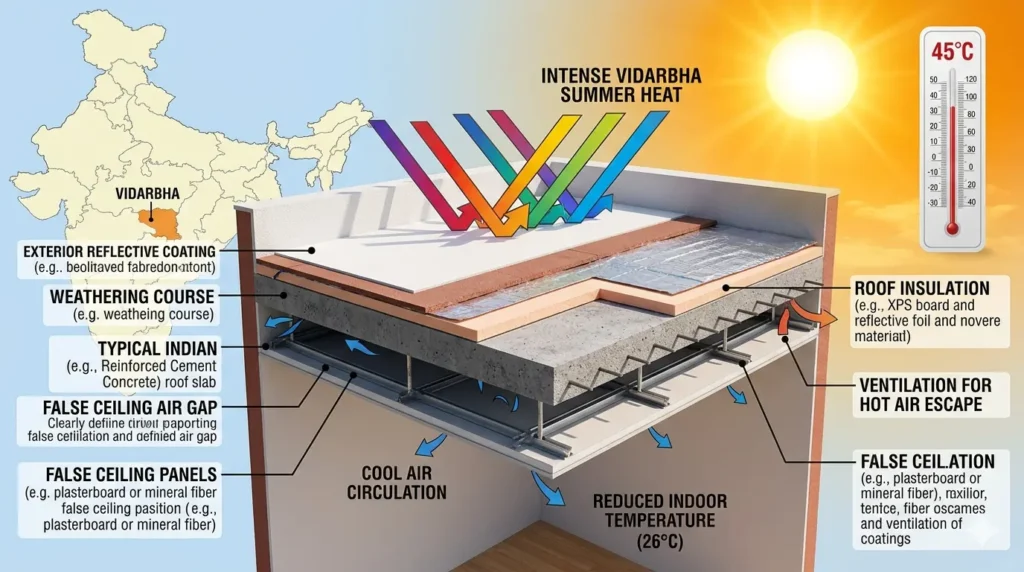
The upper floor heat problem is the most significant. In Vidarbha’s summer, the roof surface of a building reaches temperatures that transfer substantial heat load into the top floor ceiling. A well-designed Pusad duplex addresses this through a combination of roof design (adequate pitch, light-coloured or reflective roofing materials that reduce solar absorption), roof insulation (either under the roof slab or in a false ceiling cavity above the upper floor rooms), and ceiling design in the upper floor bedrooms that incorporates an air gap between the structural ceiling and the false ceiling.
Families in Pusad who’ve built duplexes without addressing this problem report upper floor bedrooms that are uncomfortably hot even with air conditioning running at full capacity in May and June. This isn’t primarily an air conditioning specification problem — it’s a building design problem, and the solution is architectural rather than mechanical.
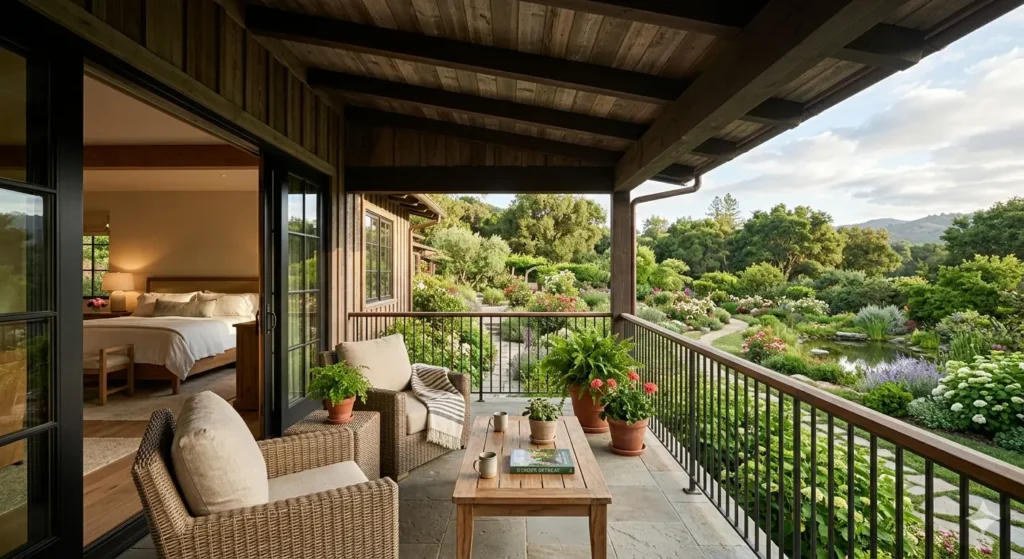
The veranda and covered outdoor space on the ground floor is as important in a Pusad duplex as in any Pusad home. A covered veranda that runs along the south or west facade of the duplex shades the main living rooms from direct afternoon sun and creates the transitional semi-outdoor space that is genuinely used and valued for most of the year.
The balcony from the master bedroom on the upper floor is the upper-floor equivalent — a private outdoor space that the master bedroom suite opens onto, creating a quality of morning use from October through February that adds real daily pleasure to the home.
Interior Design of the Duplex Ground Floor
The ground floor interior of a Pusad duplex is typically a more open, socially oriented space than a single-floor home allows. The drawing room is larger. The relationship between the drawing room, the dining area, and the kitchen can be designed as a more flowing, connected space rather than three separate rooms.
For the drawing room: warm white on the primary walls, with an accent on the most significant wall in a warm earth tone — terracotta, ochre, or a deep warm brick depending on the room’s light and the family’s preference. False ceiling with perimeter cove LED and positioned downlights. TV wall designed as a full-height architectural treatment — not stopping at a standard 7-foot height but running to the ceiling with a composition that uses the full dimension.
For the kitchen: a modular kitchen layout that reflects the actual cooking patterns of this family, with adequate counter space, proper chimney specification, quality hardware, and stone countertops. In a duplex kitchen with a dining area adjacent, the relationship between the two spaces — whether open-plan or separated — should be a conscious design decision rather than a default outcome.
For the dining area: well-proportioned furniture for the family’s actual gathering size, with a pendant light over the dining table that creates a focused, warm light quality for mealtimes.
Interior Design of the Duplex Upper Floor
The upper floor of a Pusad duplex is where the private character of the home lives. The master bedroom suite — bedroom, dressing area or wardrobe room, attached bathroom — should be the home’s most thoughtfully designed private space.
The master bedroom’s attached bathroom in a Pusad duplex is an investment worth making properly. Large-format tiles in a warm neutral palette. A proper shower enclosure with quality fittings. A vanity unit with storage designed for the bathroom’s actual contents. Backlit mirror or flanking wall lights at face height. These aren’t luxury specifications — they’re the standard that a home of this ambition and investment level requires.
Children’s bedrooms on the upper floor should be designed with adaptability across the childhood and adolescence years. Built-in study desks and storage that work at age eight and continue to work at age sixteen. Wall colours that can be updated as the child’s taste evolves without requiring structural redoing.
What a Modern Duplex Costs to Build and Design in Pusad
Land cost excluded, a modern duplex house in Pusad in 2025-26 at mid-range construction specification — good quality vitrified flooring in main areas, standard modular kitchen, painted walls with basic false ceiling work — costs approximately ₹1,900 to ₹2,400 per square foot to construct.
At premium specification — natural stone or engineered wood flooring in principal areas, premium modular kitchen, bathroom renovations to quality standard, architectural staircase, double-height feature wall — construction costs rise to ₹2,500 to ₹3,200 per square foot.
For a 3,000 square foot duplex: mid-range construction ₹57 to ₹72 lakhs, premium construction ₹75 to ₹96 lakhs. Interior design and fit-out separate from the construction cost: ₹12 to ₹25 lakhs depending on scope and specification level.
Architectural fee: 6 to 9 percent of construction cost.
FAQs: Modern Duplex House Designs in Pusad
Q1. Is a duplex house practical in Pusad’s hot climate, or is a single-floor home more comfortable?
A well-designed duplex is entirely practical in Pusad’s climate. The key is addressing the upper floor heat load through roof design, insulation, and ceiling design from the beginning of the project rather than trying to manage it with air conditioning after the fact. A poorly designed duplex with an uninsulated flat roof will be uncomfortably hot on the upper floor. A properly designed duplex with adequate insulation, ventilation strategy, and a good false ceiling cavity will be as comfortable as a single-floor home, with the additional spatial advantages that two floors provide.
Q2. How much plot size do I need for a proper duplex house in Pusad?
A meaningful duplex — one with adequate room sizes on both floors, a proper staircase, a veranda, and reasonable outdoor space — generally requires a minimum plot of 150 square metres (approximately 1,600 square feet). Below this, the floor plan becomes too compressed for the duplex to feel genuinely spacious. Plots of 200 to 300 square metres give the designer enough room to create a duplex with the spatial quality that makes the typology worthwhile.
Q3. What is the difference in cost between a flat roof and a sloped roof duplex in Pusad?
A properly sloped RCC or steel-and-tile roof adds approximately ₹150 to ₹300 per square foot to the construction cost compared to a flat RCC roof, depending on the roof structure type and tile specification. In Pusad’s climate — significant monsoon rainfall combined with extreme summer heat — the sloped roof is almost always the better investment. It handles monsoon drainage more reliably, reduces solar heat gain in the upper floor, and tends to require less maintenance over a twenty-year lifecycle than a flat roof.
Q4. Can I add a home office or business space to my duplex in Pusad?
Yes, and this is an increasingly common requirement in Pusad duplex briefs. The ground floor of a duplex can incorporate a dedicated home office or small business meeting space as a semi-public zone — accessible from the entry without requiring visitors to enter the private living areas. This works particularly well for professionals, traders, or business families who receive clients or associates at home. The design needs to think about the acoustic separation between the office space and the living areas, as well as the entry sequence that allows the office to be accessed independently when needed.
Q5. How do I find a good architect or designer for a duplex project in Pusad?
Start with word-of-mouth — ask families in Pusad who’ve built duplexes recently who they used and whether they’d engage the same person again. Visit completed projects in person rather than relying on photographs. Look for an architect or designer who has built duplexes specifically rather than only single-floor homes — the duplex typology has specific design requirements around the staircase, the double-height space, and the upper floor climate management that require experience. Ask about their structural engineering collaboration — a duplex needs a proper structural engineer engaged from the beginning, not brought in after the architect has drawn the floor plans.
Constructing a residence in Pusad is not merely a process of building; it involves forming an environment that endures extreme summers and torrential monsoons. We take smart design, durability and elegance and marry it with deep local expertise to protect your investment for decades at QC Interiors.
Skip the compromise—develop perfectly precise and quality your family should have.
QC Interiors
Serving: Pusad, Yavatmal
Specialisation: Comprehensive Home Interior Design | Architectural Planning | Turnkey Renovations
📞 (+91) 7798153303
Sign up for your consultation now and walk through with our 3D walkthrough of your home before a hammer is lifted!
