
Modern Duplex House Architects in Yavatmal — Everything the City’s Families Need to Know Before Building Two Floors
The duplex house has become Yavatmal’s most common residential aspiration for families with a decent plot and enough budget to think beyond a single floor. You see them going up across the city’s newer layouts — along the roads leading out toward Pusad and Wardha, in the colony areas where plots run to forty or fifty feet wide, in the older neighbourhoods where families are rebuilding on the land their parents or grandparents bought. Two floors, a staircase somewhere in the middle, ground floor for the family’s public life and the kitchen and service areas, upper floor for the bedrooms and the private spaces the family needs to withdraw into.
This template has been repeated so many times in Yavatmal that the city now has a substantial stock of duplexes ranging from genuinely well-designed to structurally sound but poorly conceived. The well-designed ones are immediately recognisable when you walk into them: both floors feel inhabited and connected, the rooms are comfortable across the full year’s climate cycle, the staircase is in a position that makes sense for how both floors are used, and the building performs as a home rather than as a construction exercise. The poorly conceived ones are also recognisable: upper-floor bedrooms that are genuinely difficult to sleep in during April and May, ground-floor living spaces that feel cut off from natural light, a staircase positioned where it creates privacy problems on both levels, a terrace that lets water through when the monsoon comes.
The difference between these two outcomes costs almost nothing extra to achieve. The gap is design thinking, not construction budget.
Modern Duplex House Architects in Yavatmal
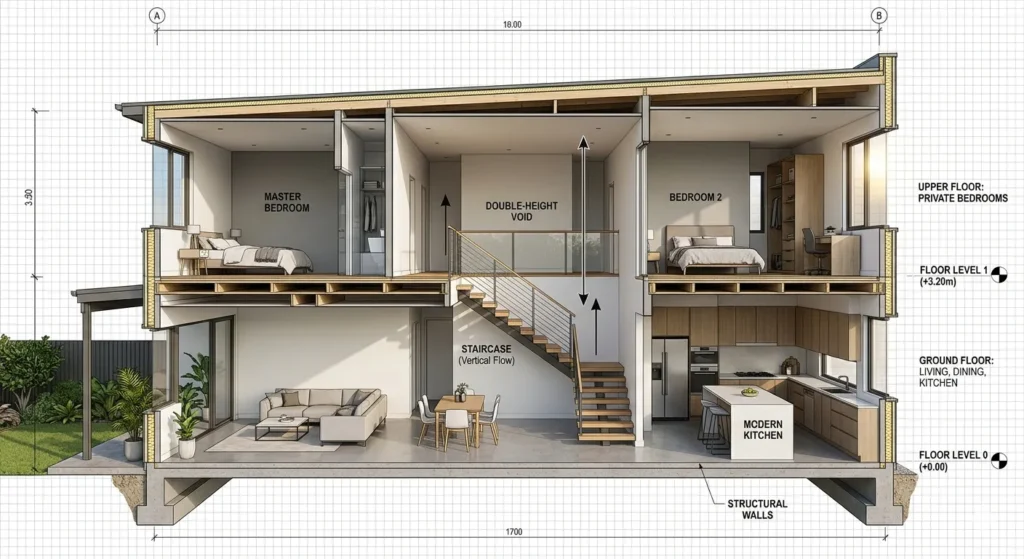
What a Modern Duplex in Yavatmal Needs to Do
A well-designed duplex in Yavatmal in 2025 needs to satisfy several requirements simultaneously, and a design that sacrifices any of them for the sake of the others will produce a building that the family feels the limitations of every day.
Climate performance across both floors is the first requirement. The ground floor, with its solid slab above and the earth’s thermal mass below, tends to be more thermally stable than the upper floor. The upper floor, with direct roof exposure, is the challenging one. A Yavatmal duplex where the upper-floor bedrooms aren’t designed with adequate thermal performance — insulated roof assembly, correct orientation, cross-ventilation designed into the room layout — will be uncomfortably hot to sleep in for four months of the year. This is not a small problem. This is a structural daily quality-of-life problem that persists for the life of the building.
Functional separation between the floors’ different roles is the second requirement. The ground floor needs to accommodate the household’s daily public life — receiving guests, family gathering, cooking, service — without that activity impinging on the privacy of the upper floor’s sleeping spaces. This requires a staircase positioned to connect the two floors through the common areas rather than through private zones. It requires the kitchen positioned to keep cooking smells and sounds away from the bedroom areas of the upper floor. It requires thinking about vertical acoustic separation between the ground floor’s active spaces and the upper floor’s quiet ones.
Multi-generational flexibility is the third requirement for most Yavatmal duplexes. Many families build with the explicit intention of the upper floor eventually serving as a semi-independent household for the next generation — with its own entry access, its own kitchen provision, its own meter if possible. This flexibility needs to be designed in from the beginning: a separate staircase entry, plumbing stub-outs for a future upstairs kitchen, electrical provision for separate metering. These decisions are inexpensive at the design stage and expensive or impossible to retrofit after construction.
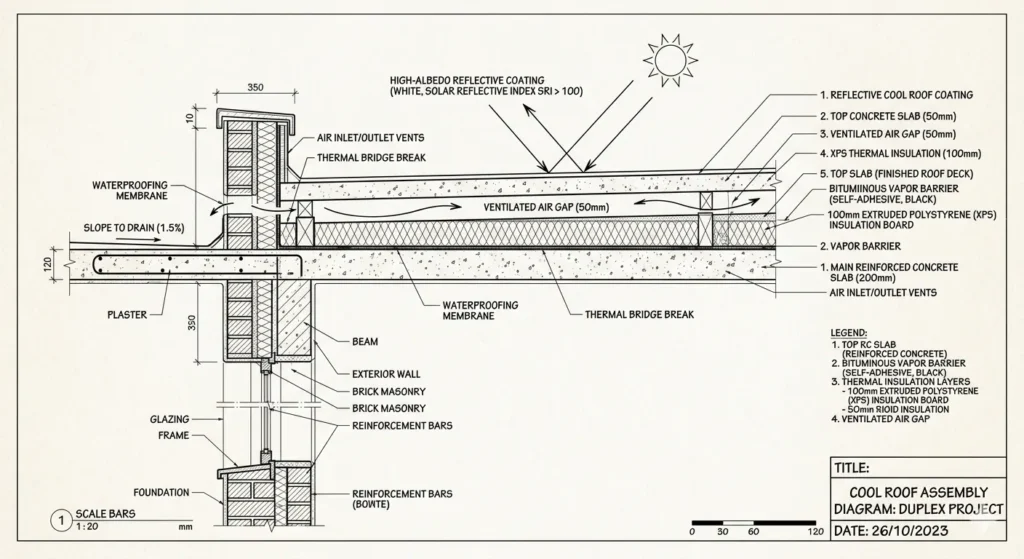
The Thermal Challenge of Yavatmal’s Upper Floor
The single most common complaint about duplex homes in Yavatmal — across many families and many buildings — is upper-floor heat in summer. It’s worth understanding exactly why this happens and what design does about it.
The roof surface of a Yavatmal duplex in April absorbs solar radiation throughout the day and reaches surface temperatures well above the ambient air temperature. Without adequate insulation between this hot roof surface and the room below, the heat transfers through the slab and into the bedroom, making the room temperature significantly higher than the ground floor rooms. Air conditioning can address this, but it runs expensively and continuously when the room’s basic thermal performance is poor, and it provides no comfort during the power interruptions that remain a reality in Vidarbha’s summer months.
Design responses to this problem work at multiple levels simultaneously. Roof insulation — whether as an insulating screed beneath the roof finish, rigid insulation boards in the roof assembly, or a ventilated air gap between the waterproofing layer and the slab — reduces the heat transfer through the slab by a significant physical amount. Adequate overhang at the parapet and roof edges reduces the direct solar radiation falling on the wall surfaces below the roof, reducing the secondary heat load on the upper-floor rooms. Cross-ventilation openings — windows on opposing faces of each bedroom — allow natural airflow to carry heat out of the room, effective on the warm evenings when the outdoor temperature drops but the room temperature is still elevated from the day’s absorption.
None of these interventions is expensive relative to the construction cost of the building. All of them require being specified and detailed explicitly in the design drawings rather than left to contractor discretion. This is exactly why having an architect engaged for the full design process — rather than a draftsman who produces approval drawings without detailed specifications — makes a direct and measurable difference to the quality of life in the finished building.
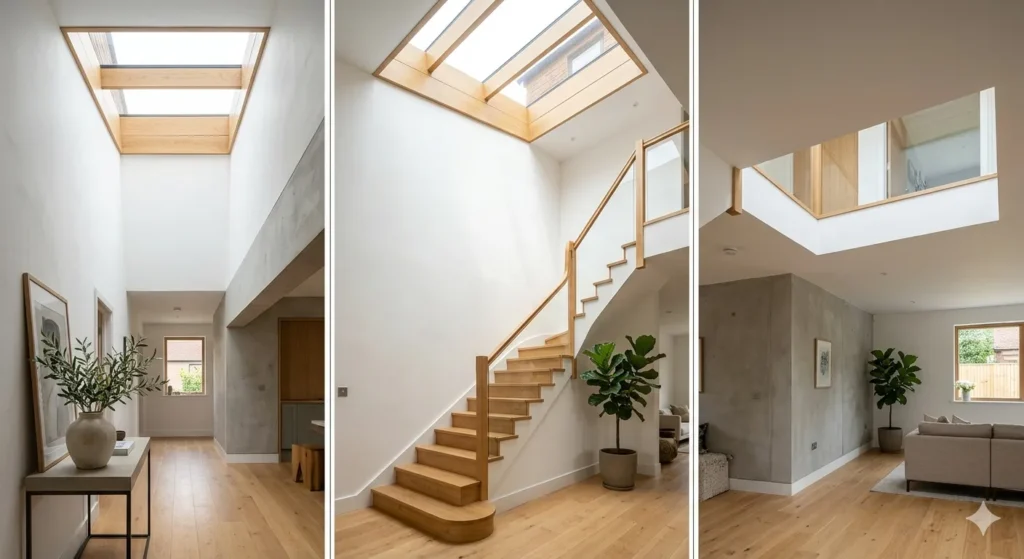
What Makes a Duplex Design ‘Modern’ in Yavatmal’s Context
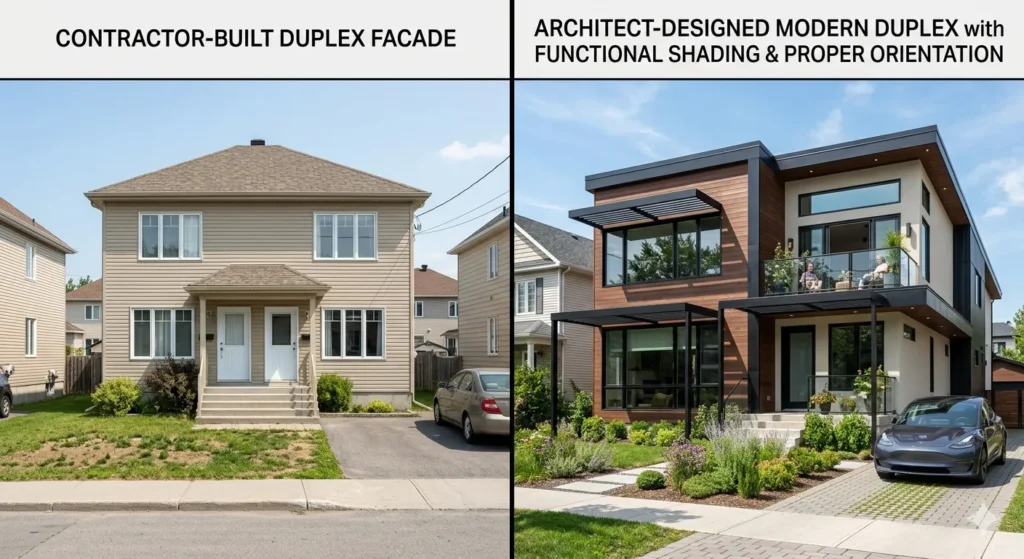
The term “modern duplex” gets applied to a wide range of buildings in Yavatmal, from genuinely well-designed contemporary homes to contractor specials that have a flat parapet and a large tiled facade but were otherwise designed the same way buildings were designed twenty years ago. It’s worth being specific about what modern design actually means in the Yavatmal residential context.
A modern duplex design in Yavatmal means, first, that the building’s form and facade are derived from its functional organisation rather than being a stylistic cladding applied to a generic box. The windows are sized and positioned for the light and ventilation the rooms need, not arranged symmetrically on the facade regardless of what’s behind them. The roof overhang is sized for the climate work it needs to do, not as a decorative feature. The veranda is proportioned for actual use, not reduced to a token strip because someone calculated it would save two feet of setback.
Modern design means that the internal organisation is efficient. Modern design means that circulation space — corridors, landings, staircase — is minimised without making the home feel cramped, so that the maximum possible floor area is in rooms that are actually used rather than in transition spaces between rooms. It means that every bedroom has natural light and ventilation that comes from the placement of the room in the plan, not from a single window cut into a wall wherever it was convenient to put it.
Modern design in Yavatmal also means that the building ages well — that the material and finish choices don’t require intensive maintenance to look respectable after five years of monsoons and summer heat cycles. Smooth, painted external surfaces that are easy to clean and repaint. Quality waterproofing that doesn’t need to be redone after every monsoon. Exterior tile or stone that doesn’t effloresce or stain. These are design and specification choices, not construction luck.
How to Commission a Duplex Architect in Yavatmal
Commissioning a duplex architect in Yavatmal requires the same due diligence as any residential architect engagement, with a few additional considerations specific to the duplex brief.
Ask specifically about upper-floor thermal performance in their completed duplexes. This is the dimension most often compromised in poorly designed Vidarbha duplexes. Ask how they address it — what insulation specification they use, how they detail the roof overhang, how they design the cross-ventilation in the upper-floor bedrooms. An architect who has solved this problem in previous projects will answer with specifics. One who hasn’t will answer with generalities.
Ask about their approach to the staircase position and the ground floor-upper floor connection. Show them your plot and ask them where they would put the staircase and why. The reasoning they offer will reveal how carefully they’ve thought about the duplex as a spatial problem rather than as a template to be applied.
Ask about the terrace — every Yavatmal duplex has one, and every one of them is a waterproofing challenge. How do they detail the junction between the terrace waterproofing and the parapet wall? How do they ensure adequate drainage slope? What waterproofing system do they specify, and why? These are technical questions with right answers, and an architect who works on Yavatmal duplexes regularly will have them.
Visit at least two completed duplexes they’ve designed, ideally homes that are three or more years old so you can see how they’ve performed through multiple monsoon seasons and summer cycles. Walk through the upper-floor bedrooms in the afternoon during the visit and see how the rooms feel thermally. Look at the terrace junction details. Look at the junction between the roof overhang and the top of the upper-floor windows. If there’s no staining or water damage at these locations after three years in Yavatmal’s climate, the detailing was right.
FAQs: Modern Duplex House Architects in Yavatmal
Q1. What does a duplex cost to build in Yavatmal in 2025-26?
At mid to good specification, ₹1,800 to ₹2,600 per square foot of total built area across both floors. A 3,000 square foot duplex — 1,500 square feet per floor — represents a construction cost of ₹54 to ₹78 lakhs before site development, compound work, and interior finishes.
Q2. How much does an architect charge for a duplex project in Yavatmal?
Typically 6 to 9 percent of construction cost, including design, documentation, approval management, and site supervision. For a ₹60 lakh construction cost, the architectural fee would be ₹3.6 to ₹5.4 lakhs.
Q3. Can I get building permission for a duplex in Yavatmal if my plot is small?
It depends on the specific zoning and FSI regulations applicable to your plot. The Yavatmal Municipal Council has specific rules about coverage, setbacks, height, and FSI for different zone categories. An architect familiar with these regulations can tell you quickly what’s feasible on a given plot before you make any other commitments.
Q4. Is it possible to design a duplex so both floors can be rented or sold independently in future?
Yes, with planning. Independent entry for the upper floor, separate utility connections, and self-contained kitchen and bathroom provision on each floor are all achievable at the design stage. Each of these requires specific decisions that need to be incorporated in the design drawings, not retrofitted after construction.
Q5. What’s the most common design mistake in Yavatmal duplexes?
Positioning the staircase along an exterior wall to save centre-plan space, then discovering that the upper-floor layout it creates is awkward — bedrooms accessible only through each other, or the landing positioned where it creates privacy problems for both floors. This is a design problem, not a construction problem, and it’s solved by having an architect think through the spatial consequences of the staircase position before it’s drawn.
Strong Foundations. Smart Living.
Building a duplex in Yavatmal is more than construction—it’s about creating a home that withstands harsh summers and heavy rains while staying comfortable year-round.
QC Interiors combines smart planning, durable construction, and modern design to deliver homes that last and impress.
Build with confidence. Build with QC Interiors.
Serving: Yavatmal, Yavatmal
📞 +91 7798153303
