
Modern Duplex Designers in Wardha — Building Two Floors That Actually Work in Vidarbha’s Most Demanding Season
The duplex home has arrived in Wardha’s residential aspirations in a meaningful way. Drive through the newer residential layouts on Nagpur Road and toward the developing areas on the city’s periphery and you see the evidence — two-floor structures going up at a pace that reflects genuine confidence in the investment, families who’ve decided that the combination of space, privacy between floors, and architectural presence that a duplex provides is what they want for their family’s home.
Some of these homes are going to be genuinely excellent. Others are going to disappoint — not because the family didn’t invest enough, not because the construction quality is poor, but because the specific design requirements of a two-floor home in Wardha’s climate were never properly addressed. The upper floor that becomes a heat trap in April. The flat roof that develops a persistent leak in its second monsoon. The staircase that’s positioned awkwardly in the floor plan because nobody thought about how a double-height space needs to relate to the rooms around it. These are design failures, and they’re entirely preventable by engaging a designer who knows what a Wardha duplex specifically needs.
This article covers that knowledge — what makes a duplex work in Wardha’s conditions, and what to look for in the designer who helps you build it.
Modern Duplex Designers in Wardha
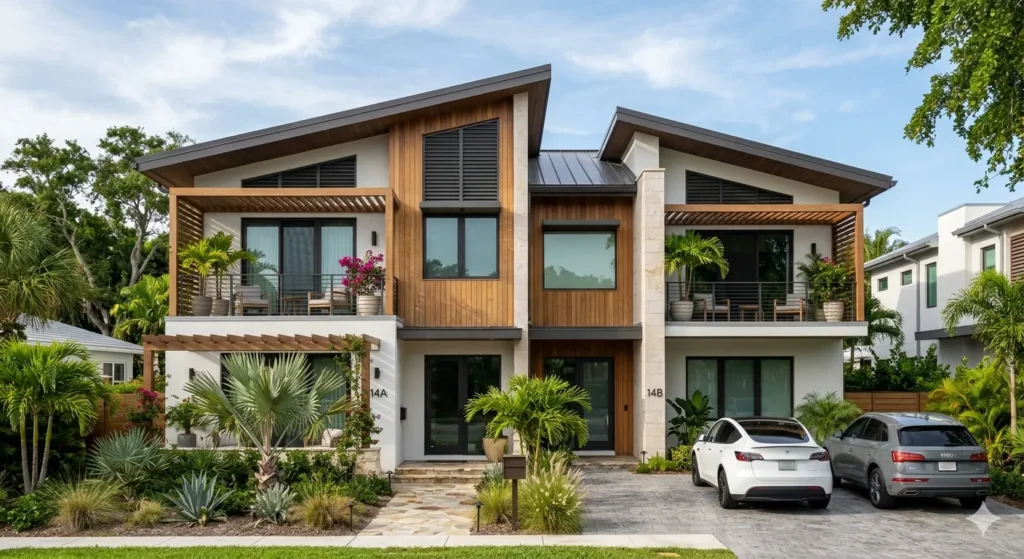
The Wardha Duplex: What Makes It Different From Any Other City
Wardha’s duplex design challenge is not unique in type — the heat management requirement, the monsoon waterproofing requirement, the orientation logic — but it is specific in degree. Wardha’s summer temperatures are severe enough that an upper floor without proper thermal protection is genuinely uncomfortable, not marginally warm but genuinely difficult to occupy without running air conditioning at capacity. And Wardha’s monsoon is real enough that a flat roof without serious waterproofing attention is a liability waiting to express itself.
The designer or architect who takes on a Wardha duplex project needs to have thought through both of these problems and have specific, tested solutions for both. Not vague commitments to “address the heat” and “do proper waterproofing” but specific design decisions — the roof pitch, the roofing material specification, the insulated false ceiling detail in the upper floor rooms, the cross-ventilation provision, the drainage design — that demonstrate that the problem has been solved in their previous work.
Ask specifically about both issues in your first meeting with any designer you’re considering for a Wardha duplex. The quality of their answers will tell you a great deal about whether they’ve actually built duplexes in this climate or whether they’re telling you what sounds reassuring.
The Right Configuration for a Wardha Duplex
The duplex configuration that serves Wardha families best places the home’s public social life on the ground floor and the private sleeping life on the upper floor. This isn’t just a preference — it’s the arrangement that makes both floors work better.
The ground floor as the public floor: drawing room, dining area, kitchen, puja room, guest toilet, and in larger homes a ground-floor bedroom for elderly family members who cannot or prefer not to manage stairs. This floor receives guests, hosts the significant occasions, connects directly to the veranda and the outdoor space that makes the home’s social life work. It can be fully open to guest access without compromising the privacy of the sleeping floor.
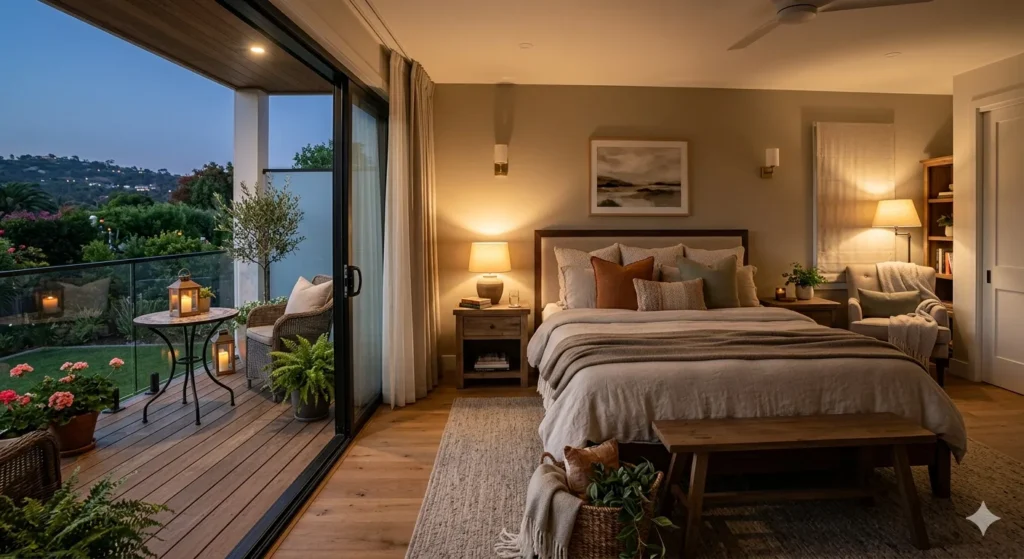
The upper floor as the private floor: master bedroom suite with attached bathroom, children’s bedrooms, family bathrooms, and — in well-designed Wardha duplexes — a covered balcony off the master bedroom that gives the upper floor its own private outdoor space. This floor’s privacy is protected because it’s not part of the guest circuit. The family retreats here at the end of the day with a quality of separation from the social activity below that single-floor homes don’t offer.
The staircase connects these worlds, and in a Wardha duplex it should be treated as an architectural element, not a circulation afterthought. The tread material, the balustrade design, the wall treatment alongside it as it rises through the double-height void — these are the elements that communicate whether the home was designed or assembled.
Upper Floor Heat Management: Solving Wardha’s Hardest Duplex Problem
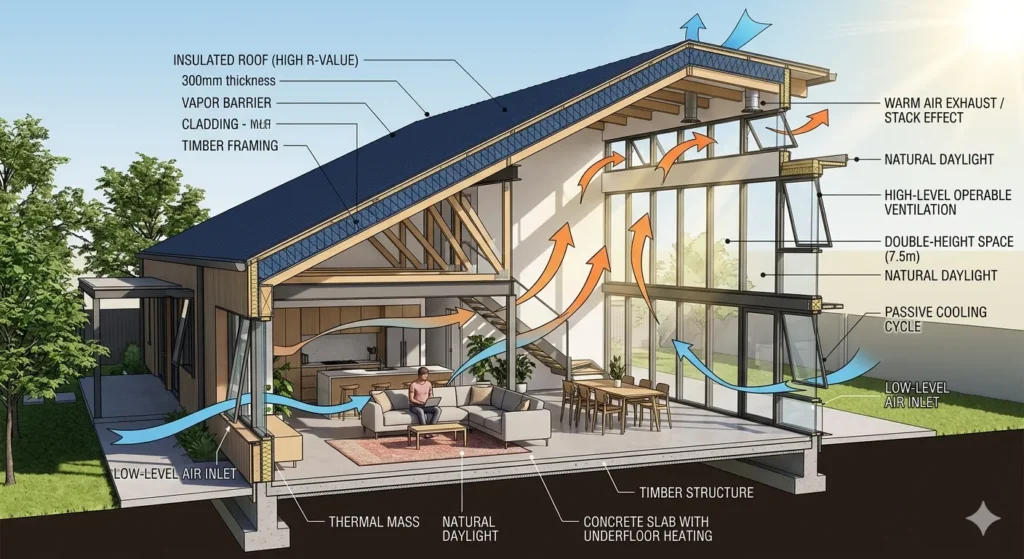
Three architectural measures together solve the upper floor heat problem in a Wardha duplex. They need to be in the design from the beginning — not addressed as retrofits after the family has moved in and discovered the problem.
The roof specification is the first measure. A pitched roof in a light-coloured or reflective roofing material reduces the solar radiation absorbed at the building skin. At Wardha’s peak summer solar intensity, the difference between a reflective pitched roof and a standard dark flat concrete surface is substantial — the roof surface temperature difference translates directly into the heat load transferred to the rooms below. A well-specified cool roof can reduce upper floor room temperatures by 5 to 8 degrees compared to an uninsulated flat roof — the difference between comfortable and genuinely difficult.
The insulated false ceiling in the upper floor rooms is the second measure. A false ceiling with adequate air gap between the false ceiling board and the structural slab — a minimum of 300mm, ideally 400 to 450mm — combined with cross-ventilation provision to allow the hot air accumulating in this cavity to escape, prevents the heat transfer from the roof structure into the occupied room. This works with the roof specification rather than instead of it.
The window design is the third measure. Upper floor windows with adequate roof overhang above them that shades the glass from the high summer sun while allowing the lower-angle winter sun to enter naturally. Windows positioned for cross-ventilation — openings on opposite or adjacent walls that allow hot room air to escape when the evening breeze allows. These natural ventilation measures supplement the mechanical cooling and reduce the AC load in a meaningful way.
The Staircase and Double-Height Space in Wardha
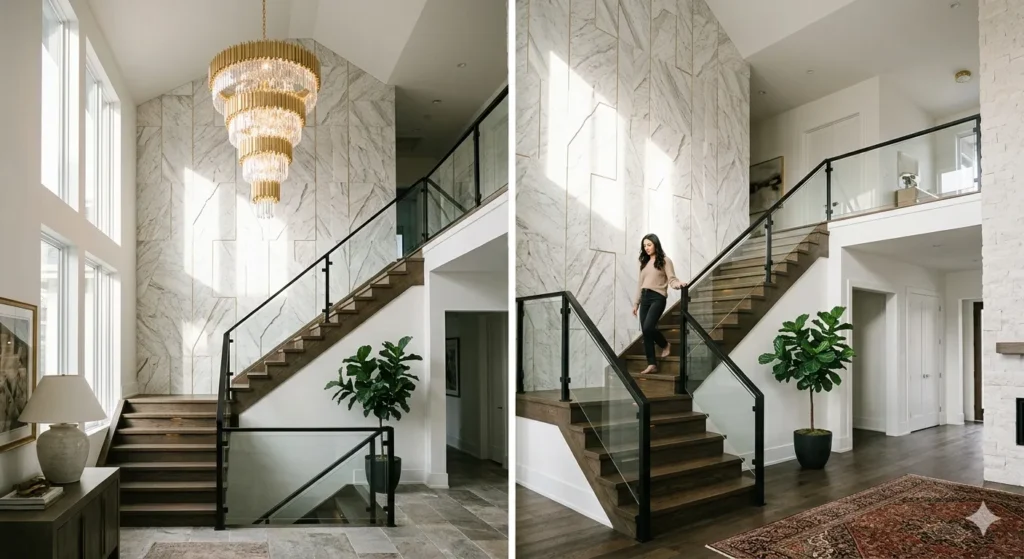
In a Wardha duplex with a double-height void above the entry foyer — a ceiling of 18 to 22 feet in that zone — the architectural opportunity is significant and the design obligation is real. This space is the home’s visual centre. How it’s designed determines whether the duplex feels like a genuinely impressive home or like two ordinary floors that happen to be connected by stairs.
The feature wall rising through the void — the wall alongside or opposite the staircase that is visible from both the ground floor entry and the upper floor landing — is the home’s primary material statement. Natural stone cladding in a warm variety running the full height from ground floor to upper landing. Vertical teak veneer panels with a consistent rhythm. Hand-applied textured plaster in a deep warm tone. Any of these, executed with genuine craft, creates a visual quality that anchors the home’s design language.
The pendant or chandelier hung in the void — a sculptural fitting in the ₹30,000 to ₹90,000 range, chosen for its visual character as much as its light output — anchors the vertical dimension of the space. Combined with the feature wall treatment, it makes the entry experience of a Wardha duplex an architectural moment.
Ground Floor Interior: The Social Heart
The drawing room as the ground floor’s social centrepiece: architectural false ceiling with cove LED and positioned downlights, focal wall treatment in warm natural materials at full height, furniture sized for Wardha’s social culture rather than the minimum that fits the zone. The kitchen designed from a genuine brief about how this family actually cooks. The dining area at the scale of the family’s real festival and celebration needs. The puja room or alcove with natural stone platform and warm soft lighting — not an afterthought but a designed space.
Upper Floor Interior: The Private World
Master bedroom suite: dressing provision either in a separate walk-in dressing room or in a well-designed wardrobe room adjacent to the bedroom. Attached bathroom at quality specification with large-format tiles, quality sanitaryware, and designed vanity storage. Bedhead wall treatment. Cove and bedside lighting.
Covered balcony off the master bedroom: properly floored, with privacy screening from neighbouring buildings if needed, usable from September through February as the private outdoor daily-use space.
Children’s bedrooms: designed for adaptability, with built-in storage and flooring that serves the room for a decade regardless of how the decorative layer changes as the child grows.
Complete duplex construction and interior fit-out in Wardha: ₹58 to ₹95 lakhs for 2,600 to 3,800 square feet at mid to premium specification.
FAQs: Modern Duplex Designers in Wardha
Q1. How do I find a duplex designer in Wardha who specifically understands the upper floor heat management requirement? Ask them directly in the first meeting: what specifically do you do about upper floor overheating in a Wardha duplex? An experienced designer gives a detailed answer about roof specification, insulated ceiling with air gap, and cross-ventilation provision. A designer without this specific knowledge gives a vague answer about air conditioning. The quality of this answer is the most diagnostic question you can ask.
Q2. Is it better to have a sloped or flat roof on a Wardha duplex? For a family home in Wardha’s climate, a pitched or sloped roof is significantly better than a flat roof on both counts that matter: it reduces upper floor heat load by reducing solar absorption at the roof surface, and it handles Wardha’s monsoon rainfall reliably without the waterproofing vulnerabilities that flat roofs develop in this rainfall context. The additional construction cost is recovered in comfort and maintenance costs avoided.
Q3. What is a realistic total budget for a well-designed duplex in Wardha in 2025-26? For a 3,000 square foot duplex at mid to premium specification — construction, interior fit-out, architectural and structural fees, and external landscape work — budget ₹68 to ₹1.05 crores. Land cost and furniture are separate. The range reflects specification level rather than floor area alone.
Q4. Can an elderly parent be accommodated in a Wardha duplex without the daily stairs problem? Yes, with good design from the architectural phase. A ground-floor bedroom adjacent to a ground-floor bathroom creates a self-contained accessible suite on the floor that doesn’t require stairs. A small residential lift shaft incorporated from the structural design phase is another option for families who want full stair-free access to both floors.
Q5. How does the double-height space affect the cooling requirement of the ground floor in Wardha’s summer? A double-height void is more challenging to cool efficiently than a standard ceiling height space. The design response involves treating the void as a separate zone from the main living area — with a ceiling fan hung at an appropriate height to create air movement in the lower occupied zone, and with the AC provision in the ground floor social rooms designed to work with the high ceiling rather than trying to cool the full void volume.
Strong Foundations. Smart Living.
Building a duplex in Wardha is more than construction—it’s about creating a home that withstands harsh summers and heavy rains while staying comfortable year-round.
QC Interiors combines smart planning, durable construction, and modern design to deliver homes that last and impress.
Build with confidence. Build with QC Interiors.
Serving: Wardha
📞 +91 7798153303
