
Modern Duplex Designers in Umarkhed — What Contemporary Duplex Architecture Looks Like and How to Get It Right
The duplex home has become an increasingly common residential typology in Umarkhed over the past decade, and for reasons that are straightforward to understand. The town’s residential land values have risen as the available plots in established areas have been absorbed and the peripheral areas have extended outward. As land costs increase, the logic of building upward rather than outward becomes more compelling — a plot that yields a 2,000 square foot single-storey home can yield a 3,500 or 4,000 square foot duplex on the same footprint, and the difference in livable area justifies the additional construction cost many times over.
But the duplex is not simply a single-storey home with another storey placed on top. A duplex well designed is a fundamentally different spatial experience from a stacked plan, and the difference matters enormously for how the finished home feels to live in. In Umarkhed’s market, where the term ‘duplex’ is used freely to describe everything from thoughtfully designed two-storey homes to buildings that are merely vertical in their organisation, understanding what makes a modern duplex work is the prerequisite for commissioning one that does.
Modern Duplex Designers in Umarkhed
What Makes a Duplex Modern — And What That Actually Means for Umarkhed
Modern duplex design in the context of a town like Umarkhed does not mean the glass-and-steel aesthetic that the word ‘modern’ sometimes evokes. It means a design approach that solves the specific problems of the duplex typology — the staircase placement, the vertical circulation, the relationship between the two floors, the distribution of spaces between floors — with contemporary thinking rather than default solutions.
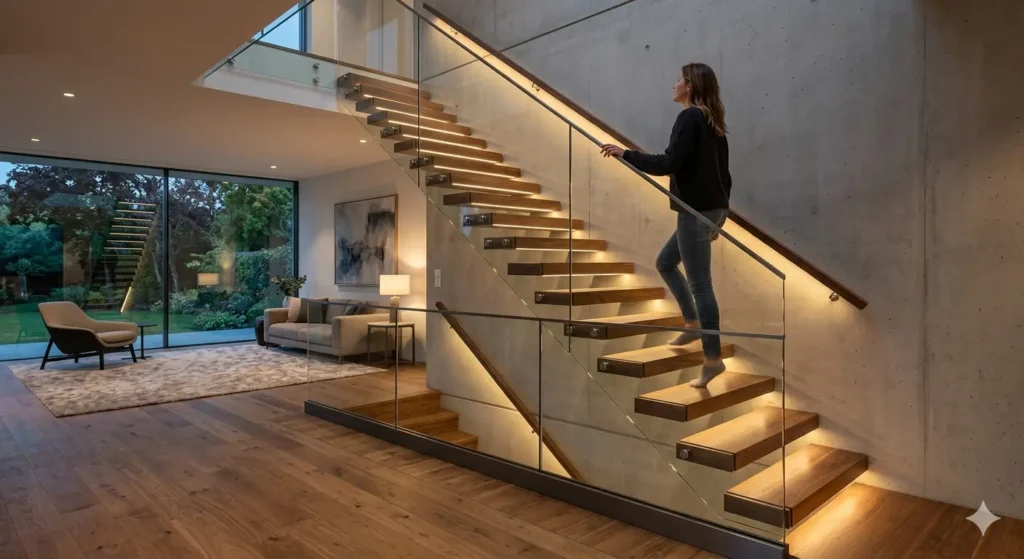
The staircase is the central design challenge of a duplex home. In a poorly designed duplex, the staircase is a functional element placed wherever it fits — often in a location that divides the ground floor into awkward zones, consumes floor area that could be better used, and creates a dark, cramped experience of moving between floors. In a well-designed duplex, the staircase is a spatial event. It is placed to organise the floor plan around it, it is given adequate width and headroom, and it is designed as an architectural element with its own character — whether that is a generous open stair that allows light to travel between floors, a more enclosed stair that creates a clear separation between the public ground floor and the more private upper floor, or an external stair in certain climate-responsive designs.
The distribution of spaces between floors is the second critical design decision. The conventional logic — living areas on the ground floor, bedrooms above — works for most Umarkhed families, but it needs to be applied with thought about how the extended family uses the home. If elderly parents are part of the household, their bedroom needs to be on the ground floor. If there is a puja room with high ceremonial significance, its location relative to the entry and the living areas matters. If the home needs to serve a home-based business that receives clients, the circulation for those clients needs to be designed separately from the family’s private circulation.
Climate-Responsive Duplex Design in Umarkhed
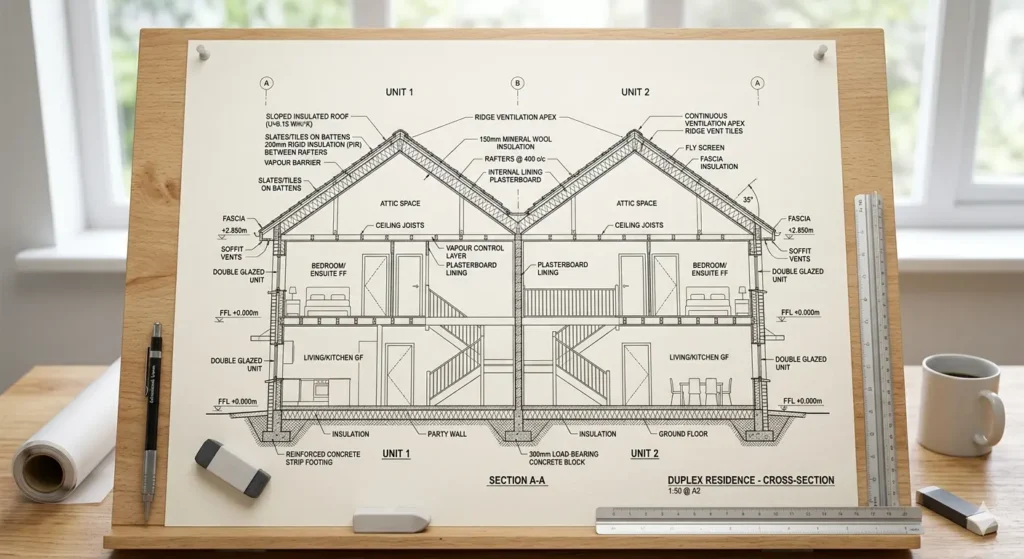
A duplex in Umarkhed’s climate faces specific challenges that a skilled architect addresses deliberately. The most significant is the fact that upper floors in Vidarbha’s summers accumulate heat in ways that ground floors do not. A flat-roofed upper storey in Umarkhed in April is a genuinely uncomfortable space without mechanical cooling, and a design that relies on air conditioning to make the upper floor habitable during summer is a design that has failed to solve the problem architecturally.
The solutions to this problem are well-established but require design commitment. A sloped roof with adequate pitch and overhang reduces the surface exposed to direct sun and allows hot air to escape rather than accumulate. Roof insulation — whether through a conventional insulation layer or through a cavity roof design — significantly reduces heat transfer from the roof surface to the rooms below. Adequate ventilation openings near the roof apex allow hot air to vent naturally. And the orientation of the building ensures that the bedrooms on the upper floor are not on the west face, which receives maximum afternoon sun during the summer months.
The veranda applies to the duplex just as fundamentally as it does to the single-storey home. A ground-floor veranda shading the main living spaces is the standard application. A first-floor balcony on the appropriate face — shaded by an adequate roof overhang and oriented to receive the evening breeze rather than the afternoon sun — extends the principle to the upper floor and creates a usable outdoor space associated with the bedrooms that adds significant quality to daily life.
The Elevation — How a Modern Duplex Should Look in Umarkhed
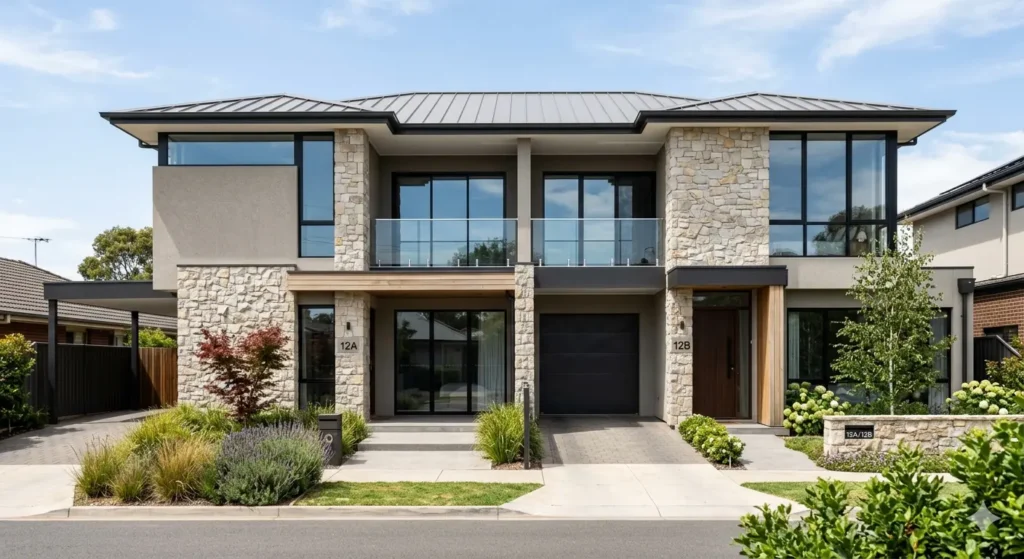
The exterior design of a duplex home in Umarkhed is an opportunity that is frequently underused. The standard outcome in the local market — a plastered box with applied decorative elements, standard window shapes, and a coat of paint in a bright colour — is a missed opportunity that makes no distinction between a duplex and any other building type. A modern duplex designed with architectural intention looks different from this.
A well-designed contemporary duplex elevation in Umarkhed uses the building’s two-storey height as a design asset rather than a challenge. The proportion and placement of windows can be coordinated across both floors to create a facade with genuine compositional logic. The veranda and balcony elements can be designed as part of the facade rather than additions to it, creating depth and shadow that give the building visual interest.
Material variation — using a different surface treatment for different zones of the facade, or introducing exposed masonry or stone elements in combination with render — creates a richness that painted plaster alone cannot achieve.
The roof line of a duplex is another design decision with significant visual consequences. A simple sloped roof is more appropriate for Umarkhed’s climate than a flat roof, and it can be designed with variation — the parapet heights, the overhang depths, the treatment of the eave line — that gives the building a distinctive character without abandoning the climate-responsive logic. A duplex that looks genuinely well-designed from the street communicates something about the family that commissioned it, and in Umarkhed’s social fabric, that communication matters.
Planning a Duplex in Umarkhed: What to Think About Before You Begin
Before commissioning a duplex design, a Umarkhed family should think carefully about several questions that will shape the design brief. How is the extended family structured, and how will it likely change over ten years? A duplex designed for parents and children today may need to accommodate a married son’s family tomorrow, and a design that anticipates this transition is worth more than one that doesn’t. Are there specific requirements for home-based business, for guest accommodation, or for a puja space with its own entry?
The plot dimensions matter specifically for a duplex. A narrow plot constrains the staircase options and the veranda possibilities in ways that require specific architectural problem-solving. A deep plot offers different opportunities than a wide plot. A corner plot has advantages in terms of ventilation and light entry that an interior plot does not. A good architect will work with the plot’s specific geometry to find the duplex design that makes the most of what the land offers, rather than applying a standard plan regardless of plot shape.
The structural system of a duplex needs to be designed with the next storey’s load in mind from the beginning. A reinforced concrete frame designed for two storeys from the start is more economical and more reliable than a ground-floor structure that is reinforced for future vertical extension, but the latter is often what families request when they are uncertain about the timeline for the second storey. Whichever approach is taken, the structural design needs to be done by a qualified structural engineer in coordination with the architect.
What a Modern Duplex Costs in Umarkhed
Duplex construction in Umarkhed in 2025–26 costs between ₹2,000 and ₹2,800 per square foot at mid-range specification, with premium specification exceeding this range. For a duplex of 3,500 square feet total built area — 1,750 square feet per floor — at a mid-range construction cost of ₹2,200 per square foot, the total construction cost would be approximately ₹77 lakhs. The architectural fee on this project would typically be in the range of ₹4 to ₹8 lakhs.
A duplex represents a large capital commitment, and the design decisions made at the outset — the staircase position, the orientation, the structural system, the floor-to-floor height — are essentially irreversible once construction begins. Getting these decisions right, with the help of an architect who has designed duplexes in this climate and this cultural context, is the single most valuable investment in the entire project.
FAQs: Modern Duplex Designs in Umarkhed
Q1. What floor-to-floor height is appropriate for a duplex in Umarkhed?
For Umarkhed’s climate, a floor-to-floor height of at least 3.2 metres and ideally 3.5 metres is advisable for both floors. Higher ceilings improve natural ventilation, allow hot air to rise away from the occupied zone, and create a sense of spaciousness that lower-ceiling rooms don’t have. The additional construction cost of an extra 30 to 40 centimetres of ceiling height is small relative to the improvement in comfort and quality.
Q2. Should I build both floors simultaneously or build the ground floor first and add the second floor later?
Building both floors together is more economical and produces a better-integrated result. When you build in phases, the ground floor is disrupted by the second-floor construction, the structural provisions made for future expansion are less efficient than a purpose-designed two-storey frame, and the design integration between the two floors is harder to achieve. If budget requires phasing, ensure the structural design is done for the complete building from the start.
Q3. How does a duplex perform better in Umarkhed’s summer compared to a single-storey home?
A well-designed duplex can actually perform better in summer than a poorly designed single-storey home, primarily because the roof — the primary source of heat gain — covers a smaller proportion of the total built area. The ground floor of a duplex has a naturally cooled ceiling (the first floor slab) rather than a roof directly overhead. This advantage is only realised, however, if the first floor and roof are properly designed for ventilation and insulation.
Constructing a modern duplex residence in Umarkhed is not merely a process of building; it involves forming an environment that endures extreme summers and torrential monsoons. We take smart design, durability and elegance and marry it with deep local expertise to protect your investment for decades at QC Interiors.
Skip the compromise—develop perfectly precise and quality your family should have.
QC Interiors
Serving: Umarkhed, Yavatmal
Specialisation: Comprehensive Home Interior Design | Architectural Planning | Turnkey Renovations
📞 (+91) 7798153303
Sign up for your consultation now and walk through with our 3D walkthrough of your home before a hammer is lifted!
