
Modern Duplex Designers in Amravati — Getting Two Floors Right in a City That’s Building Upward
Amravati’s residential aspirations have been moving decisively toward the duplex. Drive through the newer residential layouts on Badnera Road, on the areas developing toward the MIDC, on the plotted developments on the city’s expanding periphery, and the two-floor homes going up are everywhere — some of them modest in ambition, some genuinely impressive in their architectural intent, most of them somewhere in the middle of a range that reflects Amravati’s own diversity of residential investment levels.
The families building these duplexes are, by and large, families who’ve thought carefully about what they want. They want the spatial generosity that two floors provide — the separation between the social ground floor and the private upper floor that single-floor homes don’t offer, the sense of scale and presence that a two-storey structure gives to a plot. They’ve been collecting ideas, visiting relatives’ homes, imagining their own version of the double-height entry with the staircase that makes a statement.
What some of them haven’t fully thought through is what it takes to make that vision work in Amravati’s specific conditions. Duplex design in a city with summer temperatures that push toward 47 degrees has specific requirements that a standard contractor template doesn’t address. The upper floor heat question. The roof specification. The staircase positioning relative to the double-height space. The orientation of the bedrooms on the upper floor relative to the summer sun. These aren’t optional considerations — they’re the decisions that determine whether the duplex fulfils its aspiration or disappoints in ways the family discovers only after they’ve moved in.
Modern Duplex Designers in Amravati
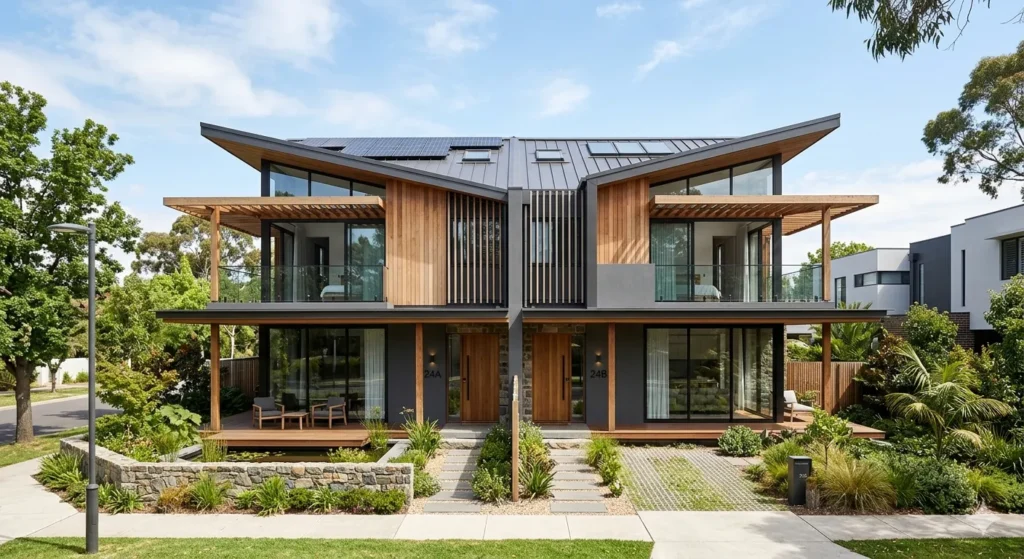
What a Good Duplex Designer in Amravati Brings
The architect or designer who does duplex work in Amravati well brings a specific combination of knowledge. Contemporary design competence — the visual vocabulary, the material palette, the spatial principles that make a duplex feel genuinely impressive rather than just tall. Climate-responsive design knowledge — the specific measures that make a two-floor home in Amravati comfortable in summer rather than a heat trap. And Amravati residential market knowledge — the contractor ecosystem, the material suppliers, the approval process, the plot conditions and infrastructure realities of the specific areas where the duplex is being built.
The designer who brings all three of these qualities to a Amravati duplex project is the designer whose work looks as good from the inside in year ten as it did on the day of handover. The designer who brings only the first — the visual competence without the climate knowledge — produces homes that photograph beautifully and disappoint in the summer months.
Amravati’s Duplex Configuration: What Works Here
In Amravati’s residential context, the duplex is almost always an independent house on a private plot — not an apartment-within-building configuration. Typical plots in Amravati’s active residential areas range from 150 to 350 square metres, with total built areas across both floors typically between 2,200 and 4,500 square feet for a family home at a serious investment level.
The configuration that serves Amravati families well is the ground floor as the home’s public social world — drawing room, dining area, kitchen, puja room, a guest toilet — and the upper floor as the private world — master bedroom suite, children’s bedrooms, family bathrooms. This separation is both practically useful and culturally appropriate in Amravati’s family life context.
The staircase and its relationship to the double-height void above the entry foyer is the design element that determines the duplex’s architectural character more than any other single decision. In a well-designed Amravati duplex, the staircase is the first thing a visitor sees that communicates genuine design quality — the tread material, the balustrade, the feature wall alongside it rising through the full height of the void, the pendant or chandelier hung in the space. In a contractor-built duplex, the same space is a missed opportunity that gets used daily without the family ever quite feeling it was realised.
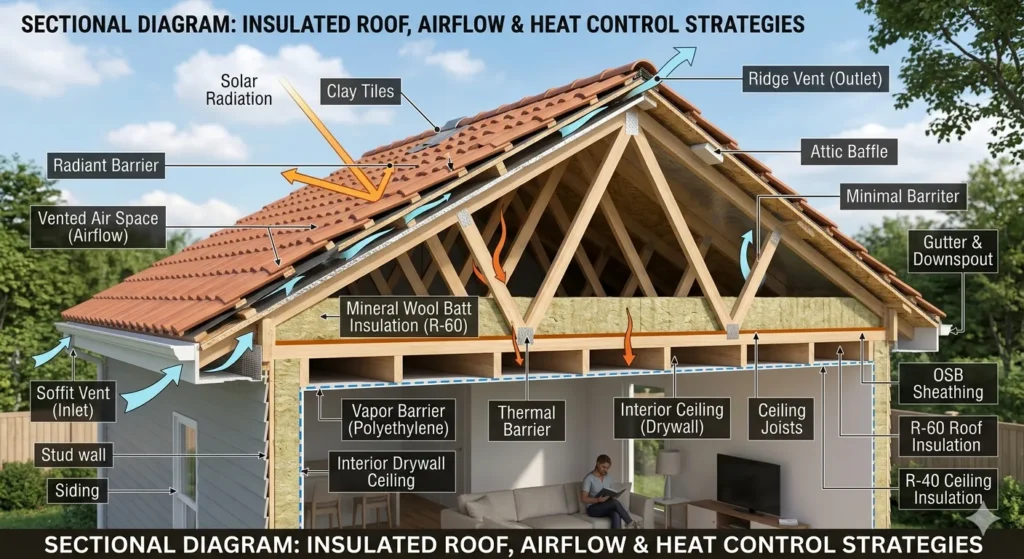
Upper Floor Climate Management: The Non-Negotiable
Amravati’s summer creates an upper floor heat problem in poorly designed duplexes that is more severe here than in most Maharashtra cities. The combination of extreme summer temperatures, high direct radiation on the roof surface, and the thermal mass of a concrete slab that retains heat into the night creates upper floor room conditions that can be genuinely uncomfortable even with air conditioning running at capacity.
Three design measures together solve this problem properly. None of them alone is sufficient.
The roof specification: a pitched roof with light-coloured or reflective roofing material. The reduction in solar heat absorbed at the roof surface compared to a standard flat concrete roof is significant — a cool roof with 70 percent solar reflectance versus a standard concrete surface absorbs approximately 35 to 40 percent less solar radiation. At Amravati’s peak summer radiation levels, this translates to a meaningful reduction in the heat transferred to the rooms below.
The insulated false ceiling: an insulated false ceiling in the upper floor rooms with a 300mm or larger air gap between the false ceiling board and the structural slab, with cross-ventilation provision to allow the hot air accumulating in this cavity to escape. This measure, combined with the roof specification, produces upper floor rooms that are genuinely comfortable rather than merely air-conditioned.
The window design: upper floor windows with adequate roof overhang above them that shades the glass from direct summer sun while allowing the lower-angle winter light to enter. Combined with windows positioned for cross-ventilation when the evenings cool, this creates the natural thermal management that supplements mechanical cooling.
These three measures need to be in the design from the architectural phase — not addressed as retrofits after the family has discovered the problem by living in the house.
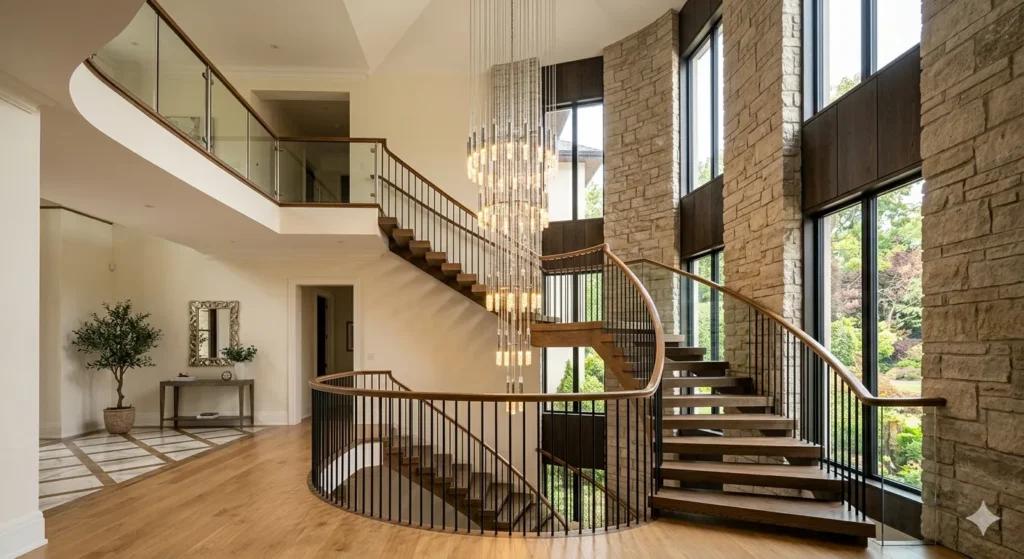
The Staircase and Double-Height Space
The double-height void that a well-designed Amravati duplex incorporates above the entry foyer — creating a ceiling of 18 to 22 feet in that zone — is the architectural feature that most strongly distinguishes a considered duplex from an unconsidered one. The wall that rises through this void is the home’s primary architectural canvas.
Natural stone cladding running the full height from ground floor to upper landing — in a warm local stone, Jaisalmer yellow, or a warm-toned imported variety. Vertical teak veneer panels with a consistent rhythm. Hand-applied textured plaster in a warm, deep tone — the kind of finish that has the slight variation of human craft rather than the uniformity of machine production. Any of these, executed with genuine craft rather than contractor speed, creates the visual centrepiece that the double-height space needs to justify its inclusion in the design.
The pendant or chandelier in the void: a sculptural fitting in the ₹35,000 to ₹1.2 lakh range, chosen for its architectural presence as much as its light output. This element, combined with the feature wall treatment, makes the entry experience of the home an architectural moment rather than a functional threshold.
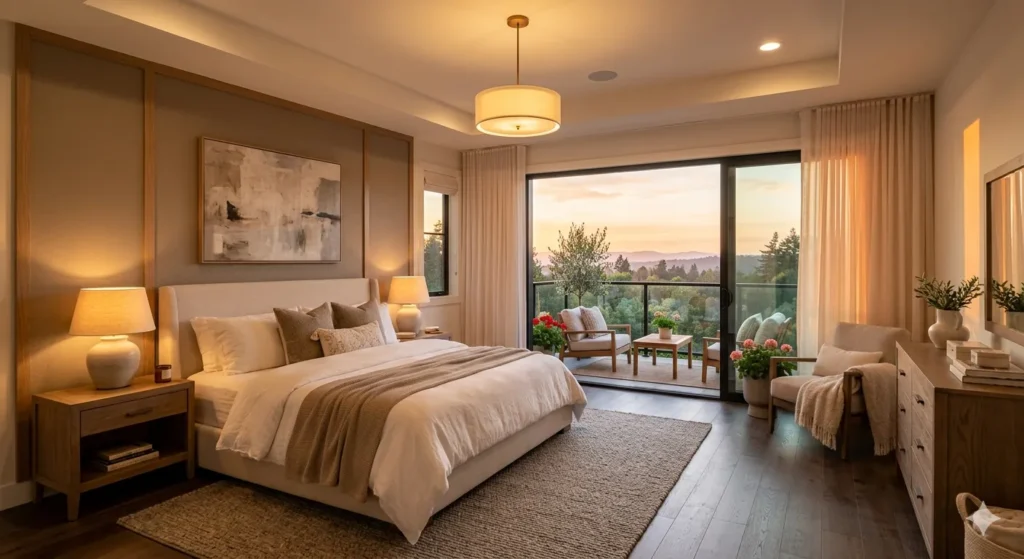
Interior Design for Ground and Upper Floors
Ground floor: drawing room with architectural false ceiling and focal wall treatment as the social centrepiece. Kitchen designed for Indian cooking at Amravati household scale — layout, storage, chimney specification, counter heights, all from the actual cooking brief rather than a catalogue template. Dining area at the size the family genuinely needs for its festival and celebration gatherings. Puja room or alcove with natural stone platform, warm lighting, and proper storage.
Upper floor: master bedroom suite with dressing room provision and attached bathroom at quality specification. Children’s bedrooms designed for the family’s actual children at their actual ages with adaptability for growth. Covered balcony off the master bedroom — properly floored, with some privacy treatment — usable from September through February as the private outdoor daily-use space.
Complete duplex in Amravati — construction, interior fit-out, and exterior landscape at mid-range specification: ₹65 to ₹1.05 crores for 2,800 to 4,000 square feet. Interior design and fit-out above construction cost: ₹14 to ₹26 lakhs.
FAQs: Modern Duplex Designers in Amravati
Q1. What’s the minimum plot size for a well-designed duplex in Amravati? 180 square metres is the practical minimum for a duplex with adequate room sizes on both floors, a proper veranda, and a double-height entry feature. Plots of 220 square metres or more give the designer enough floor plate to create genuinely generous rooms on both floors.
Q2. How do I find a duplex designer in Amravati who understands the climate requirements specifically? Ask specifically — in the first meeting — what they do about upper floor heat management in an Amravati duplex. An experienced designer gives a specific answer about roof design, insulated ceilings, and cross-ventilation. A designer who hasn’t thought about it gives a vague answer about air conditioning. The quality of this answer tells you whether they’ve actually solved this problem in completed projects.
Q3. What does a complete modern duplex cost to build in Amravati in 2025-26? For a 3,200 square foot duplex at mid to premium specification — including construction, interior fit-out, architectural and structural fees, and external landscape work — budget ₹75 to ₹1.15 crores. Land cost and furniture are separate. The range reflects specification level rather than floor area alone.
Q4. Is a home lift practical in an Amravati duplex for elderly parents? Yes, and increasingly requested in Amravati duplex briefs that include three-generation households. The lift shaft — approximately 1.2 by 1.2 metres — needs to be designed from the architectural phase. Residential lift units are available from Kone, Otis, and local suppliers at ₹5 to ₹10 lakhs for installation. Retrofitting a lift into a completed duplex is possible but significantly more expensive and structurally disruptive.
Q5. How long does a duplex project in Amravati take from brief to occupation? Sixteen to twenty-four months for the complete process — architectural design and approval six to ten weeks, construction twelve to sixteen months, interior fit-out two to three months. Families should plan around the upper end of this range and confirm contractor availability before fixing a timeline expectation.
Smart Design. Strong Homes.
Creating a duplex in Amravati, Maharashtra means building for heat, rain, and long-term comfort.
QC Interiors ensures every home is thoughtfully designed, structurally sound, and aesthetically modern—built for years of happy living.
Start strong. Stay strong.
Serving: Amravati, Maharashtra
📞 +91 7798153303
