
Residential Interior Designers in Umarkhed — Finding Design Professionals Who Can Transform How a Home Feels to Live In
Most homes in Umarkhed are built without interior design. The construction is completed, the plastering is done, the floor tiles are selected from a supplier’s showroom, the walls are painted in a colour chosen by the homeowner or the contractor’s painter, modular furniture and kitchen units are procured from the nearest available source, and the family moves in. The house functions. It provides shelter, storage, and space for the family’s activities. But it does not feel designed, and the difference between a home that has been designed and one that has been built is something that residents experience every day, usually in ways they cannot fully articulate.
The residential interior design profession in Umarkhed is growing, driven by the same forces reshaping residential aspirations across Vidarbha’s larger towns — rising incomes, wider exposure to well-designed spaces through media and travel, and a generational shift in what families consider an appropriate standard for their homes. But the profession is not yet well understood, and the gap between the services being marketed as interior design and the services that genuine design thinking actually involves remains wide.
This article is for families in Umarkhed who want to understand what residential interior design actually involves, what it delivers, how to identify professionals who genuinely provide it, and how to think about what it costs relative to what it returns.
Residential Interior Designers in Umarkhed
The Real Scope of Residential Interior Design
Residential interior design, as a professional discipline, begins with the understanding that a home’s interior is a designed environment — that the quality of daily life inside it is shaped by decisions about space, light, material, colour, and the relationships between these elements, and that these decisions can be made thoughtlessly, accidentally, or with genuine design intelligence. The designer’s job is to supply the intelligence.
The process of a genuine residential interior design engagement begins with an analysis of the space and the family. The spatial analysis involves understanding the natural light conditions at different times of day, the existing proportions of each room and what those proportions suggest about how the room can be made to feel better, the circulation paths through the home and whether they work logically, and the relationship between interior and exterior spaces. The family analysis involves understanding how the household is composed, how different members use different spaces, what activities need to be supported and where, and what the family’s aspirations for their home are.
From this dual analysis comes the design brief, and from the design brief comes the actual design — the spatial layout adjustments where these are possible within the existing structure, the ceiling design and lighting layout, the flooring specification for each room, the wall surface treatment, the joinery design for kitchens, storage, and built-in furniture, the freestanding furniture selection, and the specification of decorative and accessory elements that complete the interior.
What Residential Interior Design Looks Like Room by Room in a Umarkhed Home
The entry hall or foyer is the first interior space of the home, and it sets the tone for everything that follows. In many Umarkhed homes, this space is an afterthought — a narrow passage that connects the front door to the living room without any spatial character. A designed entry hall is something different: a space with its own identity, with a ceiling height that creates a sense of arrival if the building allows it, with flooring that distinguishes it from the adjacent living areas, with a console table or storage element that serves the practical functions of entry (keys, footwear, bags) without reducing the space to pure utility.
The main living room in a Umarkhed home is typically the most formally used space — the room in which guests are received and family occasions are marked. A well-designed living room in this context needs to balance the requirements of formal reception with the daily informality of family life. The furniture arrangement needs to facilitate conversation, which means seating arranged to face each other rather than the television. The lighting needs to be layered — ambient, task, and accent — so the room can be adjusted for different occasions. The material palette needs to be consistent with the spaces that open onto the living room, creating a coherent whole rather than a series of unrelated rooms.
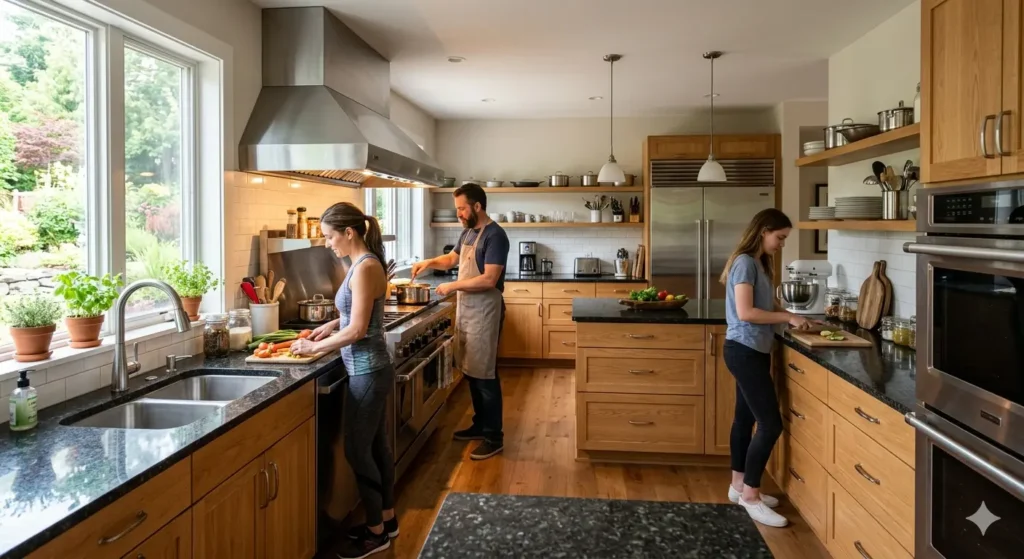
The kitchen in a Umarkhed home is a high-use, high-demand space. A large Vidarbha family kitchen is typically used for extended cooking sessions involving multiple people working simultaneously, and the design of this space needs to reflect this reality. Work surface area, storage, ventilation, and the relationship between the kitchen and the dining and outdoor spaces all matter. The design of a kitchen for a family that cooks three full meals daily — with vessels, ingredients, and family members all present simultaneously — is a different design problem from the kitchen in a nuclear household, and a good designer understands the difference.
The master bedroom is the room in the home that most directly affects the quality of rest and the experience of beginning and ending each day. A well-designed master bedroom has a quality of calm — achieved through careful material choice, controlled light levels, thoughtful storage that eliminates the visual clutter that most bedrooms suffer from, and a ceiling or window design that gives the room its own character. The attached bathroom, if there is one, should feel continuous with the bedroom rather than tacked on — a relationship achieved through consistent materials, coordinated lighting, and careful attention to how the transition between the two spaces is handled.
Lighting Design in Umarkhed’s Residential Interiors
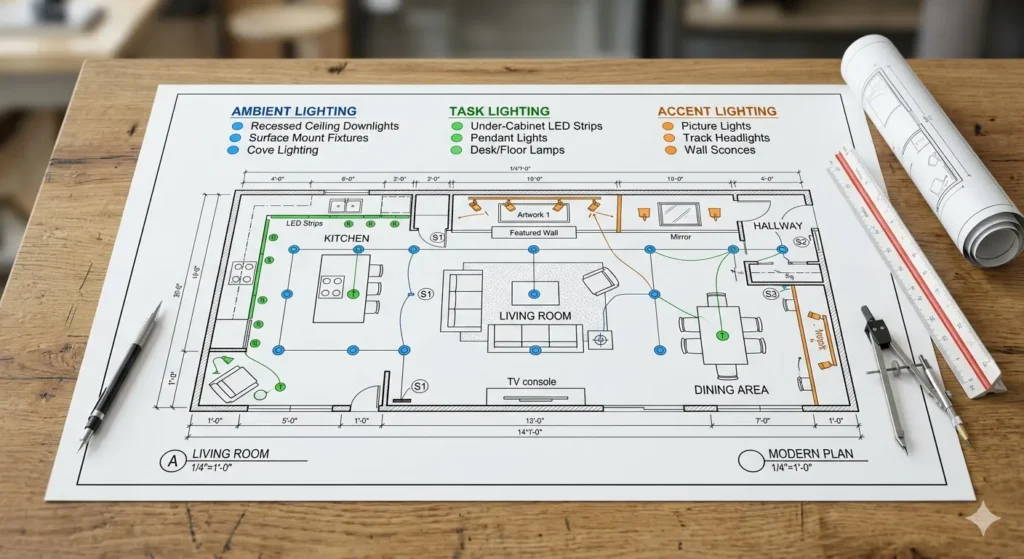
Lighting is the interior design element with the greatest impact on how a home feels, and it is the element most consistently underthought in Umarkhed’s residential market. Standard residential construction in this region defaults to a single overhead light fitting per room — often a fluorescent tube fitting or a basic LED panel — and leaves the lighting design there. The result is interiors that are uniformly, flatly illuminated in a way that makes every room feel the same and communicates nothing about the purpose or character of each space.
A properly designed lighting scheme begins with the acknowledgement that different rooms need different light at different times. The living room at the time of an evening gathering needs a different light quality from the living room during a daytime family lunch. The kitchen during active cooking needs high-intensity task light at the counter surfaces and general illumination for movement through the space. The bedroom at bedtime needs warm, low-intensity light that supports the transition to sleep. None of these requirements is met by a single overhead fitting.
The physical infrastructure for good lighting — the electrical point positions, the circuit separations that allow different zones to be controlled independently, the provision for wall-mounted and table lamps in the right locations — needs to be planned before the walls are plastered. This is one of the strongest arguments for engaging an interior designer before construction is complete: the lighting design can be integrated into the electrical layout from the beginning rather than being improvised after the fact.
Material Selection for Umarkhed’s Climate and Context
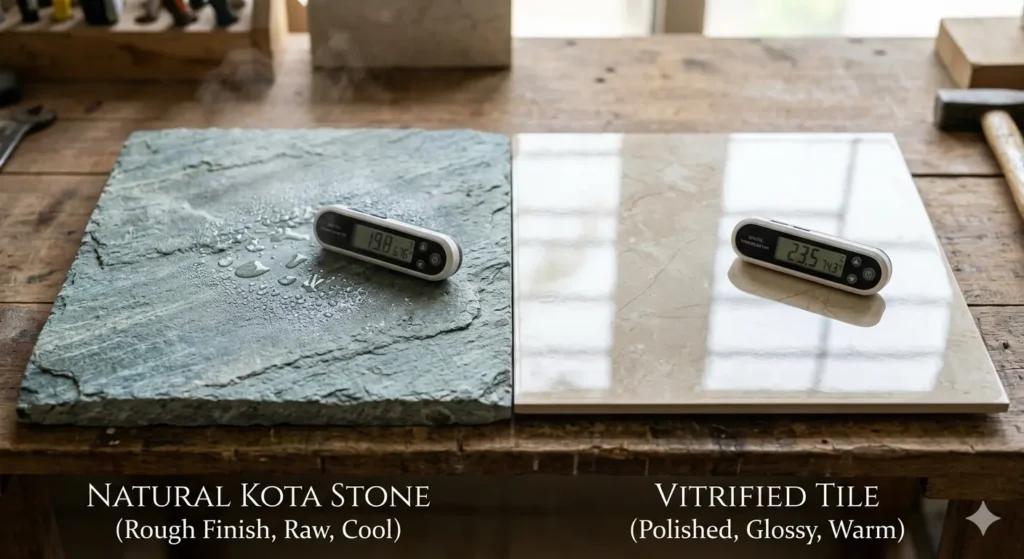
Material selection in a Umarkhed interior is a design decision with both aesthetic and functional dimensions, and the functional dimension is more consequential here than it would be in a coastal or northern climate. Flooring is the most obvious example. Stone floors — kota, granite, or natural marble — stay cool underfoot in a way that polished vitrified tile does not. In a house that will be uncomfortably hot for four months of the year, this thermal property is not a minor consideration. It is something a resident will experience with every step across the floor during the months that matter most.
Wall finishes in Umarkhed’s residential interiors need to be selected for durability as well as appearance. The monsoon months bring humidity levels that affect paint adhesion and wall finish longevity in ways that dry-climate performance data doesn’t predict. A designer with experience in Vidarbha’s climate will specify wall finishes that perform reliably through the humidity cycle rather than looking perfect at handover and degrading within two monsoon seasons.
The furniture selection for a Umarkhed home should account for the thermal mass and maintenance requirements of different materials in this climate. Heavy solid wood furniture, particularly pieces made from local timber species, is well-suited to this environment. Certain imported furniture materials — some veneers, some composite materials used in modular furniture systems — do not perform well through Vidarbha’s temperature extremes and humidity cycles. A locally experienced designer will know these distinctions.

The Design Process and How to Engage a Residential Interior Designer in Umarkhed
The process of engaging a residential interior designer in Umarkhed should begin with a clear understanding of scope. Are you designing the entire home, or a specific set of rooms? Are you starting from a new construction where the electrical layout and ceiling design can still be influenced, or working within a completed shell? Do you want a full-service engagement where the designer manages procurement, supervision, and installation, or a design consultancy where the designer provides specifications and drawings that you execute independently?
Once scope is clear, the evaluation process mirrors what was described earlier in this article — asking for completed projects you can visit in person, paying attention to the quality of the designer’s questions about your family’s life rather than their eagerness to show you their existing work, and verifying their familiarity with both the local material supply landscape and the execution capacity of Umarkhed’s contractor and installer community.
The fee structure for residential interior design in Umarkhed varies between designers and project types. Percentage-of-project-cost fees, flat fees for design services, and per-square-foot rates are all used. What matters is understanding what the fee covers — design drawings only, or procurement and supervision as well — and ensuring that the scope of services is clearly defined before work begins.
FAQs: Residential Interior Designers in Umarkhed
Q1. At what stage of construction should I engage an interior designer for a new home in Umarkhed?
The earlier the better, and ideally before the structural slab is cast. The decisions that most constrain interior design quality — room proportions, ceiling heights, the position of structural elements, the provision of electrical and plumbing points — are made during the structural construction phase. An interior designer involved at this stage can influence these decisions in ways that are impossible to achieve after construction is complete.
Q2. Can I do a partial interior design engagement — say, just the living room and master bedroom — rather than the whole home?
Yes, and for many families in Umarkhed this is the practical approach. The rooms that receive guests and the rooms used most frequently by the family are typically prioritised. The risk of a room-by-room approach is that the material palette and design language of the prioritised rooms may be difficult to extend to the rest of the home later, creating a coherence problem over time. A good designer will account for this even in a partial engagement by establishing a design framework that the later rooms can follow.
Q3. How do I verify that an interior designer in Umarkhed has genuine design capability rather than just product supply relationships?
The clearest verification is a site visit to completed projects. Ask to see at least two projects where the designer had full creative scope — not just a kitchen fitout or a single room. Walk through these projects and ask yourself whether the design decisions you are seeing feel considered and coherent, or whether they feel like a collection of individually good products that happen to be in the same room. The former is design. The latter is procurement with style.
Designing a residence in Umarkhed is not merely a process of building; it involves forming an environment that endures extreme summers and torrential monsoons. We take smart design, durability and elegance and marry it with deep local expertise to protect your investment for decades at QC Interiors.
Skip the compromise—develop perfectly precise and quality your family should have.
QC Interiors
Serving: Umarkhed, Yavatmal
Specialisation: Comprehensive Home Interior Design | Architectural Planning | Turnkey Renovations
📞 (+91) 7798153303
Book your consultation now and walk through with our 3D walkthrough of your home before a hammer is lifted!
