
Interior Designer in Tilak Nagar Nagpur: Where Central Location Meets Residential Character.
Tilak Nagar sits in a part of Nagpur where things actually work. That’s not a backhanded compliment — it’s a genuine observation about what families value in a neighbourhood after they’ve been through the experience of living somewhere that looks good on paper but has gaps in the daily infrastructure that wear you down over time. Tilak Nagar doesn’t have those gaps. The connectivity is real. The amenities are established. The neighbourhood functions the way a family neighbourhood should function.
The residential character here is mixed in a way that gives interior designers an interesting range of projects to work with. There are older independent houses with the spatial generosity that Nagpur’s better residential construction from earlier decades often delivered. There are apartment complexes of various vintages, from the older buildings with their characteristic solid construction to the more recently developed complexes with contemporary specifications and layouts. And there are a number of the shopfront-plus-residence configurations that characterise parts of Nagpur’s older, more integrated neighbourhoods.
The families in Tilak Nagar who engage interior designers are typically doing so after some years of living in their home — they’ve been through enough of daily life in the space to know exactly what’s working and what isn’t, and the brief they bring to the design process tends to be specific and honest in a way that makes the designer’s job, in one sense, quite clear.
Interior Designer in Tilak Nagar Nagpur
The Light Question in Tilak Nagar
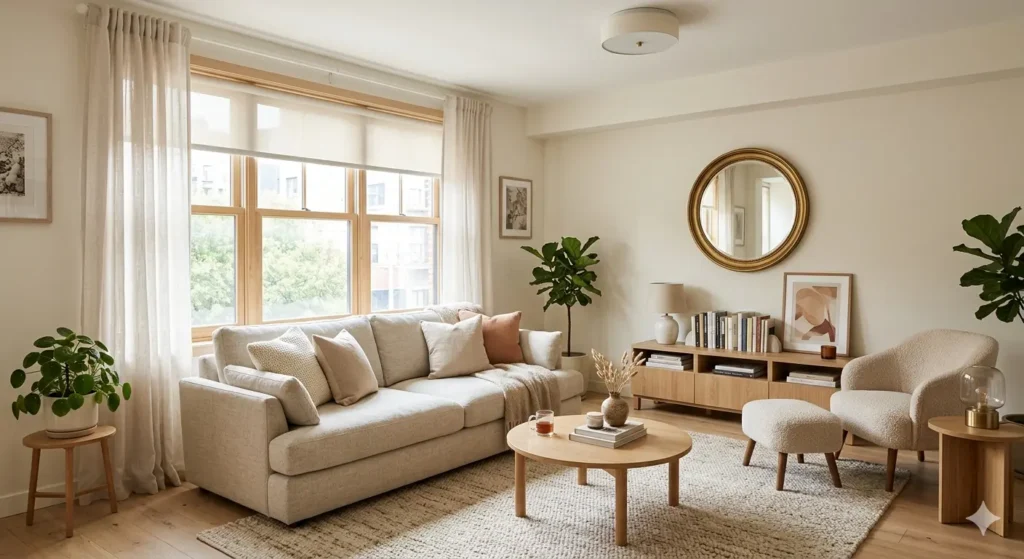
Tilak Nagar’s relatively central location in Nagpur means that its residential buildings tend to have more constrained open space between them than the newer outer developments, which affects how natural light reaches interior spaces — particularly on lower floors.
This has direct implications for colour choices. In rooms where the natural light is constrained — lower-floor apartments, rooms facing internal courtyards, rooms with windows that face other buildings at close proximity — the palette needs to work in ambient diffused light as its primary condition rather than direct sunlight. In these conditions, warm neutrals with good LRV remain the safest primary wall choice: they stay bright even when the direct sunlight isn’t present, and they don’t pick up the cold, slightly greyed quality that a cooler white or a neutral grey develops in diffused light.
For rooms with better light access — upper floors, corner units, rooms with windows facing open road or park space — the standard Nagpur palette logic applies: warm whites as the primary wall colour, accents from the earth palette on single feature walls, colours assessed in the actual room conditions before final commitment.
Living Rooms: Designing for Tilak Nagar’s Social Character
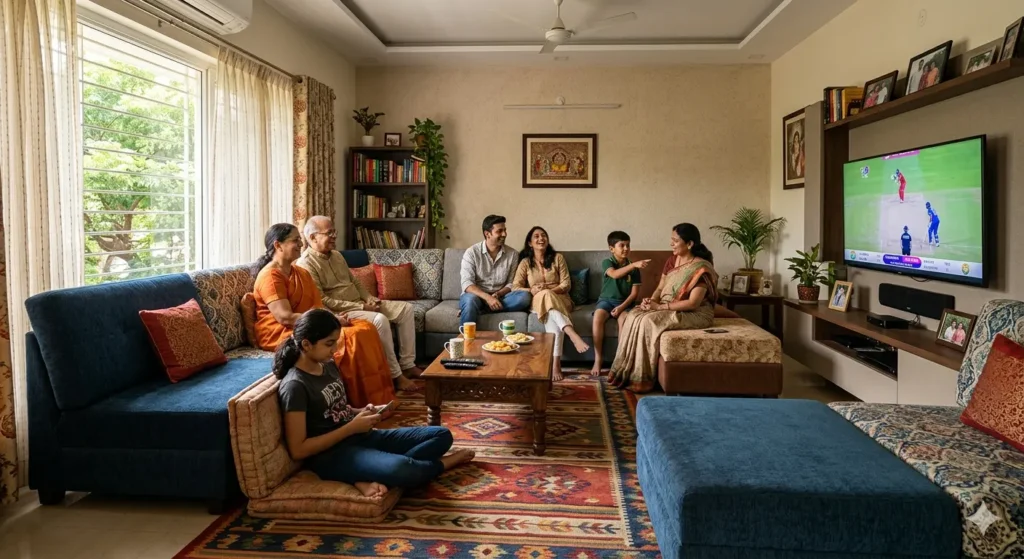
Tilak Nagar families tend to be sociable. The neighbourhood has a community character — the proximity of the housing, the established nature of the social connections — that results in homes being used for entertaining with some regularity. The living room needs to accommodate this without sacrificing its daily habitability.
The furniture arrangement that works best in a Tilak Nagar apartment living room of typical size — 280 to 380 square feet for the combined living and dining zone — positions the main seating group to face both the focal wall and each other, rather than all facing the television in a single direction. This arrangement serves both the social use and the television-watching use without fully committing to either, and it creates a room that feels like a living space rather than a screening room.
The dining area in a Tilak Nagar home often serves as an overflow entertaining space when the living room seating is at capacity. A dining table that can expand — a folding leaf configuration, or a table that seats six normally and eight with an additional leaf — is a practical design decision for a family that entertains regularly and doesn’t have the floor area to permanently accommodate a large table.
Storage design in the Tilak Nagar living room: built in from the beginning, please. The alternative — surfaces that gradually fill with the accumulated objects of daily family life — is so predictable that it should be planned for rather than hoped against. Recessed shelving in the TV wall treatment, a console cabinet below the main shelving, integrated storage in the entry area — these design decisions are made in the design phase at very low cost and solved permanently, or ignored in the design phase and creating friction for the life of the interior.
The Pooja Space: Getting It Right
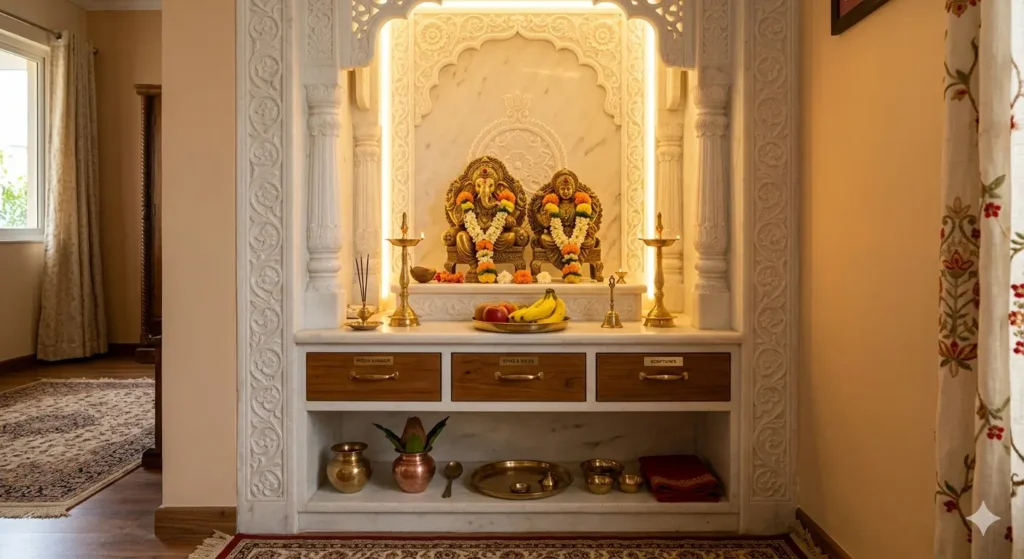
In Tilak Nagar homes — consistent with most traditional Nagpur family homes — the pooja space is not peripheral. It is a room or alcove that the family uses daily, that carries real emotional and spiritual significance, and that deserves the same thoughtful design attention as the kitchen or the master bedroom.
The most common mistake in the design of pooja spaces in Nagpur apartments is treating it as a joinery element rather than a spatial one — producing a decorative cabinet that looks attractive but doesn’t function well as a place of daily worship. A properly designed pooja space provides adequate platform area for the specific deities and ritual objects the family worships with, appropriate storage for the materials used daily, lighting that is warm and soft rather than the harsh overhead light that makes religious objects look like commodities, and a finish that is durable, cleanable, and appropriately reverential in character.
Marble or natural stone for the platform is the standard in Nagpur for good reason — it’s durable, easy to clean, and has a material dignity that laminate and acrylic alternatives don’t quite achieve. Warm LED lighting, concealed within the alcove itself rather than from an overhead source, creates the atmospheric quality that this space needs.
Kitchens and Bedrooms: The Consistent Priorities
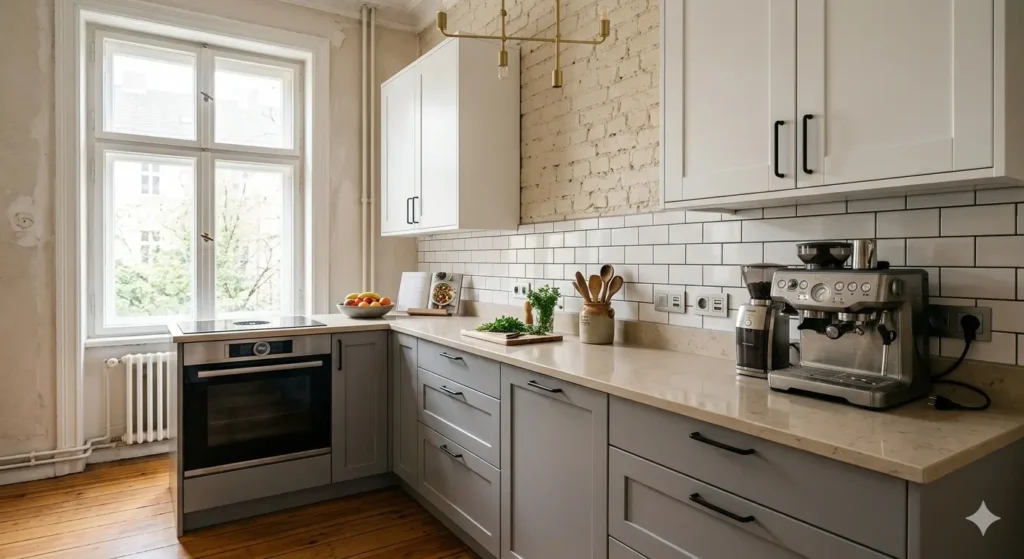
The kitchen and bedroom design principles for Tilak Nagar homes follow the same logic as in other established Nagpur localities — modular kitchen designed from an honest storage audit, chimney specified for actual cooking load, countertop in quartz or stone, hardware from quality brands. Full-height wardrobes in the master bedroom. Layered lighting in all bedrooms. Bedhead wall treatment as the room’s focal point.
What occasionally needs particular attention in Tilak Nagar’s older apartments is the electrical infrastructure. Older buildings in this part of Nagpur were wired for a domestic load that didn’t include multiple air conditioners, washing machines, instant water heaters, and the full range of kitchen appliances that a contemporary household uses. Before undertaking an interior renovation in an older Tilak Nagar apartment, it’s worth having an electrician assess the existing load capacity and wiring quality — not glamorous, but genuinely important.
Mid-range modular kitchen: ₹2.2 to ₹4.5 lakhs. Premium specification: ₹4.5 to ₹7.5 lakhs.
Complete Investment for a Tilak Nagar Interior
2BHK apartment, mid-range specification: ₹8 to ₹13 lakhs.
3BHK, mid-range specification: ₹12 to ₹19 lakhs.
3BHK premium specification with flooring, bathrooms, lighting design: ₹21 to ₹35 lakhs.
Older independent house, comprehensive renovation: ₹18 to ₹32 lakhs.
QC Interiors offers free consultations for Tilak Nagar homeowners. Get in touch.
